Showing posts with label Poetry. Show all posts

Friday, 26 March 2021

Various Artists - The C.I.A. Tape - Conspiracy Of International Anarchists -1987- (Cassette, Bluurg Tapes), UK/Canada


The following information has been extracted from the Alternative Toronto website and the BlackDotMuseum blog and partially recombined:

The C.I.A. Tape was recorded live at the Fallout Shelter and Ildiko's, and features poetry and musical performances by Dick Lucas (of Subhumans), Mecca Normal, Nick Toczek, Rhythm Activism and Mourning Sickness.

The Fallout Shelter recordings are the Toronto postscript to the Black Wedge tour on September 5, 1987.

The Fallout Shelter was a "nuclear free" performance space and coffee house run by the peace organization A.C.T. for Disarmament on Harbord Street.

The Black Wedge was a tour of activist resistance culture organized by Jean Smith of the band Mecca Normal, which set out to "spread the word of how to combine poetry, music and politics and have a fun time doing it.” As Smith comments about the Black Wedge tour in his essay "Take Something You Care About and Make It Your Life": 

One step easier than punk! The Black Wedge is out to spread the word of how to combine poetry, music and politics and have a fun time doing it. Hardcore poems and shredding guitars, radical voices crushing sexism, militarism, poverty and conformity. The Black Wedge wants to set wild hearts and imaginations free, to release a riot of emotion–opening up a new arena for activist resistance culture.

At the beginning of 1986, Mecca Normal released their first LP on their own label, Smarten Up! Records. Soon thereafter, they flew to Montreal and hooked up with Rhythm Activism; another music duo dealing with social issues with a strong anti-authoritarian perspective. While the four stood around in the basement of the Canadian Broadcasting Corporation building waiting to go live on air from coast to coast, they listened in on the segment prior to their timeslot–England’s Red Wedge was being featured. The Red Wedge was formed in the late 80's to support the Labour Party, they presented political ideas within a musical context and showcased musicians that encouraged people to vote Labour. The Black Wedge however, that came into existence that same night, would encourage people to reclaim their voices, to speak out against oppression rather than rely on electoral politics as a means to solve social problems. Answers were looked for elsewhere than e
xisting politics and against the establishment.

During the Black Wedge tour, through their lyrics or in between songs, the bands covered topics like sexism, disenfranchised citizens, poverty as well as other social issues which can be heard throughout the various songs of The C.I.A. Tape. A song like “Are you hungry Joe?” for example, includes a dialogue between Joe and someone that stands between him and the bag of groceries at a food bank, forcing Joe to argue why he needs food...

All tracks on The C.I.A. Tape were recorded live in Toronto. The tape was eventually published by Bluurg Tapes with the editing done in June '88 at T.A.S.C. Master Studios, Trinity & All Saint's College, in Leeds England.


"This tape is dedicated to all exceptionally oppressed people, but particularly to those whose entire lifestyle is being destroyed... Romany, Amerindian, Aborigine, and all other proud tribal people whose culture won't readily bow down before the all-consuming gods of western 'civilization,' social 'progress' and cash-culture.”

The original information for both Jean Smith’s essay and The C.I.A. Tape information can be retrieved from:
https://www.alternativetoronto.ca/archive/items/show/500
https://blackdotmuseum.wordpress.com/the-black-wedge-1986/

- Juan Vacas

This blogpost is a collaborative effort. Many thanks to: Juan Vacas (curation and assembling of text), Jon "Dietsociety" Kruithof and acab_in_1985 (SLSK) (providing rips and doing archival work). Editor: Bence.

Get it HERE

Wednesday, 18 November 2020

Dustbin Silence - Untitled -1985- (Square Wheel Cassettes), Netherlands

                                                  Dustbin Silence in Brussels, 1983

Dustbin Silence was a short-lived (1982-1985) jazz, noise and improvisation trio from Rotterdam that was formed by Han van Hulzen, ErikWard Geerlings and Henri van Zanten. Han van Hulzen was also part of the new wave group Corridor des Affaires during that time and Henri van Zanten is also known as a (sound) poet in his own right. 

Dustbin Silence, however, was connected to the Rotterdam based Jazzbunker scene that existed around the legendary Jazzbunker venue which functioned as a home for Dutch and international improvisation, jazz and rock in opposition. During the 80's Rotterdam had numerous special bands that created diverse styles out of a blend of new wave, jazz, home-taping and improvisation. Some of them were also performing at the Jazzbunker. Bands from Rotterdam from those times are a.o. Dull Schicksal, Nine Tobs, The Black Sheep, Kiem, Kontakt Mikrofoon Orkest, Niew Hip Stilen, Debiele Eenheid and many others.

On this cassette by Dustbin Silence we hear a recording from the Jazzbunker, but there are also pieces recorded elsewhere in The Netherlands. It gives a nice impression of the group's live recordings:  gloomy atmospheres combining free improvised sounds with punk poetry in Dutch and English. It reminds me of industrial performance art groups sounds of the 80's of which the live recordings resemble much more of a document of a scene than perfectly composed tracks. The Berlin band Sprung Aus Den Wolken sometimes created such a feel for example.

In any case here's another interesting cassette hailing from the Rotterdam improvisation scene of the 80's.

From the Collection Allard Pierson/NPI

Get it HERE

Wednesday, 12 December 2018

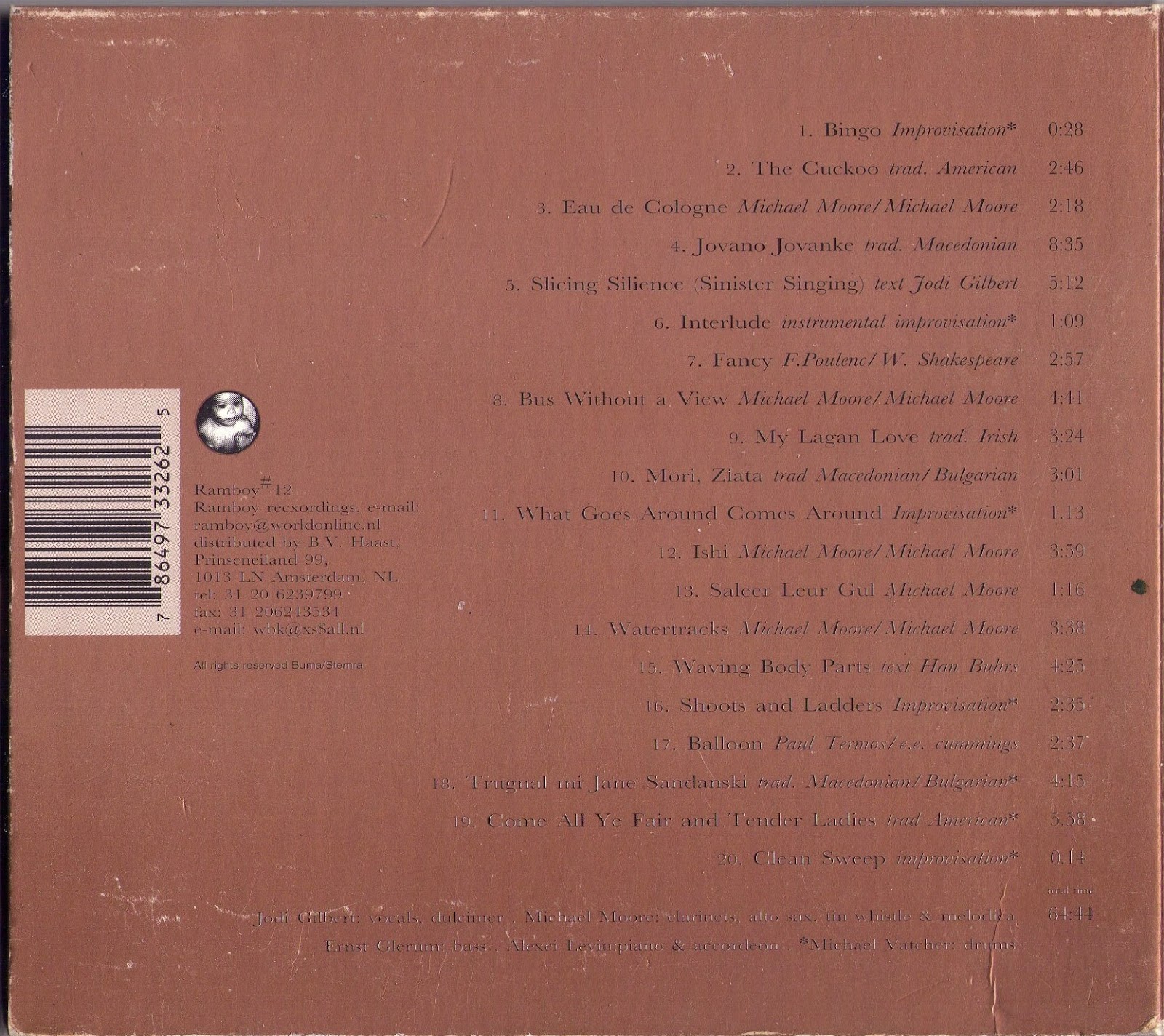
Jodi Gilbert, Michael Moore, Ernst Glerum, Алексей Левин ‎- The Voice Is The Matter -1999- (CD, Ramboy Recordings), Netherlands/US/Russia


The Voice Is The Matter is a beautiful CD-only release from The Netherlands that was created by American jazz saxophonist, clarinetist and composer Michael Moore, singer Jodi Gilbert (voice, dulcimer), Dutch double bass player and member of the Instant Composers Pool Ernst Glerum, Michael Vatcher (drums) and Russian composer and jazz musician Alexei Levin (piano, accordion). All of these musicians are based in Amsterdam.

The album The Voice Is The Matter was recorded in Amsterdam on March 11, April 18, May 24, 1997, but got released in 1999. Musically it's a mixture of free-jazz improvisation, experimental scatting, poetry, smooth-jazz and Macedonian and Bulgarian folk-song interpretations in which voice is emphasized. All musicians present are also pinnacle figures in the Dutch and international improvisation scene already for decades and have released dozens of different records. I suggest you give some other releases a listen too when you can. The album is also reminiscent of The Schismatics that I posted before on the blog.

Actually the fact that it doesn't reach too heavy 'impro moments' combined with a hollistic album approach causes this recording to be quite dreamy, listenable and comforting. Just the right soundtrack for necessary tranquility during the winter month of December we are finding ourselves in. 

Get it HERE
Support and buy HERE

Sunday, 14 October 2018

The Schismatics - Vazen Vol (Vases Full) -1994- (CD, AMF Music), Netherlands


The Schismatics were a Dutch Rock In Opposition and improvisation band that started in the 80's connected to the domain of the legendary artists squats of the Quarantaineweg in Rotterdam, although always based in Amsterdam. The Schismatics is more or less led by Dutch singer, poet and musician Han Buhrs. He was involved in many musical projects like Nine Tobs, Encore + Plus Grande with members of the French RIO band Etron Fou Leloublan, Palinckx and many more. His latest project is the Amsterdam based group Rubatong and Ensemble Extra Ordinaire.

At the time of this album, that was recorded at various locations in Holland in the early 90's, The Schismatics consisted of Han Buhrs (vocals, percussion), Jodi Gilbert (vocals), Beatrice van der Poel (vocals), Maartje ten Hoorn (violin) and Frank van Berkel (bass). The music on Vazen Vol is an interesting mixture of improvisation and avant-garde poetry with an emphasis on the role of the voice as instrument. The often absurd lyrics are a constant combination of both English and Dutch with the occasional use of other languages. The music reminds me of the Italian group Arigret, the American band Care of The Cow, the music of Maggie Nicols and Lindsay Cooper and many more acts of the rock in opposition world of Recommended Records.

This is another essential CD only release from the Dutch impro scene and probably one of the only Dutch groups that may carry the real label of the genre of Rock In Opposition. The cover of the album consists of a painting by Dutch artist Marjan Verkerk.

Get it HERE

Tuesday, 10 April 2018

Hein Pijnenburg, Ineke van Doorn & Paul van Utrecht - Barbaarse Dans -1994- (CD, GR 9409), Netherlands


This very obscure compact disc named Barbaarse Dans -in English- Barbaric Dance (not even on Discogs) contains great musical interpretations of poems by the Flemish surrealist and dadaist poet Paul van Ostaijen (22 February 1896 – 18 March 1928) and was recorded in 1994.

The music was made with voice, bass clarinet, guitar, saxophone, hammers and saws by saxophonist Hein Pijnenburg, Jazz-singer Ineke van Doorn and guitarist Paul van Utrecht. It was created to accompany Paul van Ostaijen's avant-garde sound poetry that was written in the early twentieth century in Dutch. The musical interpretation comes close to the Dutch performance artist and protagonist interpreter of abstract sound-poetry Jaap Blonk.

Even though Dutch is quite a non-important and often quite disliked language, Van Ostaijen was one of the most important people in the Dutch language territory who was inspired by the dada movement alongside the artist Theo van Doesburg. His sometimes onomatopoeiatic sound-poetry broke many barriers in the Dutch literary field and introduced sound-poetry as a performative and even visually experimental dimension in Dutch poetry in the early twentieth century. This album is quite special in the sense that it interprets his poetry. It's a unique musical example of the Dutch language literary avant-garde. It was released in a self-made fragile paper cover.

From the liner notes:

Barbaric Dance is a theatrical composition in which Hein Pijnenburg puts forward the poetry by the Flemish avant-garde poet Paul van Ostaijen. The musical work is shifting throughout the piece: at first the starting point is text and the music is composed with the text. Later in the composition this is reversed. The text: fragments of poems, words and seperate letters are fitted in the music. Hammers and saws are prescribed in the score to create two effects: to create a transition of rhythm and sound of daily life towards the silence of the theater and to increase the feelings of the listener and actor by physical powers. Furthermore the hammers and saws function as percussion.

Paul van Ostaijen was a Flemish poet who lived from 1896 to 1928. His work mirrors the changing and stirring zeitgeist of the first twenty-five years of this century: a hyper-sensitive Van Ostaijen found his inspiration amongst others in the First World War and the atmosphere of the Music-Hall (a precursor of the discotheque). He looked for possibilities to combine words, sounds and images in his poems. 

Barbaarse Dans is based on the poems: Barbaarse Dans, Angst, Fatalisties Lied, Asta Nielsen, Vers 2 en Vers 3 and Alpejagerslied.

Recommended!

Get it HERE

Wednesday, 21 February 2018

Yasui Kazumi (安井かずみ) - 空にいちばん近い悲しみ -1971- (LP, Philips), Japan


*Archaic Inventions 5 years anniversary post!*

Yasui Kazumi (安井かずみ) aka ZUZU was a known Japanese essayist, fashion model and poetess from Yokohama. At a young age she started to translate and write poetry, learn French and write many songs. In 1970 and 1971 she released two records through Polydor and Philips. Her first album "ZUZU" was named after her own nickname and was a classic japanese female pop, bossa nova, enka album that was quite chic but still also quite traditional. One of those tracks got compiled on the excellent Nippon Girls compilation series.

In 1971 she released the album 空にいちばん近い悲しみ (Sora Ni Ichiban Chikai Kanashimi) meaning something like The sadness closest to the sky. This album featured an overview of her poetic work on top of a variety of musical theme's: from a French chanson style to hippie-esque fuzz jams. Even though I cannot understand Japanese, it's clear how she gives an insight in her mind through poetry while being indulged in a life of decadent travels, fashion, hippies, melancholy and isolation. Sora Ni Ichiban Chikai Kanashimi was also published as a book aimed at girls and apparently she decided to adopt it in a musical format the same year.

The book was illustrated by the famous Japanese graphic artist Aquirax Uno who was also related to the psychedelic and tripped out theater group Tenjo Sajiki. He was known for his utterly psychedelic erotic and surrealistic drawings that are to be found all over Japan's hippie scene from the early seventies as a visual trademark. He also did many posters for experimental film. 


By the late sixties Kazumi had married a businessman in Rome and divorced a year later in New York. Just a few years later she found herself already in Paris and returned to Japan in 1971. On the album it's clear that she was travelling a lot and lived a cosmopolitan life. There is the Arc de Triomphe on the inner sleeve and many musical signs of Paris. Other places that are mentioned are India, California and New York where she probably was also finding her way into hippie scenes as well as celebrity insanity. Check out a translation of the tracklist:

The sadness closest to the sky
Voice comfort
Seaside dialogue
Young people's notes
For example, likes and dislikes
Five people in one person
Love in a beautiful city · · · white water drops in the morning
Wind
Returning from India - New York 29, April - Light of St. Moritz - Spring in California
Deauville's determination


Still you can find a lot of melancholy on this album that she displays poetically in her fragility and theme's. Kazumi died in 1994 after becoming quite famous in Japan. Most interesting is this part of her music and life when she was merging a decadent life with a hippie mind and created this beautiful concept album that catches a certain time, lifestyle and the feeling of being far from home coming from another culture. Even though I don't speak Japanese I can still kind of appreciate it. Sometimes she namedrops something from popular culture like Rosemary's Baby. It gives me a bit of a Gainsbourg and Jane Birking feeling, but also hints towards other Japanese singers or music like Harumi


Anyone that knows Japanese or more about ZUZU should feel free to add some information in the comments. Also I have an original book copy of The sadness closest to the sky for sale, since most of it is just Japanese verse with a few Aquirax Uno drawings and I cannot read it. I included all the interesting scans and pictures in the file and video below. Write me in the comments if you would like to get the book. The rip is from a 90's CD, although it was originally released on vinyl in 1971. Here's a nice crooked poetry translation excerpt to end this with: 

I am getting tired of being deeply rooted now, trying to think that I am improving after thinking about everything and thinking that it is wonderful.

I do not have the time to think about someone who I do not know, I feel so tired anyway.


It's really sad, the more I want to have fun, the more sad the depression is.

 
I wonder if that is the closest thing to the sky


Get it HERE

Saturday, 5 August 2017

Ceddo + Derschau ‎- Grüne Rose Live -1981- (LP, Saguitarius), Germany


In the early eighties punk, post-punk and new wave paved the way for new generations and created quite a musical break with the previous generations and their more (psych) rock fueled sixties and seventies. Some artists from the psychedelic era had quite some difficulties reinventing themselves in the new punk times. Daevid Allen, front man of the legendary Gong for example, made a dark album called The Death of Rock and Other Entrances in 1982. A different approach than he had before. Somewhere in the nineties when a neo-psych revival changed everything, the legends of the sixties returned fully to their spaced out selves of their prime.

But some musicians and bands were never influenced by external factors and kept making music during the eighties like it was 1972. Some real psychedelic pearls were actually made in the eighties, especially in what we could call late-krautrock. In germany there was quite a continuation of the krautrock scene and legendary pioneers as well as unknown musicians kept playing in their new or old bands. This resulted in many privately released albums, some of which are nearly impossible to find today.

Ceddo was a jazz fusion trio from Dortmund fronted by guitarist Jochen Strumpf. In 1981 they released this Live album with psychedelic jams and poetry which was recorded in Dortmund on 08.05.1981 and 9 + 10 5. 1981 im Gasthof zur Mühle, Ascheberg. They worked together with the countercultural poet Christoph Derschau. He was influenced o.a. by Bukowski and other US underground literature. The lyrics of Grüne Rose (Green rose) on this album are dealing o.a. with a corrupted state, environment, psychedelic rock music, existence and more. It's quite a good freak out album actually. If you understand German you might hear some echo's of political krautrock bands like Floh de Cologne, Von Brühwarm Theater or Ton Steine Scherben.

Grüne Rose. Das Ziel des Todestriebs ist nicht die Zerstörung an sich, sondern die Aufhebung des Bedürfnisses nach Zerstörung - Herbert Marcuse

Get it HERE

Thursday, 13 April 2017

Bewth (Bewegingstheater) - Over De Dauw Van Dit Land -1972- (LP, Space Records), Netherlands


Bewegingstheater (Movement Theatre) was a Dutch theatre group and Amsterdam based theatre school that was active from 1964 to 2005. In their existence they created 126 theatre productions. They worked with architecture, dance, music and poetry. In the late sixties and early seventies Bewth created numerous plays in which their happening-like plays were combined with psychedelic music and poetry.


The musical development started with voice experiments by the actors and were later replaced by compositions and music of the time like Pink Floyd and Arthur Brown. As the architectural element was introduced in the plays, more and more own music started to be created by some of the members, most importantly by: Peter Klencke, Walter Jaffé, Victoria Varekamp and Flip van de Pol. You can get an impression of a Bewth play in the late sixties by clicking here and here. This was a play called Bosche Bollen (1968), it starts with a still of The Garden Of Earthly Delights by Dutch medieval painter Hieronymus Bosch. Bosche Bollen are the famous patisserie chocolate balls connected to the city of 's-Hertogenbosch in the south of The Netherlands, also the birth city of Hieronymus Bosch.


In 1972 the record Over De Dauw Van Dit Land  (On The Dew Of This Land) was realized. The greater part of the music was created by Peter Klencke. From 1968 to 1974 he used country and blues slide guitar and a saxophone to create improvised sound imagery that corresponded with the movement of the actors. Also he composed music to the poetry of Bewth-member Ben Zwaal that was recited during plays. The music from this period was compiled on Over De Dauw Van Dit Land. The record was only sold during performances.


The music and poetry on this record have a distinct feeling of the Dutch countryside, in as much as that exists within the mostly urban landscape of Holland. The fragile cardboard cover shows a person in what I think is a boerenkool field. A vegetable that is eaten in Holland in the winter and which traditionally needs a night of frost over it to be eaten (frost and dew, important in alchemy, paganism.. it's all somewhere in that realm isn't it?). Most of the poetry and the song titles deal with nature in its purest form, very much in a pagan fairytale sense. Also one of the songs has a Frisian title, embedding this marginalized language and culture of the Netherlands in the record.

The record is a pearl of Dutch avant-garde acid folk and jam improvisation reminding me a bit of the Dutch obscurity Surprieze - Zeer Oude Klanken En Heel Nieuwe Geluiden from 1973. It is a beautiful example of free-form theatre mixed with spaced out music from that era, comparable to the French Théâtre du Chêne Noir d'Avignon, the Japanese Tokyo Kid Brothers, Tenjo Sajiki, the Belgian happening films of Ludo Mich or even the 1960's Living Theatre in New York.


The Bewegingstheater later went on doing many other performances including in the streets of Dutch cities (like in Middelburg on the picture above). Eventually, the company evolved out of its hippie character while focussing more and more on the relation between theatre and architecture until seazing its activities in 2005. This is one of the most amazing hidden seventies records from Holland and we can only hope there is much more musical material still in archives. This could have easily been on the NWW-List. All images I used are courtesy of Peter Klencke and Bewth.

De Kikker (The Frog)

een zonnebloem / a sunflower
beloofde / promised
de sloot / the creek
haar kromming te vergeven / to forgive its curve

en de sloot / and the creek
huilde zo / cried so

de groene kikker / the green frog
was de kasteelman / was the castle owner
de hoogste van de sloot / the highest of the creek
altijd slapende / always asleep
op luchtige schalen / on breezy scales
vol wijdblad / on wide leaves
en zonder het minste / and without the least
ooievaargevaar / stork danger

de zonnebloem / the sunflower
kende ze allemaal / knew them all
en lachte soms / and sometimes laughed
als het zomer was / when it was summer

Highly Recommended!

Get it HERE

Sunday, 25 December 2016

Simon Vinkenoog - Liefhebben, Zien en Proeven (Poezie en Muziek) -1966- (LP, Sigma Relax), Netherlands


             Merry Christmas and an Archaic New Year to all followers and friends of the blog! 

This record (which is rare as hen's teeth) is one of the most important documents of the Dutch countercultural psychedelic movement of the sixties. 

Simon Vinkenoog (18 July 1928 – 12 July 2009) was a Dutch author, poet, elocutionist and pioneer of the psychedelic revolution of the last century. He published his first poems around 1950 and kept working his way into the Dutch literary world from the fifties on. In 1959 he willingly tried LSD under medical supervision and later became a protagonist in the world of mind-altering substances, Dutch literature, happenings, free music and advocated for a world in which people lived in astonishment of the universe we belong to and the richness of culture and nature on planet earth. Because his early involvement in the counter culture combined with his literary career, Simon Vinkenoog can be seen as a European example of the Beat Generation. In 1966 he hosted an iconic poetry manifestation in the Royal theatre Carré showcasing a new generation of fresh poets in the Netherlands. If you understand German, check Simon Vinkenoog out in this panel on LSD and Gegenkultur in Europe in the sixties.


William S. Burroughs with Simon Vinkenoog

In 1968 Vinkenoog took part in the making of the mythical album Woorden (words) together with two other Dutch poets where free form music was combined with poetry. The album was only distributed through literary book stores and the first ´coffeeshops´ of Amsterdam, back when those places where not yet polluted with mass tourism and irresponsible behaviour. In that time Amsterdam was an important international centre of free-thinkers, alternative gatherers and hippies comparable to San Francisco in the US. It's ironic that Amsterdam is often perceived as a freedom city because of the endeavours of sixties and seventies and that now almost nothing relates to those values anymore. The Woorden record is seen by many as one of the most striking examples of the Dutch hippie-movement and spaced out sixties. Also it's one of the most rare albums on the legendary NWW-List. 


Anyway, this even rarer record here dates from before Woorden. Liefhebben, zien en proeven (meaining: To love, see and taste) is from 1966 and in record collecting circles often regarded as a literary album. But as the back of the record reveals, this is not just spoken word. The album was recorded on the 30th of December 1966 (literally 50 years ago!) in the in Dutch Royal Tropical Insitute and contains sitars, tabla's, gamelan gongs, indonesian flutes, indian bells etc. It's interesting how the interest in cultures and ethnic instruments of these crazy dope smoking youngsters was still regarded within an anthropological frame. The Tropical Institute was probably delighted that young people wanted to explore their colonial possessions and dig into exotic cultures. 

I know most of you will not understand a word from this album, but hopefully you can appreciate it with the given context. The poems are about life, death, rebirth, love, human potential and much much more. One of the poems is about DMT (in 1966 already.. man). I think I saw him one time in my life during a demonstration at the Dam square of Amsterdam on a stage speaking against the ban of magic mushrooms in Netherlands. Vinkenoog did millions of things in his lifetime: he wrote numerous poems, many novels and also frequently wrote on so called 'pseudo-scientific' topics in various magazines. It's important to note that Vinkenoog is not just some hippie-poet, he is ranked amongst all the important writers of the Dutch literature too. 

He made two albums with Spinvis (the Dutch Beck?) in the 00's which were his last musical recordings. In the video below I included scans from a little sixties underground book that Vinkenoog compiled. It was called Moksha, a timebook for the alteration of consciousness and drugs. Simon Vinkenoog, a very inspiring person and icon of the Dutch counter-culture. From the liner notes:

I wish that the human heart would beat faster. I wish that I could tell everyone everything I know at once: how the battle between light and dark is won by the light. I wish that people carried the sun with them. I wish that cheerful light would shine from all houses. I wish so many things, I still want so much: peace, peace, peace. I can't say it differently than with words: I don't want to persuade, convince or entice - I Just want you to listen, so you can find your own answers. Listen. And also stop the record, so you can listen to yourself! Have a good trip!

Get it HERE

Thursday, 29 September 2016

Pierre Courbois, Edgar M. Böhlke, Oskar Gottlieb Blarr - Free Music & Orgel -1969- (LP, Schwann AMS Studio), Germany/Holland


This record is linked to many other posts on the blog. Free Music & Orgel was a freeform endeavour to combine Christian church music with avant-garde, free-jazz and 'beat' music. The main composer behind it was the Dutch Pierre Courbois (to be found on the blog). Together with German organist Oskar Gottlieb Blarr, German narrator Edgar M. Böhlke, Dutch trumpetist Boy Raaymakers, Dutch sax player Peter van de Locht and Ferdi Rikkers on double bass a spontaneous project was recorded on October 13th and 14th, 1968 at Melanchthon-Kirche Düsseldorf and at Grote Kerk Arnhem.

This album showcases how the church tried to find new ways of connecting to the youth that was more and more being submerged in hippieness in the late sixties. An important figure in this German wave of the Christian krautrock-beat-mass genre was Nicaraguan priest-poet Ernesto Cardenal. His poems were also used on this album. Cardenal related things like the cosmic unity of the universe to Christ to use the hippie discourse for a Christian message, although politics are also important in this case.

The Christian Schwann label was quite adventurous with its releases. It also published the first two legendary Kluster albums. Somehow redemption was thought to be found in the experience of the free and abstract. But also in the popular culture, like Cardenals poem tells on this album: praise the lord of the milky ways and space between the milky ways with violins, with flutes and saxophone, praise him with blues and jazz, praise him with record players etc.

Musically I find this an amazing album where a sound reminiscent of Italian library music in the vein of Il Gruppo di Improvvisazione Nuova Consonanza meets jazz, poetry and dark psychedelic sounds. It also comes close to the Risonanze series which I published before. It is almost a Christian take on the Dutch hyperrare cult psychedelic beat poetry album Woorden. I actually find the balance between the church organ and the church bells with the other instruments really impressive. Much more could be said about this album because it has so many implications and so many different musicians, but I'll keep the rest to you.

Highly Recommended!

Get it HERE