Eight Intimate Poses was a free-jazz and free improvisation endeavour by a Flemish trio that consisted of Leo Coomans (reeds), Kris Vinck (trombones) and Marc Denhaene (guitars, accordeon). It was recorded at King Kong in Antwerp on December 11th and 12th, 1977. King Kong was an independent cultural centre for music, theatre and film, founded in the
early seventies. It was situated on Keizerstraat 38 in Antwerp. Joy Division even played the King Kong venue in 1980.
The three musicians on Eight Intimate Poses were regularly part of other jazz and improvisation formations (WIM Fanfare, Madou etc.) in Belgium but also played with foreign jazz musicans. Furthermore there was an important exchange of recorded material with other free-jazz and impro labels. This copy of Eight Intimate Poses for example was distributed through the BVHaast label in Amsterdam which was one of the most important contemporary jazz labels in Holland founded by saxophonist and composer Willem Breuker.
Eight Intimate Poses is another interesting release of the Belgian independent impro scene. The music consists of free improvisation in some of its most minimalistic shapes with occassional hectic outburst. It reminds me a.o. of the intricate, delicate yet anarchic acoustic sounds by the American impro duo and NWW List residents LaDonna Smith and Davey Williams and their Trans Museq label.
Finally I tracked down one of the last mythical lost records from the Dutch free-jazz and avant-garde 70's realm that I tried to find for many years.I have never seen a copy of this record before, probably also not many copies of this private release were pressed. It's also not listed on Discogs. I only knew that it existed somehow, but had no idea how it sounded nor what the cover looked like. I apologize in advance for the somewhat vague pictures I took, since the record comes in a very fragile and quite large foldout poster that was hard to scan (the cover reminds me of Soft Machine's first album cover). It's a hyper rarity that could have easily been included on the NWW-List (which is receiving some increased attention at the moment, with yet unknown consequences).
Love Cry and Super Nimbus was one of the first efforts by Amsterdam born jazz pianist Loek Dikker who was supported by a group of great Dutch musicians (posing like some sort of football team on the record cover). Loek Dikker would become more famous later in the 70's with his Waterland Ensemble that played very intricately composed jazz suites. He would also start composing for cinema in a later stage of his career.
For this particular recording, still hailing from the cosmic provo and hippie high-times in Holland, the line-up is Loek Dikker (piano, percussion) Erik-Jan Kromhout (violin), Aimée Versloot (alt-violin), Indonesian-Dutch musician Wim Essed (bass), Ralph de Jong (drums) and Pierre Courbois (drums). Courbois is also known from his amazing experimental progressive rock and free-jazz group Association (P.C.).
The record starts with a recording of an old gramophone recording of Gloomy Sunday (Hungarian: Szomorú vasárnap), also known as the Hungarian suicide song, a piece composed by Hungarian pianist Rezső Seress in 1933. The urban myth was that many people that commited suicide had been listening to the song and it also became an exemplification of the widespread reputation of the Hungarian people having a melancholic nature. The piece was popularized due to the interpretation by Billie Holiday.
When the actual music starts we hear a varied effort mostly leaning on heavy improvisation and
deranged classical music meeting the modern composed "avant-garde". Not only are
instruments used unconventionally, the record also uses collage, found
and existing sounds, backwards played Indian singing and has a piece where
the listener is encouraged to be in control of panneling the music from
left to right on his or hers stereo listening equipment. We have entered a world of musical deviance and playful provocation where cosmological tuning and cucumber drums are reigning. What the music actually means we read from the liner notes:
"Side 1
Trauriger Sonntag (Gloomy Sunday) is the attempt of a semi-authentic reconstruction of a much loved 78-rpm record. Cosmoligical Tuning 1: a summary of more than an hour. Collage. Ralph de Jong handles the drums. Cucumbers is a work by bass player Wim Essed that was written for the Calvé quartet. Ralph de Jong on drums. Smooth Triangular is a graphic piece by Loek Dikker, mostly written in triangular shaped notes. Pierre Courbois: percussion. Followed by a commercial and non-fitting accompaniment.
Side 2
Cadmium Primrose is a little musical work by pianist Dikker. Pierre plays drums.
Emptiness is a full Concert Hall is a strong example of desk work by composer Loek Dikker. The writing time of the piece has costed only slightly more time than the execution. Aimée Versloot is playing alt-violin here. Vioolkonsert in A van J.S. Bach is being played in the ever popular "choose your music"-version. With the help of the balance knob on your stereo amplifier you can make what you want. Have fun with Ralph and Johann. Cosmological Tuning 2 a version with Pierre Courbois Souer Grapes by W. Essed is based on problems with starting and archetypes"
So much can still be said about this album! Another missing link of the Dutch cosmic free-jazz and improvisation history. ps I just realized almost 50 years are between the birth of this release and that I'm posting this here today.
Orbitale Trio was one out of many bands and projects under the umbrella of the Italian independent cult label for improvisation and free-jazz Setola Di Maialewhich was created by multi-instrumentalist Stefano Giust in Pordenone.He started out with the legendary improvisational, punk and experimental band Le Bambine. A completely underrated band that to me still stands out as one of the greatest musical projects of the Italian alternative autoproduzioni scene that was bridging the 80's and 90's.
During the 90's Giust produced a great amount of releases with Setola Di Maiale and the musical output became more jazz oriented in combination with a few excursions into techno, turntablism and such. All projects on the Setola Di Maiale label were played mostly by the same musicians. None of the output was aiming for commercial success and the label was very clear in communicating this as you can read on the cover of this tape.
Orbitale Trio consisted of Stefano Giust, Ivan Pilat and Paolo De Piaggi. Improv Series Zzaj shows their playful repetitive free jazz sounds. It has a real open approach of do-what-you-want improvisation that results in nice tracks which they gave lovely absurdistic titles. One of the tracks on this tape is called Valzer Per Mikols Chadima which is clearly a tribute to Czech multi-instrumentalist Mikoláš Chadima who is the founder of Czech experimental underground groups like Elektrobus, Extempore and later the MCH Band. The music of Orbitale Trio is quite reminiscent of the Italian group Arigret that followed a similar approach with their Italo Calvino inspired album "Se Una Notte D'Inverno Un Viaggiatore..." which I posted some time ago.
I suggest that you dig deeper into the vast Setola Di Maiale catalogue to find the releases you like the most yourself. There is a lot to be discovered and most of the material is freely accessible. Maybe I will post some more music of the label later on.
Károly Binder is one of Hungary's most prominent jazz pianists. He is known for his rhythmic and unorthodox style of playing as well as for his experiments with the prepared piano. Binder takes the piano as a starting point but also uses many percussion instruments on the side. His first albums In Illo Tempore and Kontinentspiel that came out in the 80's in Hungary are great examples of Eastern European free jazz with lenghty pieces exploring rhythms while taking the listener into a world of its own. That is what usually matters: it's not just the plain exploration of sound. The sound is able to birth the existence of an own world. A bit comparable to the Pierre Courbois album I posted a long time ago.
Oriens & Occidens was recorded in the southern Hungarian cities of Baja and Szekszárd in 1995. On the album Binder works together with the Italian percussionist Federico Sanesi from Milan who was greatly inspired by oriental rhythms and percussion instruments like the Indian tabla and Javanese Gamelan. The result is an interesting musical meeting of cultures and free exploration of jazz, rhythm and non-western percussion instruments.
The music is played quite gently most of the time and tends to create an oriental background atmosphere that doesn't demand an overly focused attention from the listener. At times the music breaks loose from this atmosphere reminding me of certain moments of Embryo's Reise or of the British-Indian jazz album Cosmic Eye. Oriens & Occidens seems to fit this great European jazz tradition where Indian and oriental sounds are being combined with free jazz. Some examples of this tradition are the German project Jazz meets India, the British project Curried Jazz as well as the music of the Reform Art Unit from Austria.
In any case, this is a nice album of mid-90's Hungarian-Italian contemporary jazz meeting the orient.
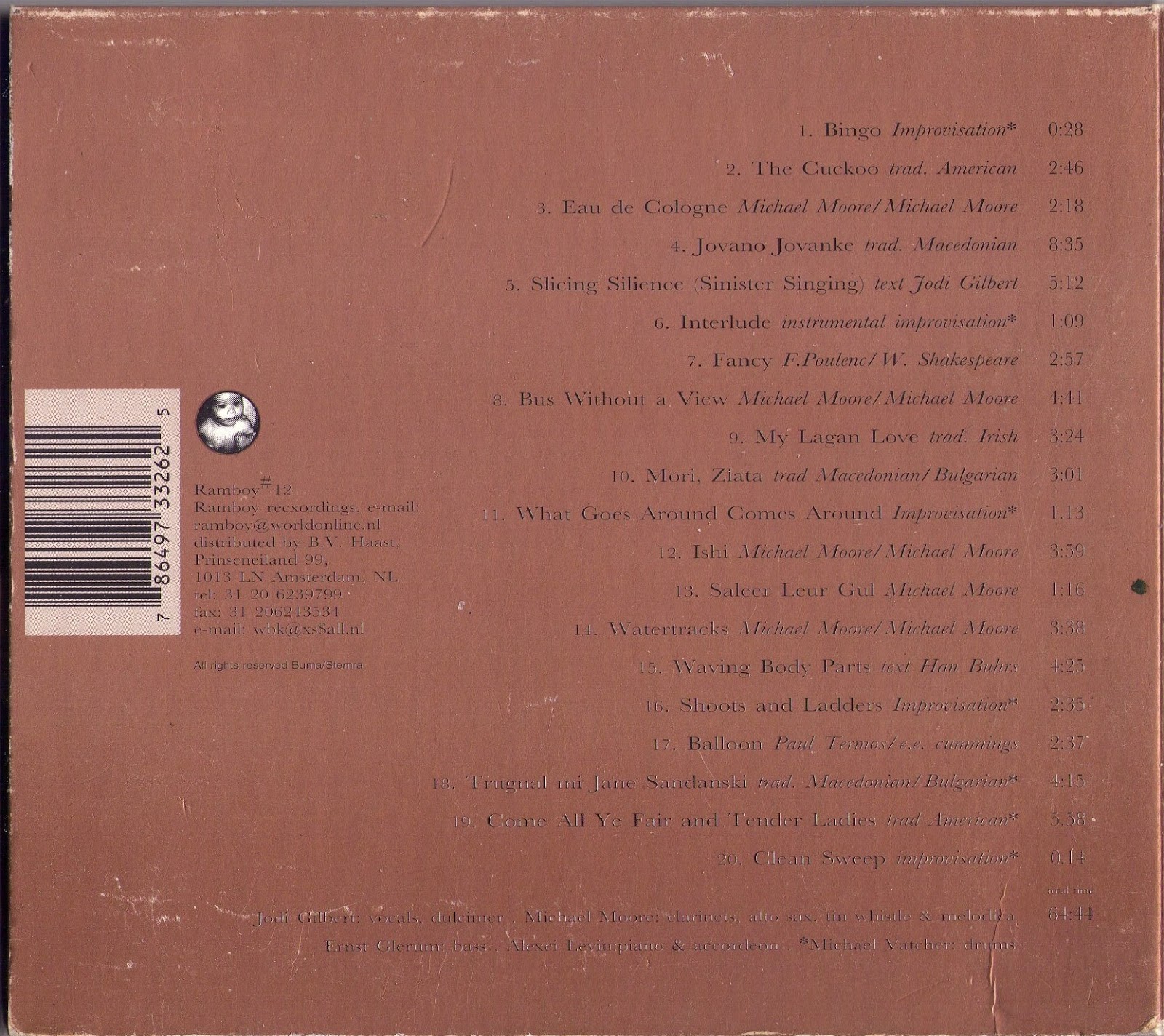
The Voice Is The Matter is a beautiful CD-only release from The Netherlands that was created by American jazz saxophonist, clarinetist and composer Michael Moore, singer Jodi Gilbert (voice, dulcimer), Dutch double bass player and member of the Instant Composers PoolErnst Glerum, Michael Vatcher (drums) and Russian composer and jazz musician Alexei Levin (piano, accordion). All of these musicians are based in Amsterdam.
The album The Voice Is The Matter was recorded in Amsterdam on March 11, April 18, May 24, 1997, but got released in 1999. Musically it's a mixture of free-jazz improvisation, experimental scatting, poetry, smooth-jazz and Macedonian and Bulgarian folk-song interpretations in which voice is emphasized. All musicians present are also pinnacle figures in the Dutch and international improvisation scene already for decades and have released dozens of different records. I suggest you give some other releases a listen too when you can. The album is also reminiscent of The Schismatics that I posted before on the blog.
Actually the fact that it doesn't reach too heavy 'impro moments' combined with a hollistic album approach causes this recording to be quite dreamy, listenable and comforting. Just the right soundtrack for necessary tranquility during the winter month of December we are finding ourselves in.
Continuing the blog on the track of improvisation CD-only releases from Europe's alternative 90's we have Arigret from Italy. Arigret was an adventurous Italian improvisation group that had a strong contemporary jazz foundation but also used some kind of Rock In Opposition approach with the great transitions in their compositions that were created by sax player Massimo Rossi (who would carry on with a contemporary Italian jazz outfit called Actis Band).
Se Una Notte D'Inverno Un Viaggiatore... was the only album by Arigret released through CMC records from Turin. It has great titles that are somewhat reminiscent of Zappa's. The vocals by singer Rossella Cangini contain nice eccentric lyrics and are a constant highlight when the jazz-patterns make way for the poetical absurdity on the album.
This is another great release from the 90's, specially for the more (free-)jazz-oriented music fans. It reminds me of Italian 80's groups like Ensemble Havadià, Mamma Non Piangere or the stricter impro-jazz releases one can find on Materiali Sonori records.
Austrian free-jazz and improvisation knows a long tradition that traces back to acts like the pioneering Reform Art Unit that started out by the late sixties. In these musical themes there are distinct Austrian and European sound traditions that are sometimes combined with other musical influences like the eastern and Indian musical traditions, always in an improvisational and free way.
This album created by pianist and keyboardist Josef Novotny and saxophone player Max Nagl directly tries to incorporate the Austrian musical traditions and showcases a complex avant-gardist mixture of free-jazz, church organ and synthesized computer programs. In a way it resembles the German-Dutch album Free Music & Orgel that was posted on the blog a long time ago. On that album the church organ is also used as a free instrument in combination with improvised theme's. AMen # was released as a CD only in 1989.
From the liner notes of AMen #:
The music is a confession to the European, and more specific Austrian tradition, naturally influenced by many cultural currents with which we are confronted. It ranges from traditional church songs to the tonal shape of the Vienna school right up to Jazz Avant-Garde. The pieces are largely improvisations based on fixiated computer-programs and prefabricated sound combinations each of which determine the form and the process.
De Reizende Verkoper (Dutch for The Travelling Salesman) was an obscure freak jazz improvisation band created around Croatian avant-garde musicians who settled in Amsterdam during the nineties (maybe late 80's). The band consists of guitarist Razorblade Jr., drummer Marc and sax player Kafka (Damir Prica). Some members were a.o. also involved in the no-wave group Blisters and the highly recommended experimental group Pink Noise Quartet.
During the 80's and the 90's there were quite some Eastern European underground musicians that came to live in Holland. Many of them came from Ex-Yugoslavia. An example could be the great Croatian experimental punk band SexA. All these musicians brought a new energy to the Dutch and mostly Amsterdam local underground and improvisation scene. I know a lot more about this scene because I knew some people in person being a child, but I rather keep that personal.
Aguardiente is a great album of experimental improvisation and no-wave with free-jazz freak out moments. It was recorded in a matter of a few hours in an Amsterdam basement in 1999, probably with some good quality aguardiente involved. It's a pure example of the vivid Yugo impro scene that had an important influence on what maybe can be viewed as the last real vibrant time of music in the Amsterdam underground. At least it's a scene that was never properly covered or given the right attention in music history. Luckily some of the protagonists are still active!
This is a rare CD-only release of a live concert of Italian jazz trumpeter Pino Minafra with Dutch Cellist Ernst Reijseger and Dutch drummer Han Bennink. It took place at Europa Jazz Festival di Noci somewhere in Puglia on the 14th of July, 1990. Because a lot of information is already in the booklet (click on it) I keep it short:
Minafra is an important figure in the Italian free-jazz and avant-garde improvisation scene. In 1990 he founded the Italian Instable Orchestra (IIO) to bring Italian jazz musicians closer together since many of them never played together because of the big distances between the northern and southern part of Italy. Minafra and the IIO can be compared to the Dutch Willem Breuker Kollektief (only less of a constant entity) and were a.o. indeed influenced by the Dutch improvisation and free-jazz scene. Hence this great collaboration with Ernst Reijseger (of whom I have posted other albums on the blog) and legendary impro-drummer, Fluxus artist and ICP Orchestra founder Han Bennink.
A nice slab of European free-jazz! Specially the voice parts.
Leo Cuypers (Maastricht, 1947) is one of Holland's most inventive and important pianists in the improvisation and Jazz world. He started out as a drummer but soon moved to the piano. As a pianist he developed a unique jazzy playing style by which he improvised many songs just by feeling, mostly in a rhythmic way based on moods and imagined titles. He was frequently playing with Dutch impro Saxophonist Willem Breuker (founder of the Instant Composers Pool and Willem Breuker Kollektief).
Leo Cuypers is probably most famous for his Zeeland Suite from 1977 also with Willem Breuker and others. Throughout the decades of the last century he did many scores and other soundtracks with Willem Breuker. Cuypers was the only person Breuker would trust with his opinion when showing new scores. Their work together keeps a unique place in the Dutch jazz and impro history. On the verge of the nineties Cuypers stopped collaborating with Willem Breuker. By then he had built a decades-long reputation as an impro pianist in a 'jazz world' of women, booze and other nightly endeavours. You can see a short documentary in Dutch with Leo Cuypers here. I love when he basically concludes that he didn't learn shit(!) during his time at the conservatory. This first album he made came out on BASF in The Netherlands, just like the Theo Loevendie Consort (of which Leo Cuypers was a member) as well as the Indonesia inspired experimental Jazz prog band Banten. Also he played on the most psychedelic album by Dutch cult singer Ramses Shaffy from Amsterdam, called Sunset Sunkiss. From the original 1972 liner notes:
"Maastricht was a beautiful city to live in. People from the Conservatory, the Academy of Arts, painters, sculptors - they all made it a nice scene. But then the hippies from the western part of Holland moved in and things changed so much that many of the artists left." This is pianist Leo Cuypers Talking. Born in Heemstede (near Haarlem) on December 1, 1947 (his parents originally came from Amsterdam) he moved to Maastricht with his family when he was about nine. And he always wanted to study at the Maatricht Conservatory. But after three years he quit; in fact he was chased away after four months of absence. "I was frightened, you know. What was going on there at the time (1962-1965) had nothing to do with making music. One was trained to play one's part in a symphony orchestra - not to play too much out of tune - not to play too well - just to do the job. And nobody was really interested in that kind of music. After lessons the kids ran to their favourite drinking place to listen to pop music, that's what they loved. And besides that, I played jazz, I wanted to become an arranger. I played drums, piano was at first only an obligatory second instrument. I started on drums when I was six. We had a piano at home, but I liked the drums better. It was only when I had learned to play enough piano that I discarded the drums. One day my set was stolen. Or rather, I hoped someone would steal it. Which they did. So I just had to go on with piano. Anyway, at the Maastricht Conservatory the scene finally changed too. Two years after I was chased away I made a guest appearance there."
As for many musicians in this country, the competition that's been held every year since 1958 at the lakeside resort of Loosdrecht meant a big change for Leo Cuypers as well. He entered the 1969 competition, playing solo. It was the percussion element, an echo from his playing the drums. As Maastricht is way down south in holland and the music scene - or anyway the jazz scene - is in the west, by being at Loosdrecht and winning this competition he was heard. Drummer Pierre Courbois liked his playing and when working at the festival of contemporary jazz in Baden-Baden, Germany, he advised Joachim Ernst Berendt to let Leo Cuypers replace Joachim Kühn, who had had a car accident. It was there that Leo Cuypers met composer and reedman Willem Breuker, founder member of the Instant Composers Pool, and it was through Breuker that Leo got his first gig in Amsterdam. Where a little later Theo Loevendie heard him and asked him to play with his consort. So, today, with Misha Mengelberg and Kees Hazevoet, Leo Cuypers is one of the three most foremost pianists in the contemporary music scene. He lives in Amsterdam. - 1972
This record is linked to many other posts on the blog. Free Music & Orgel was a freeform endeavour to combine Christian church music with avant-garde, free-jazz and 'beat' music. The main composer behind it was the Dutch Pierre Courbois (to be found on the blog). Together with German organist Oskar Gottlieb Blarr, German narrator Edgar M. Böhlke, Dutch trumpetist Boy Raaymakers, Dutch sax player Peter van de Locht and Ferdi Rikkers on double bass a spontaneous project was recorded on October 13th and 14th, 1968 at Melanchthon-Kirche Düsseldorf and at Grote Kerk Arnhem.
This album showcases how the church tried to find new ways of connecting to the youth that was more and more being submerged in hippieness in the late sixties. An important figure in this German wave of the Christian krautrock-beat-mass genre was Nicaraguan priest-poet Ernesto Cardenal. His poems were also used on this album. Cardenal related things like the cosmic unity of the universe to Christ to use the hippie discourse for a Christian message, although politics are also important in this case.
The Christian Schwann label was quite adventurous with its releases. It also published the first two legendary Kluster albums. Somehow redemption was thought to be found in the experience of the free and abstract. But also in the popular culture, like Cardenals poem tells on this album: praise the lord of the milky ways and space between the milky ways with violins, with flutes and saxophone, praise him with blues and jazz, praise him with record players etc.
Musically I find this an amazing album where a sound reminiscent of Italian library music in the vein of Il Gruppo di Improvvisazione Nuova Consonanza meets jazz, poetry and dark psychedelic sounds. It also comes close to the Risonanze series which I published before. It is almost a Christian take on the Dutch hyperrare cult psychedelic beat poetry album Woorden. I actually find the balance between the church organ and the church bells with the other instruments really impressive. Much more could be said about this album because it has so many implications and so many different musicians, but I'll keep the rest to you. Highly Recommended! Get it HERE
This record is most likely the first real jazz album I've put on the blog so far, but it's a real classic in its genre. Theo Loevendie is a Dutch jazz clarinetist and composer and has been one of the key figures in Dutch jazz and improvisation since the sixties. In the early seventies Loevendie created two albums under the name Theo Loevendie Consort: Chess and Mandela (both have been reissued on a CD which is also out of print).
The Theo Loevendie Consort is basically a Dutch supergroup of jazz and impro musicians. The group consisted of trombonist Willem van Manen, icon of Dutch jazz: saxophonist Hans Dulfer, bass clarinet wizard Harry Sparnaay (to be found on this blog), pianist Leo Cuypers, bass player Arjen Gorter, saxophonist Leo van Oostrom and drummer Martin van Duynhoven (who was also in Group 1850, one of the best psychedelic Dutch bands from the sixties and seventies). You can find all these musicians on countless albums over at Inconstant Sol, as well as more Loevendie stuff.
Chess! is an important album in the Dutch (free)jazz realm, but to my personal taste not the best effort you'd expect from a supergroup like this. I suppose it was hard for them to find the right balance between their melody foundations and free jazz outburst and the space everyone had within that division. But then again maybe that's exactly what they tried to do according to the liner notes, namely: "Anthitheses, depicting a fight between worn-out traditions and the modern improvisation approach". For example the first piece chess is a nice combination of a simple happy melody and free jazz. The piece brasilia combines a Brazilian-like melody with chaotic saxophone bursts. All in all the whole is a cool example of Dutch free jazz and does grasp the groovy spirit of that particular time in Holland. Maybe it's just that one has too high expectations being confronted with a supergroup of this degree.
Moonyana was a free-jazz, impro outfit from Slovenia. This particular cassette is a recording of a concert in 1989 and released according to the label's website in 1991. I don't know whether this group existed for this occasion only, or if they had other releases or concerts. Since there is almost no info around on this group it's hard to tell. About some individuals in the group there is some information: Saxophone player Primož Schmidt is known for having made more releases as well as performing alongside Bosnian underground hero Marko Brecelj. Nino de Gleria is a quite renowned Slovenian bass player in the Slovenian jazz and RIO world.
This cassette came out on Slovenian underground label FV Založba / FV Music. From their website:
- As a label FV has been documenting with a pioneering
spirit Slovenian alternative rock for fifteen years. It was the first to expose Laibach's
music to the listeners. As a booking agent FV took two of the most exposed bands from its
rooster Dicky B. Hardy and Hic Et Nunc to an American coast to coast tour in 1998. The
tour marked the first occasion of Slovenian musicians having toured the States without the
support of a multinational music label. As a promoter FV has been bringing challenging
sounds from groups as different as Einsturzende Neubauten and Dead Moon to the audiences
in Slovenia as well as in countries from ex-Yugoslavia.
FV Music was established in 1985 by the musicians of the
group Borghesia and a circle of music aficionados that had previously run Disco FV, the
first punk club in Ljubljana. FV, for several years the only Yugoslavian independent label,
was born out of necessity to satisfy the creative impulses of its founding members. Today
FV is the nation's first in promoting and booking alternative r'n'r bands. It has a strong
network of relationships with clubs and local promoters in Slovenia and other
ex-Yougoslavian states. It has a number of long standing contacts with European and
American agencies. And it has a rooster with some of the most exiting and popular r'n'r
bands in Slovenia and Croatia - Dicky B. Hardy, Rhythm Thieves, KUD Idijoti, The Spoons
and Bambi Molesters. These are the bands that on Slovenian and ex-Yougoslavian club
circuit guarentee a good night out. In Slovenia of today FV is a synonym for rock &
roll. -
The recording has quite some surface noise since it's a documentation of a concert transferred to cassette, transferred by me to the computer. Nevertheless, it's fine free jazz improvisation with some minor RIO hints.