Showing posts with label Improvisation. Show all posts

Thursday, 24 June 2021

R-27 - Activity 1987-1988 -1989- (Cassette, Anti-Musik Der Landsh), Poland


R-27 (initially Fragments of R-27) was an underground improvisational and experimental avant-garde music group from Kraków that was active during the second half of the 80's. They were comprised of Rafael Kozub (keyboards and percussion instruments, singing, compositions), Damian Kozub (drums, voice, piano, compositions), Rafał " Walek "Walczowski (bass), Piotr" Buzer "Łabuzek (trumpet, voice, synthesizer) and Pawel" Rudy "Ochel (guitar, voice). The band gave many concerts in their native Kraków (Klub Podwawelski, Nowohuckie Centrum Kultury, Klub Wola Zoo, Dworek Białoprądnicki etc..) as well as some concerts in other Polish cities.

The Polish underground from the 80's was generally influenced by two traditions. One side was the jazz tradition that was very developed in Poland after the Second World War during the communist period. There was a large output of Polish jazz and international jazz artists came to play many annual festivals. From there on jazz-rock and prog-rock cross-overs opened the doors for even more abstract and stranger forms of music that due to their nature were not banned and identified as clear political revolt. Towards the 80's the jazz and improvisation traditions kept evolving in the underground with bands like Reportaż, Kirkut Koncept or 13 -11. 

The other side of the spectrum consisted of new music influences that gradually had found their (secret) way into the Polish underground. The improvisational groups were now also accompanied by new wave bands, punks, industrial noise makers and everything in-between. Quite a strong grey and bleak accent was being put in the music, reflecting the last bleak decade of communist totalitarian repression. Obviously some small cracks in the totalitarian regime were already showing and there was a bit of a decrease of cultural repression to be felt, but nevertheless general society was still rough and gloomy during late 80's Poland. A series like Dekalog by director Krzysztof Kieślowski gives an interesting insight in the depressing existential crisis of Polish society at the time. A feeling that in a way was commonly felt in different countries behind the iron curtain. The musical underground can largely be regarded as non-existent compared to that dominant society, that's how marginal things were.

To return to R-27 we can hear some of this existential crisis in the music. The band was formed by amateur musicians that combined different elements of free-jazz, electronics and poetry based on their own subtleties, feelings and expressions. The mood, the state of mind and inspiration came from their own environment: the underground community of Kraków. R-27 released a couple of cassettes in very limited quantities. Most of the recordings are very primitive and lo-fi in quality reflecting their technical means at the time. 

Activity 1987-1988 was released on the legendary Polish underground cassette label Anti-Musik Der Landsh in the limited quantity of 30 copies and was dedicated to Charlie Mingus.

I'm living Still
At once time, I come
here, but I didn't know,
where I went
At once time I came
here, in order to take
a rest in the shadows
of the trees
And now we ask
What for I'm living
still
And that only I'm
living still,
although my soul
chose the shadow
And so, how can it be
so... - Buzer

Get it HERE

Sunday, 10 January 2021

José Iges & Concha Jerez - El Diario De Jonás -1997- (CD, Unió Musics), Spain


To bring in some music from other realms I think it's nice to start this blog-year off with a longer piece of music that creates a different listening experience than let's say a cassette compilation.  

El Diario De Jonás was a multi-disciplinary soundwork from 90's Spain that was written and imagined by the artists, scholars and music composers José Iges and Concha Jerez. At the end of the 80's they started collaborating on a series of projects called "Media Interference" that were combinations of audiovisual pieces, crossmedia concerts and performances. 

In line with these artworks the piece El Diario De Jonás was created in the 90's with contemporary experimental musicians Belma Martín (voice), Pilar Subirá (percussion) and Pedro López (live electronics). Martín and López were founders of the Madrilenian CEDI Institute for improvisation and sound-research and published a magazine on music called Hurly Burly during the 90's. The musicians also released music on the Spanish Modisti label that tried to operate on the intersection of music theory, politics and free music expression.

El Diario De Jonás was recorded live on 27-9-97 at Las Cuevas de Canelobre (caves of Canelobre) in Busot, Alicante as part of the 13th International Festival of Contemporary Music of Alicante. The release was supported by the Counsel of Mallorca. Partially performance, partially soundscape and partially sound-poetry (in Spanish and French) El Diario De Jonás is an interesting piece of Spanish music from the 90's. It reminds me a bit of the Galvana album by Victor Nubla and Pelayo Fernandez Arrizabalaga from 1992. 

From the liner notes:

"This work is shaped as a personal diary developed on internalized fragments. For that it's integrated by different episodes, linked from a certain subjectivity than the "diary" gender always suggests. Likewise, the understanding, the inverted commas or underlined, the monologue truncated on a word or the design or the linguistic gesture takes part of the expressive strategies of the piece. Making it we have gone to the bottom of our memories, on a time of speed and forgetfulness. As a Diary, its structure is given rather from the physical support -the diary- and from the graphy of the person that writes it. {..} The work is developed with three musicians performing live - a singer, an acoustic percussionist and an electronic percussionist, plus organized sound taped on 4 sources. All the material for the interpreters arised from 40 sentences, memories expressed orally, 20 coming from each one of the two authors. Different types of visual, phonetical and even semiotical interpretations of the sentences generated the ways in which the piece was performed. The modular apect assured that it would sound mainly the same during each performance yet always differ and show unprevisible elements." 

Due to the nature of this release no download link yet.

Sunday, 29 March 2020

13 - 11 - Temporization -1988- (Cassette, TN/N 001), Poland


13 - 11 were a one-off improvisational outfit from Warsaw that consisted of Monika Szczecińska (Percussion), Bolek Błaszczyk (Cello and Keyboards), Michał Rollinger (Saxophone), Sernik (Tape, Guitar) and Jarek Siwiński (Keyboards). The group was named after the date on which they played this live-opus in Warsaw on the 11th of November 1988 at the Riviera-Remont Klub. Simultaneously, the 11th of November is the Polish National Independence Day on which Poland gained autonomy from the German, Austro-Hungarian and Russian empires in 1918. Whether that plays a role on this cassette is unclear.

When looking at the members of this group the name of Bolek Błaszczyk provides the most context for me. Błaszczyk is a cellist that played in several important Polish underground groups like Legendarne Ząbki. He also played together with the magical Rock In Opposition outfit Cukor, Bila Smert' (Цукор Бiла Смерть) from the Kiev underground scene (Ukraine). You can hear their collaboration on their beautiful album called Selo from 1993.

13 - 11 is a project that can be placed in the light of the Polish experimental underground of the 80's, the extensive Polish jazz and improvisation history and in the larger context of the Eastern European Rock In Opposition tradition. Even though the sound fidelity of this obscure tape is not very high the band displays a wonderful interplay of improvisational jazz, ambient electronics and cinematographic sound collage all subtly based on the city of Warsaw and the temporality of different places and their atmospheres. It's almost a soundtrack to a non-existing film at times. The music was recorded live as a continuous opus of which the compositions flow into each other. Because of that it was not easy to index this tape, so I left some tracks to transition into the following track. The music reminds me of their peer-band Kirkut-Koncept that also played in a similar style. Somehow the 90's project Kaddish by Towering Inferno also comes to mind, maybe because of its thematic approach.

A lo-fi sound quality cassette from behind the iron curtain again, but this truly is another masterpiece of the Polish underground of the 80's.

This tape was limited to 40 copies.

Highly recommended!

Kindly donated by the Y Create Archive

Get it HERE

Wednesday, 30 October 2019

Art Moulu Tréfin - Self-Titled -1985- (Cassette), France


Art Moulu Tréfin were a Rock In Opposition band from France that consisted of Jean-François Welter, Jo Thirion, Maurice Ott, Olivier Masson and Richard Antez. Their sound obviously has something akin to Magma, which is basically the start for most French bands with complex intrumental structures in their composition, but they also remind me of the French band Komintern from the 70's. Ofcourse Art Moulu Tréfin is a product of the 80's and had an own signature to their music with strange lyrics, humor and zig-zagging compositional manoeuvres. The band was also compiled on one of the Recommended Records quarterly series.

The music on this self-released cassette EP from 1985 was recorded on a Fostex 8-track recorder thus sometimes a bit lo-fi in quality. Nevertheless, it consists of some top-notch humoristic RIO complexity that fits a similar musical realm as the French Rock In Opposition band of the first hour Etron Fou Leloublan, the Swiss group Debile Menthol or the Estonian outfit Ne Zhdali.

Finally we can hear Art Moulu's music from the early times after Mutant Sounds published their equally great live album from 1990 over a decade ago. Another essential piece of French RIO history.

This cassette is not on Discogs.

Get it HERE

Tuesday, 8 October 2019

Various Artists - Polish Road, Vol. 1 & 2 - Alternative Polish Scene -1989- (2x Tape, Organic), Poland/France


Here we have one of the pivotal compilations covering the Polish underground from behind the iron curtain during the 80's. It came out right before the change of the political system in Eastern Europe in 1989 on a French label. Obviously many of these bands only released their music marginally in their own circuits. They had to operate in the underground because of their subversive nature and artistic expression directly or indirectly opposing the socialist regime. Poland had a longer history of underground bands and artists fitting that realm already in the early 70's, with examples like the mythical psychedelic band 74 Grupa Biednych and improvisers like Grupa W Składzie. The Polish music underground has always been heavily inspired by Jazz and improvisation. Also more known bands from Poland that were accepted by the regime during the 70's like Niemen or SBB were quite experimental in their approach. Polish jazz played a hugely influential role behind the iron curtain during the 60's and 70's and became a trademark of adventurous quality jazz. 

During the 80's a broader underground had emerged in different Polish cities. The improvisational groups were now accompanied by new wave bands, punks, industrial noise makers and everything in-between. Quite a strong grey and bleak accent was being put in the music, reflecting the last bleak decade of communist totalitarian repression. More and more Polish music was slowly finding its way to the west by cassettes that were swapped as well through Polish dissidents that made their way to the west of Europe. One of the greatest post-punk bands that had a Polish singer (Andrej Dziubek Nebb) was Holy Toy from Norway. Their first album Warszawa (Warsaw) still stands as one of the strongest experimental new-wave albums from the 80's and incorporates a strong Polish component. 

Now that I think about it, even Joy Division was called Warsaw at first ofcourse. In the imagination of wave bands and punks from the west during the 80's Poland was definitely the epitome of bleakness and a symbol of the east-west schism that was casting its darkening shadow over Europe including the threat of nuclear warfare. This was pushing the no-future mentality even further in the heads of many youngsters. Subsequently theme's like the Warsaw-Pact were often used by western wave bands from the 80's. But let's get back to this release:

Polish Road was one of those important compilations for Polish bands to be heard in the west  spreading their underground sounds. It's a very nice, although heavily fragile, recording of different bands ranging from punk, wave, industrial and improvisation groups. It was released as a double cassette in a VHS case. The first volume consists of more experimental and punk groups, while the second volume has more improvised and electro-acoustic bands on it of which Reportaz might be the most known. The music was all recorded between 1985 and 1988, often containing live recordings. I won't go into every band separately because it's too much work, although from some bands I will upload more tapes in the future of the blog. 

Polish Road can be seen as a critical undermining of the socialist regime and a time document of what was going on at that time in the Polish underground, while Solidarność was already making big leaps and the change of political system was very near. Please note that I'm putting this music in a political narrative, but a lot of this music was just artistic expression and didn't have any political agenda in itself.

After the communist period a hopeful time arrived to Eastern Europe during the 90's (apart from Yugoslavia), but nowadays we know how much political difficulties we are facing yet again. It slowly fosters the realization that this music and its urgent character, pushing through all possible limits, whether having no audience, no listeners or the lack of technical production or musical skills, yet giving expression to the inner spirit and the need for change in society, could still be perfectly inspiring today.

Many more obscure Polish cassettes will be uploaded to the blog with time.

Get it HERE


Friday, 27 September 2019

Loek Dikker - Love Cry And Super Nimbus -1970- (LP, Private Release), Netherlands


Finally I tracked down one of the last mythical lost records from the Dutch free-jazz and avant-garde 70's realm that I tried to find for many years. I have never seen a copy of this record before, probably also not many copies of this private release were pressed. It's also not listed on Discogs. I only knew that it existed somehow, but had no idea how it sounded nor what the cover looked like. I apologize in advance for the somewhat vague pictures I took, since the record comes in a very fragile and quite large foldout poster that was hard to scan (the cover reminds me of Soft Machine's first album cover). It's a hyper rarity that could have easily been included on the NWW-List (which is receiving some increased attention at the moment, with yet unknown consequences).

Love Cry and Super Nimbus was one of the first efforts by Amsterdam born jazz pianist Loek Dikker who was supported by a group of great Dutch musicians (posing like some sort of football team on the record cover). Loek Dikker would become more famous later in the 70's with his Waterland Ensemble that played very intricately composed jazz suites. He would also start composing for cinema in a later stage of his career.

For this particular recording, still hailing from the cosmic provo and hippie high-times in Holland, the line-up is Loek Dikker (piano, percussion) Erik-Jan Kromhout (violin), Aimée Versloot (alt-violin), Indonesian-Dutch musician Wim Essed (bass), Ralph de Jong (drums) and Pierre Courbois (drums). Courbois is also known from his amazing experimental progressive rock and free-jazz group Association (P.C.).

The record starts with a recording of an old gramophone recording of Gloomy Sunday (Hungarian: Szomorú vasárnap), also known as the Hungarian suicide song, a piece composed by Hungarian pianist Rezső Seress in 1933. The urban myth was that many people that commited suicide had been listening to the song and it also became an exemplification of the widespread reputation of the Hungarian people having a melancholic nature. The piece was popularized due to the interpretation by Billie Holiday.

When the actual music starts we hear a varied effort mostly leaning on heavy improvisation and  deranged classical music meeting the modern composed "avant-garde". Not only are instruments used unconventionally, the record also uses collage, found and existing sounds, backwards played Indian singing and has a piece where the listener is encouraged to be in control of panneling the music from left to right on his or hers stereo listening equipment. We have entered a world of musical deviance and playful provocation where cosmological tuning and cucumber drums are reigning. What the music actually means we read from the liner notes:

"Side 1

Trauriger Sonntag (Gloomy Sunday) is the attempt of a semi-authentic reconstruction of a much loved 78-rpm record.

Cosmoligical Tuning 1: a summary of more than an hour. Collage. Ralph de Jong handles the drums.

Cucumbers is a work by bass player Wim Essed that was written for the Calvé quartet. Ralph de Jong on drums.

Smooth Triangular is a graphic piece by Loek Dikker, mostly written in triangular shaped notes. Pierre Courbois: percussion. Followed by a commercial and non-fitting accompaniment.

Side 2 

Cadmium Primrose is a little musical work by pianist Dikker. Pierre plays drums.

Emptiness is a full Concert Hall is a strong example of desk work by composer Loek Dikker. The writing time of the piece has costed only slightly more time than the execution. Aimée Versloot is playing alt-violin here.

Vioolkonsert in A van J.S. Bach is being played in the ever popular "choose your music"-version. With the help of the balance knob on your stereo amplifier you can make what you want. Have fun with Ralph and Johann. 

Cosmological Tuning 2 a version with Pierre Courbois

Souer Grapes by W. Essed is based on problems with starting and archetypes"

So much can still be said about this album! Another missing link of the Dutch cosmic free-jazz and improvisation history. ps I just realized almost 50 years are between the birth of this release and that I'm posting this here today.

Get it HERE

Tuesday, 21 May 2019

Orbitale Trio - Improv Series Zzaj -1996- (Tape, Setola Di Maiale), Italy


Orbitale Trio was one out of many bands and projects under the umbrella of the Italian independent cult label for improvisation and free-jazz Setola Di Maiale which was created by multi-instrumentalist Stefano Giust in Pordenone. He started out with the legendary improvisational, punk and experimental band Le Bambine. A completely underrated band that to me still stands out as one of the greatest musical projects of the Italian alternative autoproduzioni scene that was bridging the 80's and 90's.

During the 90's Giust produced a great amount of releases with Setola Di Maiale and the musical output became more jazz oriented in combination with a few excursions into techno, turntablism and such. All projects on the Setola Di Maiale label were played mostly by the same musicians. None of the output was aiming for commercial success and the label was very clear in communicating this as you can read on the cover of this tape.

Orbitale Trio consisted of Stefano Giust, Ivan Pilat and Paolo De Piaggi. Improv Series Zzaj shows their playful repetitive free jazz sounds. It has a real open approach of do-what-you-want improvisation that results in nice tracks which they gave lovely absurdistic titles. One of the tracks on this tape is called Valzer Per Mikols Chadima which is clearly a tribute to Czech multi-instrumentalist Mikoláš Chadima who is the founder of Czech experimental underground groups like Elektrobus, Extempore and later the MCH Band. The music of Orbitale Trio is quite reminiscent of the Italian group Arigret that followed a similar approach with their Italo Calvino inspired album "Se Una Notte D'Inverno Un Viaggiatore..." which I posted some time ago.

I suggest that you dig deeper into the vast Setola Di Maiale catalogue to find the releases you like the most yourself. There is a lot to be discovered and most of the material is freely accessible. Maybe I will post some more music of the label later on.

Get it HERE


Wednesday, 12 December 2018

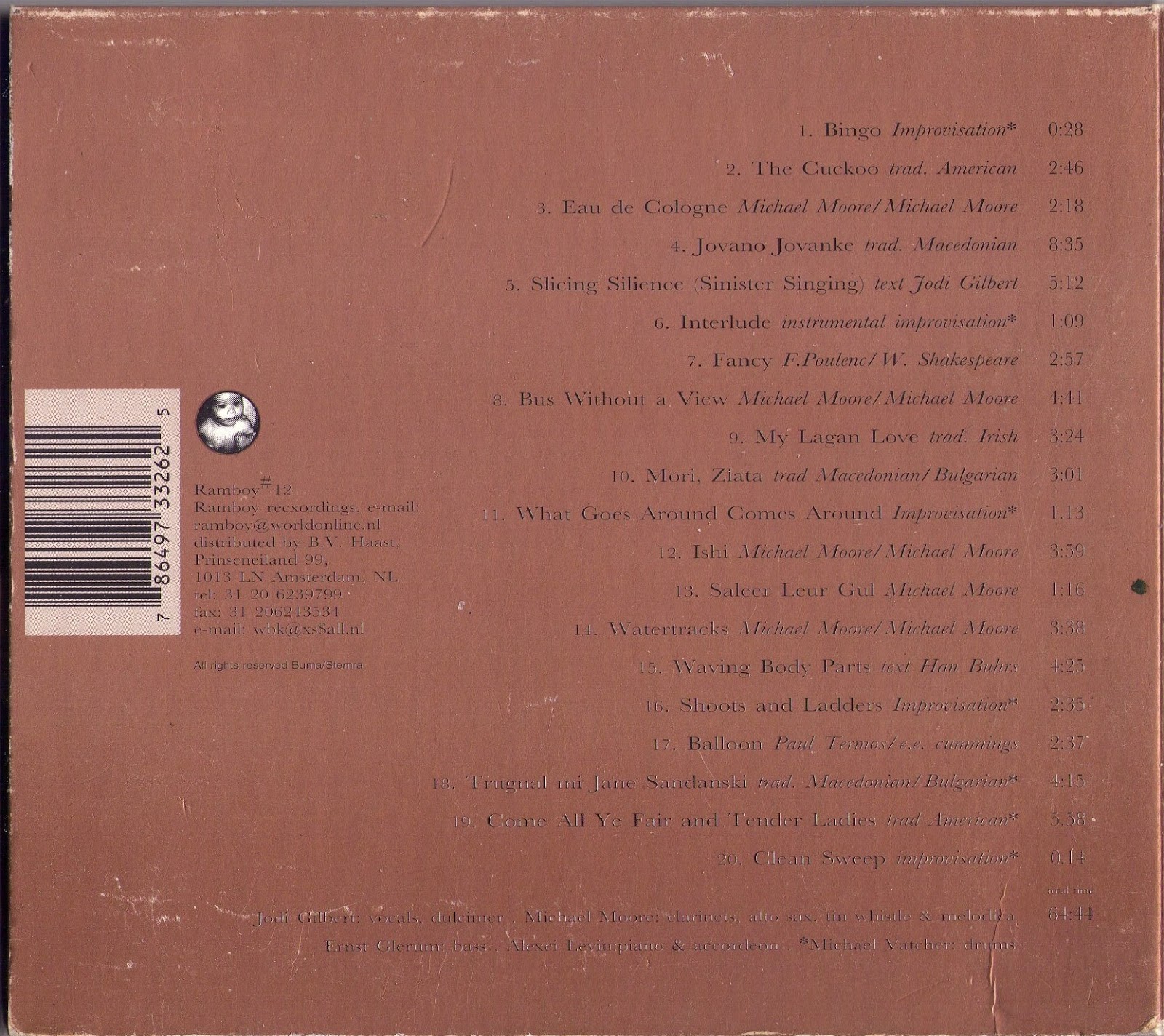
Jodi Gilbert, Michael Moore, Ernst Glerum, Алексей Левин ‎- The Voice Is The Matter -1999- (CD, Ramboy Recordings), Netherlands/US/Russia


The Voice Is The Matter is a beautiful CD-only release from The Netherlands that was created by American jazz saxophonist, clarinetist and composer Michael Moore, singer Jodi Gilbert (voice, dulcimer), Dutch double bass player and member of the Instant Composers Pool Ernst Glerum, Michael Vatcher (drums) and Russian composer and jazz musician Alexei Levin (piano, accordion). All of these musicians are based in Amsterdam.

The album The Voice Is The Matter was recorded in Amsterdam on March 11, April 18, May 24, 1997, but got released in 1999. Musically it's a mixture of free-jazz improvisation, experimental scatting, poetry, smooth-jazz and Macedonian and Bulgarian folk-song interpretations in which voice is emphasized. All musicians present are also pinnacle figures in the Dutch and international improvisation scene already for decades and have released dozens of different records. I suggest you give some other releases a listen too when you can. The album is also reminiscent of The Schismatics that I posted before on the blog.

Actually the fact that it doesn't reach too heavy 'impro moments' combined with a hollistic album approach causes this recording to be quite dreamy, listenable and comforting. Just the right soundtrack for necessary tranquility during the winter month of December we are finding ourselves in. 

Get it HERE
Support and buy HERE

Tuesday, 4 December 2018

Various Artists - The Meridian Crossings -1995- (CD, Hermit Foundation), Czech Republic


This is a CD only compilation around the music and arts symposium The Meridian Crossings that took place in Plzeň, Czech Republic in 1995. It is a varied release containing Czech folk musician Pavel Fajt, a.o. known of the amazing Czech group Dunaj, Cellist Vojtěch Havel who also did many ethereal folk and avant-garde world music soundscapes with his wife Irena Havlová and also many more improvisation musicians from the country I know less about.

Then present on here is English Rock In Opposition hero Tim Hodgkinson, known ofcourse as member of the pioneering RIO band Henry Cow. Also Dutch and Scandinavian artists are compiled (like Ad van Buuren) with art-installation sounds and improvisation pieces. Drummer Jim Meneses is also featured on the compilation, who played in the Berlin based band Stan Red Fox which I posted before on the blog. Lastly present here is Australian sound-art poetess Amanda Stewart.

The Meridian Crossings is a nice historical sound document of a manifestation of experimental music. A moment in which people from different countries exchanged musical talent in a post-socialist country that always had a very strong experimental underground scene in which music played a pivotal role. Within Eastern Europe, Czech Republic was always musically ahead with legendary groups like The Plastic People of The Universe, DG307 or Extempore. Their sounds concealed critical politics, poetry, art and philosophy in a context of the darker realms of folk and progressive rock experimentation to fight repression and to share state-forbidden information in order to uplift generations of people who were fighting to change the system. On The Meridian Crossings we can hear a new time that is still rooted in this past, but already merging with a global contemporary art-world representing a new transnational unity through the serious but also light-hearted musical avant-garde.

Get it HERE
Sunday, 25 November 2018

Down With People - Same -1990- (LP, Circularphile Records/Nadirean Extensions), US


Down With People was an experimental art rock outfit from Rochester, New York that consisted of Jan Cermak (voice, clarinet percussion), Jack Schaefer (guitar), Zeppi (Bass), John Grieco (drums), Brad Watson (violin), Dan Schelley (bassoon), Steve Peck (trombone) and Carl German (organ).

DWP is a classic example of absurd art rock groups from the US reminding me of dozens of bands, from The Jaunties to Care of The Cow to Blacklight Braille etc! Its existence at the beginning of the 90's makes that the band is portraying a hybrid sound in-between the weird art damaged rock from the 70's and 80's and a more indie sound that would become dominant in the 90's. There are various songs with strange lyrics, deconstructed rock moments and lots of improvisation. I guess the band is a good example of the transition of musical decades, holding on to a DIY ethic with their crazy artwork and experimental approach as well as a healthy dose of absurdism and critique of society in a proto-indie or grunge manifestation.

The bass player Zeppi also did an experimental album in 1988 on the same label Nadirean Extensions. It was posted on the great, now inactive, music blog Continuo ages ago.

Get it HERE

Saturday, 15 September 2018

Barbieri & Fabbri - Angeli -1988- (LP, Stile Libero), Italy


Next up is another album that connects to the previous post balancing on the thin line of alluring musical ambience and a generous pinch of cheesiness.

Italian Bass player Tiziano Barbieri and Guitarist Moris Fabbri made this quite obscure album of Mediterranean contemporary jazz and late 80's ambient sounds in 1988. Both musicians were not heavily involved in other projects but were definitely active musicians. Moris Fabbri still makes  remarkable experimental music today which you can find on his own Youtube channel.

The music on this album is pretty much divided: the A-side has three tracks of composed atmospheres thriving on Italian Mediterranean guitar, eastern voices and guitar-synths-scapes. Actually no real synthesizer is used on the album and all electronic sounds are coming from the processed guitar. These first tracks are maybe too slick, although you also have the feeling that you're familiar with those melodies already for an eternity. The impressionistic style is similar to the Swedish Vinterhjärta tape I posted some time ago.

The music on the B-side should be more pleasing for the improvisation and experimental jazz fans. Those tracks are more abstract and free-form, showing the cinematic and adventurous side of the duo. It reminds me a bit of the Dutch contemporary Jazz soundtrack Golven by Louis Andriessen, but it mostly reminds me of the biblical Risonanze series of Italian library music that I posted ages ago on the blog.

Maybe something different, but it's definitely the soundtrack of the current Indian summer channeling the elements of Earth, Water, Air and Fire while you reminisce of a summer that gently flushes away...

Get it HERE

Tuesday, 10 July 2018

Yeti - Haw Hawaaaw -1994- (CD, Obi Music), Netherlands


Yeti was a one-off improvisation and free-jazz outfit from The Netherlands founded in 1994. It consisted of Jan Hans Berg on bass and vocals, Martin van Duynhoven on drums (ex-Group 1850, Theo Loevendie Consort etc.), Wolter Wierbos on trombone and American cellist Tristan Honsinger (who has played a lot with Derek Bailey). Basically Yeti brings together again some important figures of the Dutch impro scene and beyond.

The quite lengthy album showcases nice cinematic jazz and improvisation moments that are at times absurdistic as well as loosely inspired by the Nepalese Yeti-myth. It is quite a unique effort that somehow became rather obscure because of the medium through which is was released in its particular time period. The booklet actually shows a nice piece of hand-made DIY-art from the impro scene. Haw Hawaaaw sounds a bit like other things I've posted on the blog before like Ernst Reijseger, because of Honsingers cello-work or even Palinckx & Palinckx.

Another nice slab from the Dutch impro scene of the last decade of the previous century!

Get it HERE


Message:
This is the last post I prepared before I left home some time ago. Expect some new uploads on the blog somewhere later this summer since I am currently travelling around in Europe. The stuff that's coming to the blog later will be truly insane! Also in new directions with an emphasis on the Eastern-European underground from the 80's and 90's.