Here we have another obscurity from the Hungarian underground of the 90's. Flagrum was an experimental minimalist metal band from Budapest that consisted of Tibor Gáll, János Gáll and Levente Borsay. They started around 1992 and released their first album Per Ipsum in 1995 both domestically (cassette) and on the Czech Malarie label (vinyl). However, their second album Occulitur Ante Verba is probably their best work and even less known.
During the 90's there were obviously lots of different bands in Hungary. The metal, punk and hardcore genres were very much alive during that decade. That music was cultivated on aesthetics and ideologies that were not easy to put forward before the collapse of the totalitarian socialist regime. Surely these genres were already developing during communist times, but the full potential wasn't felt publicly yet because there was no infrastructure for their output. It was only from the 1990's on that alternative festivals were created and new communities of people started to carry alternative and independent culture through music and lifestyle.
Flagrum is one of those bands that operated deeply in the Hungarian underground of the 90's. Even in Hungary they are largely a mystery. During an era in which lots of new music from outside was rapidly entering the country a large proportion of bands was just imitating whatever they could hear. Flagrum on the other hand was more alone in its genre. They had a sort of doomish metal sound, but stripped it down to the bare minimum. Their music is fully instrumental, minimal and repetitive leaning towards an experimental No-Wave sound that is perhaps a bit reminiscent of Swans. There's a Godflesh inspiration too. I wrote about that some time ago regarding the Hungarian band Carwashtagnacht.
More unknown sounds from the Eastern European alternative music landscape of the 90's. (If you can, try to listen to this while having an Unicum!). Élvezd!
Here we have another obscure cassette from Hungary's underground belonging to the alternative 90's. I won't make it a habit to intertwine my personal history with the music I present on the blog, but in this particular case it's inevitable.
Persona Non Grata is a band from the small Southern Hungarian town of Szigetvár that in its longest consistent period consisted of Kaszper „René” Gyula (guitar and vocals), Bodor "Gizi" Ákos (bass guitar), Rosta „Kakas” Béla (Trumpet) and Balogh Tamás (drums). The band sometimes involved other musician friends and has been morphing into different line-ups until this day.
The band was formed in 1990 by a couple of friends living in the same building who were not specifically musically educated. They decided that a band had to be created and each person had to pick an instrument. No sooner said than done, Persona Non Grata came into existence and hours and hours of try-outs took place. In the beginning the band had an unorthodox punk sound of which the attitude was loosely reminiscent of the music approach of Dutch DIY punk band The Ex. Not long after that they started to grow into different directions and incorporated various music styles. The punk attitude became more of a point of departure than the main sound of the band.
Within the Hungarian music landscape of the 90's a protagonist band and label was Trottel (Stereodream Experience), another example of a band that started a decade earlier as a punk band within the context of totalitarian communist repression and developed a new more ethno-pychedelic sound later on. They created an important underground distro infrastructure and were a center point for contact information on different alternative bands in Hungary. PNG soon caught the attention of Trottel Records and some cassettes were released through their label and distributed across the Hungarian underground circuit.
PNG became a band I got close to during childhood in the 90's. My grandmother had moved to Szigetvár after the collapse of the communist system and my father was finally (communism collapsed) able to travel back to his native country after fleeing to Holland in 1980. Arriving to this unknown place it was almost miraculous that such a great band that had almost no other reference than itself had established itself in this small Hungarian town. My father became friends with these young musicians and an intensive creative music exchange took place. After some years past the guys of PNG had a rehearsal space in an old socialist shoe factory in town where a parallel universe existed to the regular quite poor and rough life of the Hungarian countryside. For me it was an introduction to a sort of communal setting where music and alternative leisure (people getting wasted) was the daily routine. As a child I was present at many of the rehearsals and concerts of the band. It was the first time being 5, 6 or 7 etc. years old playing drums or holding a bass guitar. I was fascinated with the whole scene and I knew they were my friends. It was life changing from the perspective of a child.
In Hungary, historically, most bands (attitude not sold separately unfortunately) come from the capital Budapest. There has always been a sort of weird bias against bands from the countryside. Nevertheless PNG did something incredible for their region and kept true to their city, identity, political stance and were not intimidated by public opinion nor popularized their sound. The music represented something of its own and proved to be of international quality (Kisvárosi Psycho). Gradually they started to play every year at the big Sziget Fesztivál in Budapest (that has an alternative origin, but corrupted into one of Europe's biggest commercial summer festivals) and they started touring abroad from Holland (a.o. OCCII Amsterdam) to Italy and from Croatia to Germany. They did so many gigs, organized many local festivals and did many other projects in their home-town Szigetvár and beyond. Eventually they developed a tight experimental nu-jazz and trip-hop infused art rock sound akin to 90's/early 00's bands like UK's Red Snapper or the underrated Polish band Robotobibok, yet maintaining an alternative edge.
I'm fortunate enough to have witnessed and grown up with this band during the entire 90's and beyond. This cassette is Persona Non Grata's first ever release from 1994. In April this year their drummer Balogh Tamás, one of Hungary's greatest drummers in general sadly passed away. I found out that the band had been looking for their first cassette in an attempt to gather their entire discography, but they couldn't find a copy anymore.
Here we are in this insane year of 2020 during their 30 Years Anniversary and I'm happy that I can recover that first cassette (my father's copy from an old dusty box here, maybe the only one that survived?). It brings back endless memories of Hungary in the 90's. Such good times. Probably those days are never coming back again but the legacy continues...
In loving memory of Balog Tamás and as tribute to Persona Non Grata (30 év!).
Korai Öröm are a psychedelic and tribal band from Hungary that started out in the early 90's in the wake of the fall of the iron curtain and the end of the socialist system. At that time the gates of Eastern Europe were flooded with new sounds that came into the newly liberated countries and the neo-psychedelic 90's hit harder than anyone would have imagined. Tribal gatherings, free festivals and dance music styles changed the musical landscape and pirate radio stations (in the case of Hungary Tilos Radio meaning Forbidden Radio) started to transmit the music of the new underground and the neo-psychedelic revolution.
Korai Öröm was a band with many members that played free-flow jams that were a mix of psychedelic rock, tribal rhythms, electronics, downtempo and experimental sounds. The tradition of Hungarian jam music and the channeling of a free form stream of music can be traced back to the Shamanic rock group Vágtázó Halottkémek that can be seen as the originator of the genre within the Hungarian underground.
During the 90's Korai Öröm became increasingly more known playing many festivals as well as concerts outside of Hungary. They created some iconic albums during their first decade capturing the 90's underground mentality in a re-opened democratic Hungary that was searching to realize its new potential. It was the moment in which music was here. Music was now. Music was liberating. This rare tape is a collection of obscure unknown live recordings by the band from the mid 90's capturing the communal aspect of the Hungarian underground at the time through some lo-fi psychedelic jams. It reminds me somewhat of the Serbian psychedelic band Igra Staklenih Perli from Belgrade.
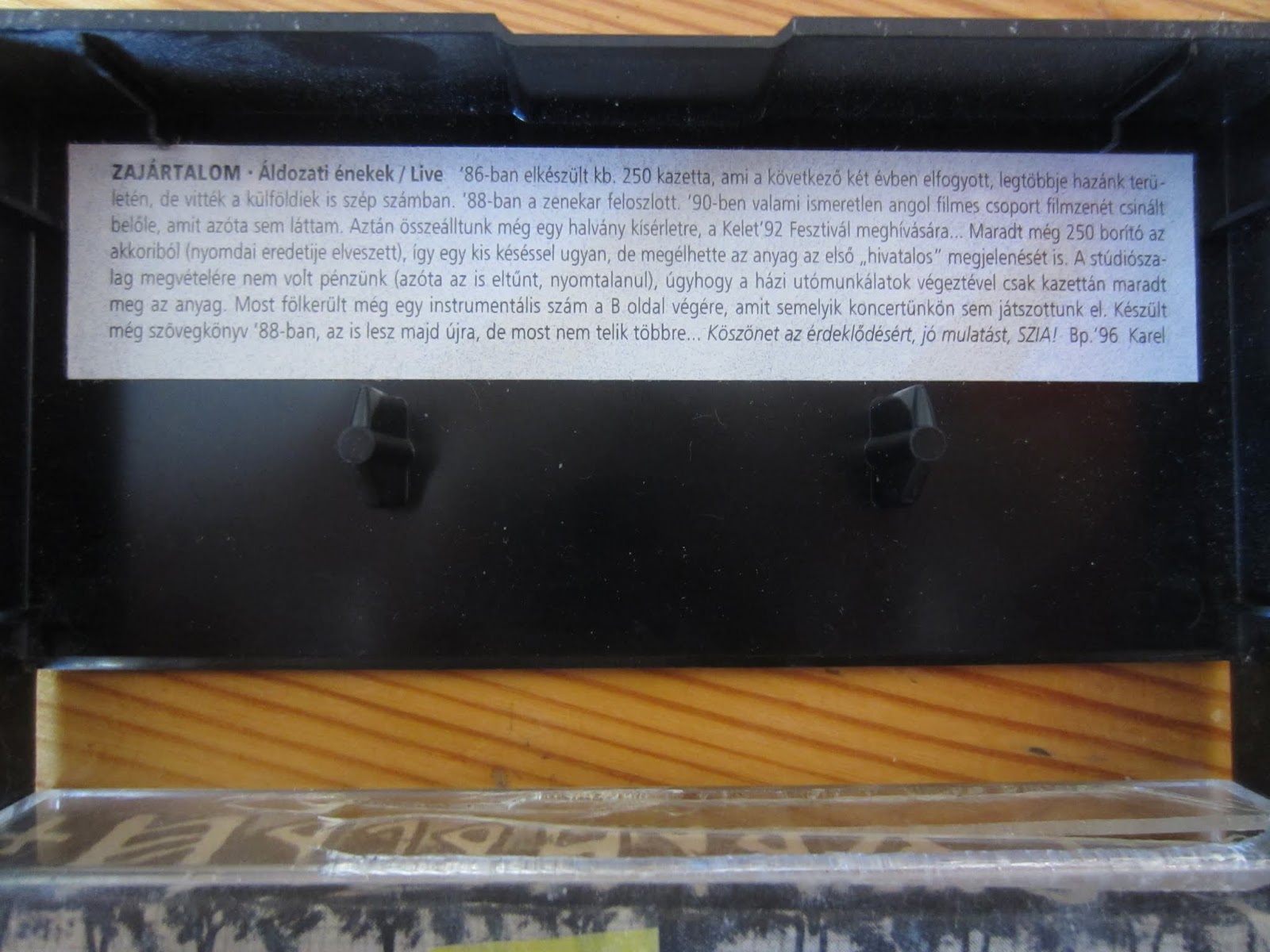
In 1986 about 250 cassettes were made that were distributed in the next two years. Most of them were shared in Hungary, but the foreigners also took the tapes with them in royal amounts. In 1988 the band disbanded. Somewhere in the 90's an unknown English film crew made film music out of the recording that I haven't seen or heard since. Then we reformed for a faint experiment being invited by the '92 East Festival... About 250 of the original cassette sleeves remained (the original print got lost), so with a little delay the first "official" publication survived and got published. We didn't have money to purchase the studio recording tape (it also vanished since then (without a trace), so after finishing this at home (as homework) the material only remained available on cassette. Now on the last bit of the B-Side an instrumental recording has surfaced that we didn't play at any of our concerts. A book with lyrics was made in '88, which will be republished, but as of now it doesn't go any further, thank you for the interest, jó mulatást, SZIA! (Have fun, BYE!), Budapest '96 Karel
Zajártalom means "Noise Pollution" in Hungarian and this little cassette here is an ultra rare music relic from the Budapest underground. And also of industrial music culture behind the communist iron curtain in general. I have uploaded some Hungarian industrial tapes before of bands like Art Deco, BP. Service or musician Kósa Vince. Zajártalom kind of fits a similar realm, mainly in its use of cut-up and collage, but they also move into greyer alternative noise-rock areas similar to the shamanic noise-rock punk of Vágtázo Hallotkémek or the obscure Hungarian industrial project Falatra(x).
The music is pure experimentalism with improvisation where noise and collage find each other with an added protagonistic role for dark existential poetry through lyrics. I wish I would be able to tell more about what the the lyrics say. Also the text that is recited at a certain point by a child is some of the darkest existential stuff I have heard. These are all musical examples of real subversive and deep artistic statements in need of freedom in a totalitarian country in which grey society bleakness and state censorship were shaping daily life. To get an idea of this feeling and to understand the Hungarian music underground within this bleak communist realm I recommend you to watch the 2012 documentary East Punk Memores which is uploaded online. It gives a nice view on the mentality and life back then.
This Zajártalom cassette is such a special document of that time and it's not often I stumble upon these things even when I know quite some of the underground figures of that time in Hungary. Ofcourse there was some Industrial music in the former socialist countries, but in extremely marginal forms. Czech Republic had a movement, Poland, Hungary etc. and ofcourse Yugoslavia that really birthed some iconic bands like Laibach or Borghesia. The political circumstances differed per country and in Yugoslavia there was less cultural censorship for example. Some punk and wave music from the west came out quite regularly on vinyl. Also their cinema was not overdubbed so people could much better understand and learn English and deal with all the marginal information. In Hungary it was much rather fragmented. A handful of people knew about industrial music somehow. Some tried to musically mimic that style, but some were just making noise or some detuned rock music and ended up doing industrial in hindsight.
A few examples of how Industrial music entered Hungary from what I know is the visit of some Hungarian punks to East-Berlin in the 80's. The East-Berlin punks knew about Einstürzende Neubauten, but also had more knowledge already about new wave bands like The Cure and such. Furthermore I know that Antwerp based industrial pioneers Club Moral visited the artist village Szentendre near Budapest at the beginning of the 80's where they also played live. This village birthed the legendary Hungarian art rock group A.E Bizottság for example, that was formed by a group of artists and painters.
Then later on in the first Budapest underground pubs like Fekete Lyuk (Black Hole) there were some alternative concerts. Once there was a concert of Belgian industrial band à;GRUMH, but this was already later than this release, maybe around 1989. The German Neue Deutsche Welle group Der Plan did a legendary compilation with different European bands called Fix Planet! in 1981. The album contained the first release of Esplendor Geometrico's cult song 'Moscu Está Helado' (Spain) for example, but also a track by Vágtázo Hallotkémek. Der Plan visited Budapest back then and met the band according to the sleeve notes. Anyway one never really knows how the information flow worked precisely, but these are just some examples of Industrial and underground music encounters in Hungary during the socialist times. Check out the energy of this cassette, it's pretty interesting. It's all an answer to political repression as well as self-established anti-culture as an antidote to this repression. There is a so called 'album' entitled Áldozati Énekek (Songs of Sacrifice) on the A-Side that I couldn't dissect into different tracks and a Live recording on the B-Side that doesn't sound much more live than the A-Side. A rare relic of subversive experimental music from behind the iron curtain. Marginally released on cassette in 1987, officially marginally re-released in 1996.
Károly Binder is one of Hungary's most prominent jazz pianists. He is known for his rhythmic and unorthodox style of playing as well as for his experiments with the prepared piano. Binder takes the piano as a starting point but also uses many percussion instruments on the side. His first albums In Illo Tempore and Kontinentspiel that came out in the 80's in Hungary are great examples of Eastern European free jazz with lenghty pieces exploring rhythms while taking the listener into a world of its own. That is what usually matters: it's not just the plain exploration of sound. The sound is able to birth the existence of an own world. A bit comparable to the Pierre Courbois album I posted a long time ago.
Oriens & Occidens was recorded in the southern Hungarian cities of Baja and Szekszárd in 1995. On the album Binder works together with the Italian percussionist Federico Sanesi from Milan who was greatly inspired by oriental rhythms and percussion instruments like the Indian tabla and Javanese Gamelan. The result is an interesting musical meeting of cultures and free exploration of jazz, rhythm and non-western percussion instruments.
The music is played quite gently most of the time and tends to create an oriental background atmosphere that doesn't demand an overly focused attention from the listener. At times the music breaks loose from this atmosphere reminding me of certain moments of Embryo's Reise or of the British-Indian jazz album Cosmic Eye. Oriens & Occidens seems to fit this great European jazz tradition where Indian and oriental sounds are being combined with free jazz. Some examples of this tradition are the German project Jazz meets India, the British project Curried Jazz as well as the music of the Reform Art Unit from Austria.
In any case, this is a nice album of mid-90's Hungarian-Italian contemporary jazz meeting the orient.
Carwashtagnacht was a Hungarian industrial metal band from the small city of Békéscaba in the south-east of Hungary formed by Kiss Balázs (guitar), Knyihár Pál (bass guitar) and Sörös Gergö (vocals and programming). They played a Godflesh inspired style in which long-lasting repetitive metal riffs were combined with drum machine patterns with in this case gloomy distorted vocals in Hungarian and English. A band like Godflesh has had a lot of influence in Eastern Europe after the change of the political system in the 90's. Because of the lack of musical extremes in dominant music culture in socialist countries like Hungary before the 90's, many people were inspired by metal and punk bands.
Those type of foreign alternative bands were also some of the first to tour the smaller cities in Eastern Europe. At first many of these unclassifiable alternative experimental metal bands came from Italy for example, but eventually even bands from Latin America came to play. Eastern Europe became a new fertile domain after it had previously been closed for tours of such bands. This development also had its influence on locals that in turn started bands with a similar sound. I think it's also a reason why metal and alternative rock styles are still big in Eastern Europe. But aside from that: the 90's was just an insane decade for the development of any genre really. More than end results and completion, potential ruled the musical output.
In the late 90's Carwashtagnacht published a CD on the legendary Trottel Records in Hungary that together with the label Bahia was responsible for the output of alternative and experimental bands in Hungary. The label revolved around the alter-rock band Trottel that started out in the early 80's as a punk band and later evolved into an ethno-experimental-space-band.
This particular cassette of Carwashtagnacht seems to be some sort of demo tape that was self-released a long time before their official album. The musical style is somewhat different to what usually finds itself to the blog, but it's important to keep extending genres and to shed light on the Hungarian underground of the 90's that is totally overlooked and that I happen to have an access to. The term rare doesn't even qualify anymore for a cassette like this. Specially since the band comes from the countryside and not from the capital Budapest.
More obscure Hungarian tapes will be gradually uploaded to the blog.
Calliope Quartet was a short-lived Hungarian Jazz-Rock and experimental folk outfit that consisted of Molnár Tamás on bass, Pásztohy Bálint on drums, Hűvösvölgyi Péter on guitar and
Bonyár Judit on cello and vocals. They released this one cassette only album on the Hungarian Crossroads Records. A label that tried to merge the genres of folk, jazz and world music with the contemporary sounds of the nineties.
Incognita that was recorded in 1997 is a stunning album balancing somewhere on the crossroads of rock in opposition, jazz-rock and even hinting towards Hungarian folk music at times. Within a Hungarian context they probably come closest to the RIO group Kampec Dolores, known for their combination of avant-rock, folk and improvisation. The tracks on Incognita are quite lengthy and leave lots of room for the listener to enter the musical world of the band. The tracks have nice abstract and sometimes humoristic titles like Aszimmetrikus Fémbuborék (Asymmetrical Metal Bubble) or Jelmezbál Jazzsznoboknak (Costume Ball For Jazz Snobs). The band plays great quality music, but doesn't lose its approach to have fun while playing. Also they don't portray themselves as academic jazz musicians. This is actually a great album from Hungary and already nearly impossible to find after just two decades that have passed. Clearly there is some Zappa influence going on, but it also reminds me of 70's French Zeuhl band ZAO or of Italian jazz-rock group Perigeo from the 70's or of the Ethno-Krautrock sound of Embryo or... should I keep it going?!
Excellent avant-jazz-rock from the East of Europe! Get it HERE
This cassette is a solo effort by Hungarian musician and Industrial music protagonist Kósa Vince. Kósa played in the pioneering Hungarian industrial group Art Deco (posted a long time ago on the blog) as well as in the industrial group BP. Service. On this cassette he plays the music to the play A Görög (The Greek) written by English actor and playwright Steven Berkoff that was premiered in 1980 in London and performed in the Radnóti Theatre in Budapest in 1994. The Greek was a modern interpretation of the well-known ancient tragedy Oedipus Rex by Sophocles. The tragedy that also inspired Freud in his work to develop his concept of the Oedipus complex.
The music on the tape consists of two long pieces. The first side starts with rhythm based industrial in combination with collaged music taken from classical music. Later the music transitions into a subaquatic dark ambient soundscape. The B-side is a slightly more interesting affair, where Kósa fully embraces a synthetic tribal ambient sound even ending up in some 90's beats. Nevertheless it still holds on to darker atmospheres.
A Görög reminds me of the 1983 piece Neveleiland by Dutch home-tapers De Fabriek. Furthermore, the music is really in similar realms as the Hungarian avant-garde album Private Exits by composer Tibor Szemző or Hungarian composer László Hortobágyi and his electro-acoustic music built on Indian cosmologies.
A rare cassette, often mistaken for a screenplay or spoken word. Great music and soundscapes from the early nineties and another piece of the Hungarian experimental music puzzle. Lots of Hungarian cassettes still to come to the blog!
This is the first in a series of Hungarian cassettes that I will slowly upload to the blog:
BP. Service was one of Hungary's important industrial music groups. Industrial music in Hungary did exist behind the iron curtain in the 80's but in very marginal forms. Some of the bands I can come up with are Art Deco (posted ages ago on the blog), CMC and Falatra(x). Basically it was not until the early nineties that industrial groups could publish their music regularly in Hungary and that also more groups started to exist.
BP. Service consisted of Szabó György, Kósa Vince and Orbán Balázs. Szabo György is subsequently known for his graphic design and creating many of the posters for underground concerts in Budapest before the fall of the iron curtain. Lately those posters have received renewed attention and have been compiled in a book. Kósa Vince was also the founder of the group Art Deco and can be considered as one of the pioneers of Industrial music in Hungary.
This cassette that came out in 1990 contains two lengthy tracks of classic industrial sounds. It conceptually takes on the big city or metropole (in this case Budapest) as a place of noise where traffic, construction, dirt, automation and industry are part of the daily urban environment. A concept that can be seen often in this particular vein of industrial music, tracing back most notably to Berlin's finest Einstürzende Neubauten, but ofcourse there are numerous examples. The music contains bleak Hungarian lyrics, sound-manipulations and the use of metal and other physical materials that are being used rhythmically.
I finally was able to track down the last of four cassettes by Hungarian band áPolóK (The Nurses) somewhere. The other three tapes I posted before on the blog. áPolóK is one of Hungary's finest groups to rule the Hungarian underground that manifested itself during the mid-eighties until the alternative boom of the nineties after the fall of the iron curtain.
Their absurdist music displays intricate musical structures, Hungarian folklore, zappa-esque manoeuvres and alternative rock. They are comparible to the Hungarian group Tudósok. Also later bands from Eastern Europe share some of this musical absurdity like the Slovenian band Pinja Dzazna (can anyone please find those albums for me? They seem to have disappeared.)
The title of this album is Szarvasgyár meaning Deer Factory as well as Shit Iron Factory. The title makes a lot of sense since the band came from the city of Miskolc which is Hungary's main city for heavy industry. This album is probably one of their craziest, but also the one that stands closest to Hungarian folk music.
áPolóK belong to Hungary's finest experimental underground music groups. Make sure to check out their crazy video's online to get an idea of who they were. Today they still exist through other obscure bands in Hungary.
Time for another cassette by Hungarian cultband áPolóK (trans. The Nurses) after two of their other releases I posted on the blog before. áPolóK comes from the Hungarian city of Miskolc and started out in 1982. They are ranked among Hungary's finest weirdo avant-garde groups. They can be placed among other Hungarian underground bands from the eighties and nineties like A.E. Bizottság (Albert Einstein Committee), Kampec Dolores, Tudósok, Vágtázo Hallottkémek and many others.
Their humoristic hyper-intelligent lyrics combine the insanity of the Hungarian culture with great poetic depth and absurdity. áPolóK is a quite unique band in Hungary mashing up a Rock In Opposition sound that contains unorthodox transitions in zappaesque ways with a great punk attitude and alternative rock manoeuvres. It's a band that is very underrated and deserves a lot more attention.
Egyedül A Világon (alone in the world) was áPolóK's first album that was also published abroad as a CD in England which was translated to The One And Only In The World (get that one here!). The cassette was self-released on their own Artalom label (it's a word merging the words Art and Content with each other.) I think this album is one of the stronger releases and shows a more developed sound of the band. The musical quality is keeping the right pace with the showcased absurdity. Some of the members of áPolóK are still playing in bands in Hungary like the absurd punk group Büdösök. Again check out their other releases in the archive of this blog.
Highly Recommended!
Get it - in all its original cassette glory - HERE
After this very early material of áPolók (The Nurses) I posted about a year ago, here is a later release by these Hungarian musical cultfreaks from the city of Miskolc. The title of the cassette refers with the word 'Kondás' to an old Hungarian swineherd. So the title basically means "Pigmansdisco", which is very very Hungarian.
áPolók are not to be caught in some type of musical genre, they exceed the borders of music types so much that sometimes you have no clue how to pinpoint them. The music ranges, depending on the release, from punk to RIO to Techno. Kondásdiszkó is basically áPolók's satirical take on the new digital era when the first computer programs to make music became available for the masses. It's a totally absurd collage of video game music moving into proggy soundtrack quirkiness through bad equipment genius reminiscent of Japanese nineties dada 8-bit fuckery acts of Boredoms-minded weirdness.
One of the songs is called Török Ádám who is the frontman and flutist of one of Hungary's well known jazz and fusion bands Mini from the seventies. They named the song after him because their track happened to get into similar sounding realms. There is always a lot of intricate mockery within the Hungarian (music) culture present in the music of áPolók.
This is a very psychotic, yet amazing recording that ultimately makes your head explode. Moreover it's excellent music to accompany you during this summer. Get this next piece of the áPolók puzzle and great cassette from Hungary's underground now! Oh yeah, and the cassette inlay tells us not to put this tape into a CD-player or computer.
Unfortunately I don't find the time to upload nice rarities or other weird releases and also write about them next to this blog. Therefore I will just start to upload that stuff to my Youtube Channel. This way I can uncover a lot more weird stuff while maybe write a line or two about it in the description box. If you need the file, just write me a message.
So if you haven't subscribed yet you can do it here.
Batu Kármen is the moniker and band from the early nineties of Hungarian painter, writer, musician and director feLugossy László. He is a notable underground figure in Hungary and was the leadsinger of one of Hungary's best avant-garde groups called A.E. Bizottság (Albert Einstein Committee). They made two albums and toured Europe in the eighties. Make sure you find those recordings somewhere. Here you can see them in an old clip of the underground-movie Jégkrémbalett (Ice Cream Ballet) from 1984 in which they took part and did the soundtrack.
feLugossy is known for being part of a vibrant artist scene of Budapest and the nearby artist-town of Szentendre of the eighties. This recording of Batu Kármen is a nice insight into Hungary in the early nineties when many things became possible to do in the alternative scene due to the change of the political system. New bars and underground places were opened and festivals were being created which helped artists and musicians develop themselves in the new times.
The lyrics are quite absurd while keeping a very intelligent essence. The music is quite a bit Captain Beefheart-like in a post-punk context with maybe some strange eastern european "indie"-influences. Actually a great album. Some songs were uploaded to youtube before, but here's the whole thing.
As promised in the first post of Hungarian electronic music, here's the second one that came out in Hungary compiling some of the electronic music composers that were active in the seventies and eighties. I have to say that this one is probably the key record for Hungarian electronic composed music and in my opinion even more incredible than the other one.
Five Hungarian composers are present here: Iván Székely, Miklós Csemiczky, Máté Victor, Lászlo Király and István Szigeti. Some of these composers have published some solo records in Hungary which are really worth it to check out. The music ranges from electro-acoustic pieces to really intense electronic pulsating sounds intwertwined with singing of Hungarian vowels. It never bores and is really versatile while still creating the feeling that it's a whole, which is an amazing effort done for a compilation.
The first piece For Alrun by Iván Székely was recorded live in 1975 during an electronic music showcase in Bayreuth. The record starts and ends with two Hungarian folk songs to complete the musical journey:
Népdal: Gyere ki te gyöngyvirág
Mert feljött a holdvilág, jaj
Majd kimegyek hajnalba Magos fejű kalapba, jaj
Folk Song:
Come out, you lily,
For the moon has risen, jaj
I'll go out at dawn In a high-topped hat, jaj
Weöres Sándor: Lied:
Várlak a déli sugárban,
várlak az éji sötétben,
várlak a télben, a nyárban
várlak a földön, az égen
Lied by Sándor Weöres:
I await you in the noon sun,
I await you in the dark night,
I await you in winter, in summer
I await you on earth, in the sky
This is one of Hungary's greatest compilations of electronic avant-garde music together with this one which I will post later if it's not around somewhere. There are five Hungarian composers of electronic music present here: Zoltán Pongracz, Péter Eötvös, Iván Patachich and a combined piece by Máté Victor and Péter Winkler. A great piece on here is "Mese", meaning fairy tale, in which the sentence Egyszer volt, hol nem volt, meaning Once upon a time - the classic opening line of a fairy tale - is being processed looped and cut-up.
As you can guess electronic music from behind the iron curtain is quite an obscure thing. Nevertheless, many composers from the countries of the ex-eastern bloc had the possibility to travel to the west so they could study with people like Karlheinz Stockhausen or others. Usually these things were considered legitimate in the name of science, academy or high art. Also almost every big city in Eastern Europe had an experimental radio or television station studio in which they experimented with sound. From Warsaw to Bratislava to Beograd they all had their own kind of Radiophonic Workshop. Loads of cool Hungarian modern composed avant-garde stuff here.
This record has been uploaded to youtube, but has less than a hundred views and my copy happened to be in slightly better condition. This blog may lose a bit of its orthodoxy just to be able to keep on going with new material. Sometimes it might be available somewhere, but as a worse rip or practically not to be found. I will post some of these recordings by doing my own rips and I will shed my own light on those releases.