Merry Christmas to all friends and followers of the blog!
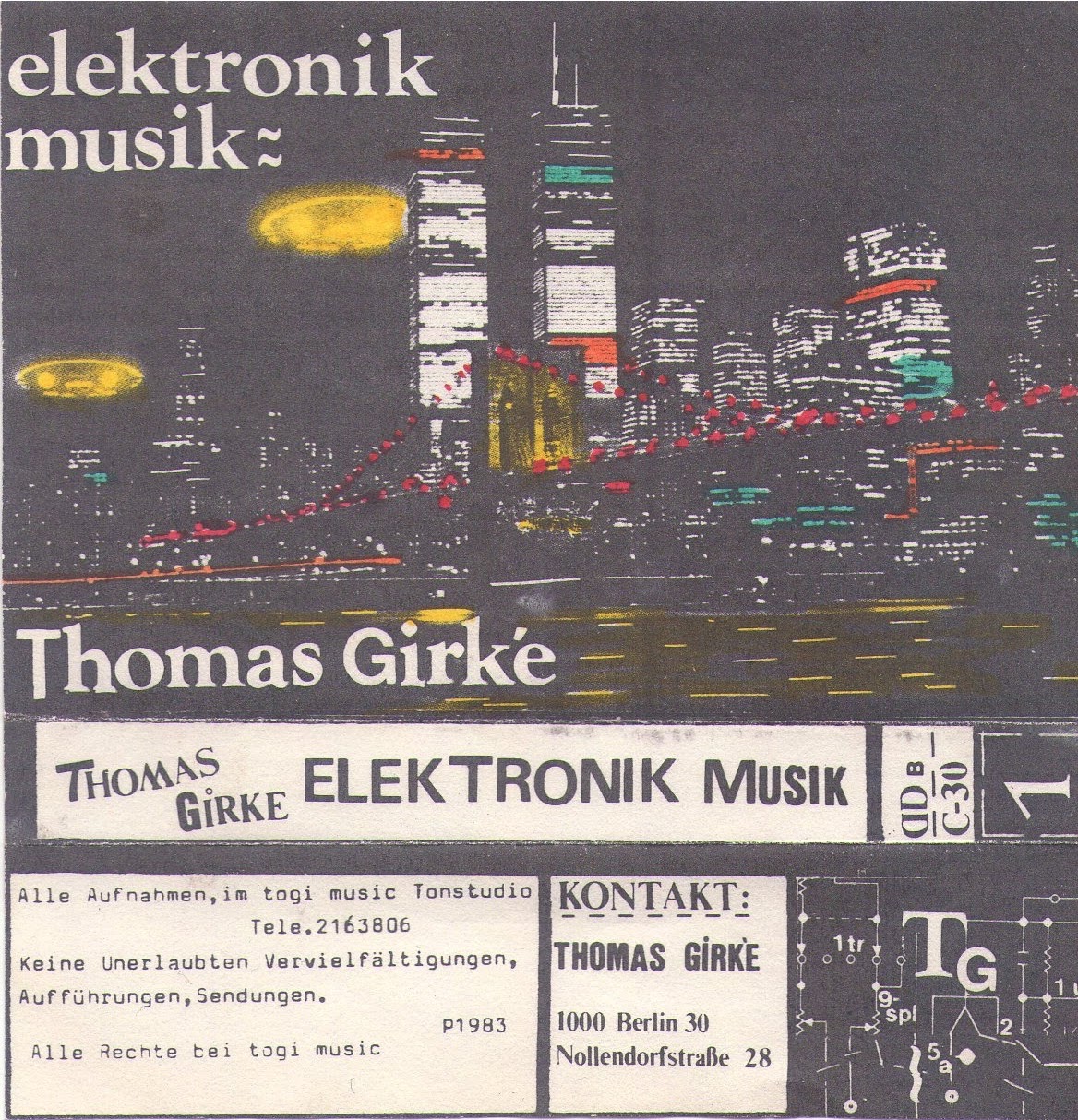
Is that an image of the Brooklyn Bridge with the Twin Towers in New York? Can't really figure out the angle of the photo though. Ofcourse those towers were already there decades before they got used to scam us into the new millennium. But whether this image is a correct depiction of the skyline is quite unclear. Actually it doesn't really matter. All we care for is that those UFO's high up there in the sky were real! The rest is basically constructed around them. Skyscrapers, UFO's, modern metropoles: some key signs of the future in one depiction. Needless to say that within such a vision Thomas Girke from West-Berlin created a wonderful and futuristic soundtrack.
Elektronik Musik is a piece of Berlin School analog electronics on the synth-pop and minimal synth side of the spectrum. Analog arpeggiators, keyboard melodies, electronic syncopations and drum computer rhythms take us on a neon-light disco journey across the elektronik sky by way of China Town into synthetic dreams in time and space.
Quick get on board of the UFO! I heard those aliens have a space dancefloor and they are spinning some Italo disco records. Might have heard some Patrick Cowley and Stratis up there in the sky. Is that Magic Fly by Space now?! Abandon earth!
So I've posted something before that was on the mysterious Slang Tapes label, a US cassette label that was dedicated to strange humorous free-jazz and improvisation. That live improvisation cassette fell a little flat amidst all the home-taping music on this blog, but it was strange enough to share. I actually try to redefine that eternal crescendo of music posts of which one thing should be constantly better than the previous. In all actuality all of this musical output knows its own historical context, in its own place and time. There are different musical styles or approaches but a lot of it shares an underground ontology or a deviancy to whatever the dominant culture has been pushing. That's why it remains important that different types of music are represented on the blog.
In any case, the previously shared Slang Tape release is very different from this one. That cassette came from Allentown, Pennsylvania, so I assumed that the label was based around that area as well. However there is no real confirmation. Also I don't know which musicians were actually part of the Songs From Ward 6 project.
Songs From Ward 6 is a stunning piece of American avant-garde music. It sort of balances on the minimal music tradition within modern composed music, jazz or other more trained musicianship traditions, but at the same time it's far out in its experimentation while displaying absurdistic lyrics and vocals. It also presents amazing crystal-like cosmic ambient synthesizer manoeuvres with a deep sound, creating different hypnotizing grooves. It eventually even ventures into some self-explored ethnic sounds. Not too far fetched from some of the more unclassifiable acts that were included on the NWW list.
I'm pretty sure that this was made in the early years of the 80's, but it clearly has some ground in the weird 60's or 70's music traditions too. From Silver Apples to Cromagnon and from Care of The Cow to the Los Angeles Free Music Society, the music by Songs From Ward 6 once again emphasizes the endless eclectic creativity and inventiveness of musical output that existed within the fringes of American underground music culture during the second half of the 20th century.
A great piece of lost music! Also any additional information on this would be highly appreciated!
Since this is the third time that I write about Liza N. Eliaz on this blog I will re-use some of the older texts:
Liza Néliaz (1958 - 2001) was an electronic dance music producer and hardcore techno (terror) DJ originally from Oostende, Belgium. During the late 70's Néliaz started out as musician part of different Belgian avant-garde and new-wave bands. Inthe
80's Neliaz become more involved with the international home-taping
network and contributed her tracks to cornerstone compilations on
pivotal cassette labels like Insane Music (Belgium) and Exart (Netherlands).
By the late 80's, Neliaz started to play a self-invented style of proto-dance music
that somehow connected the DIY spirit of 80's home-taping with new beat
and the upcoming rave culture that would later evolve into established
genres like techno, hardcore and acid house. She was a pioneer (one out
of many ofcourse) in exploring these new musical styles in which perhaps
the most important element was musical continuity. From the 90's onward Liza 'N' Eliaz established herself as an
important hardcore techno DJ in the free party spheres which granted her the underground title of Queen of Terror. The name Liza
was adopted because in those days it used to be a nickname given to
Trans people in Flanders. She used her abilities as a musician for her DJ-sets that were uncompromising, lethal and full of energy. Neliaz lived a nomadic lifestyle dedicated to music until the end of her life. She sadly passed away in 2001.
The cassette that has surfaced here is an odd one. It was dubbed on a blank tape and specially given to Hessel Veldman and his family by Liza during the late 80's when she resided in Holland. First of all it contains the instrumental versions of the first Sensecruise release (not sure if there are any non-instrumental versions since I don't own the "official" Sensecruise part 1 cassette, so can't verify - let me know!). The interesting part is that the cassette continues with some loose tracks that I can partially recognize by checking out other releases, but there are also some tracks that are unknown to me.
Still the fact remains that this is a remarkable set of songs from that late 80's Neliaz sound palette. Quite a treasure, because we repeatedly have no idea whether more music by Liza might be out there. You never know what survived on cassettes of her friends or whether some music was given to befriended DJ's from the time. Her later DJ mixes are still alive on many platforms on the web and seem to inspire many people today and beyond.
According to the review on the cover of this cassette The Unwillings were a duo comprised of the German born Steve and Pete who were working at Audi-Motors in the German town of Ingolstadt. Whether any of that is true remains unknown, however it really doesn't matter.
The Unwillings were a Velvet Underground influenced band that released only one cassette on the Servil label that was created by bedroom-pop and home-taping pioneers Fit + Limo from Altdorf, Bavaria. Their rhythm box driven neo-psychedelic fuzzy garage tunes are in line with other bands from the time like 39 Clocks (Also from Germany, later incarnated into The Phantom Payn), The Rest (from Naples, Italy), Hi-Fi (from Amsterdam, Holland) or any other brown sugar dripping, sunglasses after dark, vintage fuzz pedal to the metal, slowly burning cigarettes, shiny boots of leather bands. These guys must have had records by Spacemen 3 and The Monks at home too.
The Unwillings also play a cover of Amon Düül II's Archangel's Thunderbirdwhich underlines their neo-psychedelic spirit. Actually, before Krautrock propelled the world into cosmic realms with musical innovation that we could have never imagined, many groups from Germany from the mid- and late 60's already heralded that near future to come. A series like the Prae-Kraut-Pandaemonium provides a great overview of that realm for those who are interested. With the neo-psychedelic revival of the 80's everything kind of went full circle.
Anyhow, as for now, here are The Unwillings for everyone who remains unwilling!
Merry Christmas and an Archaic New Year to all Friends and Followers of the blog!
So here it goes, the last post of this year:
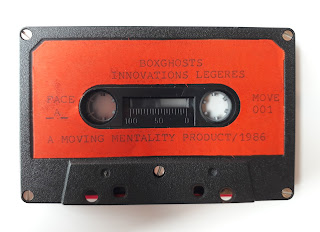
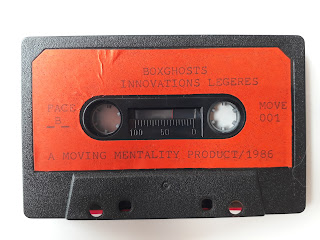
Boxghosts is a project I don't know much about. It seems to have been a one person home-taping project that was created in the Dutch town of Venlo in the southern province of Limburg. During the 80's Venlo was home to a small but lively squatting scene around the recording studio and music venue Bauplatz which was also connected to the town's most important punk and home-taping cassette label called Limbabwe. During those years many different national and international underground bands played the Bauplatz venue like Einstürzende Neubauten, De Brassers and The Ex.
The Boxghosts project however, doesn't seem to have had a notable relation with Bauplatz or Limbabwe Records other than that it was just a home-taping project from the same town. The only trace I could find about Boxghosts is a track that was included on the Seventh Dimension Quasette compilation series that were issued by Zimbo Tapes, a Dutch home-taping label that was about home-made electronic music and (casio) keyboard experiments.
Boxghosts' Innovations Legères (Light Innovations) was packaged in a nice grey carton box with a religious touch to its visual presentation (the south of the Netherlands is known for its catholic history). It has some dark and minimalistic music that consists of short atmospheric electronic pieces played on synthesizers and keyboards. It might hint a bit towards the otherworldly electronic music of Enno Velthuys, just less polished. Boxghosts should definitely be another little highlight of the Dutch cassette culture of the 80's.
Here we have another obscurity from the vast Dutch home-taping realm of the 80's. It Is Not A... is a totally unknown project that doesn't give any information other than that it was played by AF + Adulaar. The dark cover artwork that is hidden inside the uniformic beige cassette case only adds to the mysterious nature of this release. There is no year of publication given, nor any indication given about the place where this was made and there's no tracklist.
The minimalist nature of the artwork is also reflected in the music of It Is Not A... Basically the tracks revolve around the drum sounds of the Roland TR-606 in combination with simple basslines that are accompanied by analog synthesizers, voice and tape collage. Another example of a minimal synth bedroom production that stresses simplicity as a protagonist artistic means. It also reflects the cold signature sound approach of the 80's. A total mystery from the Drumatix shadow world...
We advice to play this cassette with loudness, it will give an uncomfortable but paradisiac nerve-shaking ambience to the sound.
Liza Néliaz (1958 - 2001) was an electronic dance music producer and hardcore techno DJ from Oostende, Belgium. During the late 70's Néliaz was part of different Belgian avant-garde and new-wave bands. Inthe 80's Neliaz was strongly involved with the international home-taping network and contributed her tracks to cornerstone compilations on pivotal cassette labels like Insane Music (Belgium) and Exart (Netherlands).
By the late 80's, Neliaz started to play a self-invented style of proto-dance music that somehow connected the DIY spirit of 80's home-taping with new beat and the upcoming rave culture that would later evolve into established genres like techno, hardcore and acid house. She was a pioneer (one out of many ofcourse) in exploring these new musical styles in which perhaps the most important element was musical continuity. No breaks were taken in-between the tracks. Through her inventive hardware set-up she was able to play a variety of different tracks that were weaving in and out of each other continuously resulting in what we would call a "live-set" today. From the 90's onward Liza 'N' Eliaz established herself as an important hardcore techno DJ which granted her the underground title of Queen of Terror. The name Liza was adopted because in those days it used to be a nickname given to Trans people in Flanders. She used her abilities as a musician for her DJ-sets that were uncompromising, lethal and full of energy. Neliaz lived a nomadic lifestyle dedicated to music until the end of her life. She sadly passed away in 2001.
Sensecruise Part 2 is an early cassette by Liza Neliaz that was released around 1989 or 1990. It's the sequel to the Sensecruise Part 1 cassette which I've never heard. Unfortunately there is no cover for this tape, but who knows whether this was properly distributed at the time in the first place. Musicwise it embodies the sound of the transition of decades and the birth of a new sound of the 90's. Sensecruise Part 2 contains a pretty spot on home-made rave sound. I filed this release under "Belgium", but it clearly could have been recorded in France or England at the time. The music resembles the early work of 808 State or Orbital here and there, big acts (as we all know) that would soon succesfully spread similar sounds on a worldwide scale. However Liza Néliaz was never interested in the commercial aspects of dance music and couldn't identify with the course the culture took when free parties were starting to decline and certain DJ's were gaining so called star levels bringing competition and jealousy into a free music culture. Her DJ sets could sound relentless at times, yet humor, interaction and joy through the music were the main reasons behind Liza's musical practices.
Maybe it's the first time some kind of dance music comes to the blog, but also that is part of the underground music kaleidoscope of the past decades. Another piece of the Liza Neliaz puzzle at least. A special musician that deserves some proper attention from labels out there. Maybe someone has more early recordings?
Here's another article in French about Liza Néliaz that also provided some of the information above.
Kindly donated by Hessel Veldman (Y Create Archive)
Here's another highly obscure cassette release from the American underground. Out of a mixture of lagging electronics, dark vocals, minimal synth experimentation and flashy guitarwork arises the world of Eulipian. By the end of the cassette we learn that the name Eulipian was taken from a Rahsaan Roland Kirk suite called Theme For The Eulipions. In any case, the music of Eulipian definitely belongs to that American underground feeling of the 80's where the nightlife soundtrack consists of a cocktail of no-wave, disco, punk, Detroit techno, industrial experimentation,funk etc.
Somewhere in that underground we meet Eulipian who slowly turns us into Eulipians with an intimate and hypnotic mix of tracks that comprises of fatalistic underground punky-junkie beatnik mumbling over dark and sleazy synthesized dream-realms with lots of weird electronics, experiments and collaged sounds. It all grows into each other and the entire cassette can be seen as one long trip. The Eulipian one man project kind of resembles Foetus, but is musically closer to an American home-taper like John Lafia.
I have no idea whether the title of this is Heetseeker or Leisure Fear, but let's use them both. I also don't know who was behind the Eulipian moniker or to which part of America this belongs. I left the one-sided cassette unindexed as I felt that the continuity of the music was intentional.
It would be nice to know if more Eulipian music exists. Mysterious, strange and atmospheric. Probably also the good stuff when listening under the influence.
We continue our April fool's journey with another rarity from a far away galaxy of the Neue Deutsche Welle universe. If I'm correct Markenzeichen XY was the first solo release by Uwe Linke from the city of Marburg. He was a delegate of some of Germany's craziest and wacked out Kassettentäter groups of the 80's which he formed with his partner in crime Exo Neutrino called Die Gefährliche Klons (Dangerous Clones) or Different Klons or FunTastiClones or MicroClones etc. I posted their very first cassette some time ago.
Inspired by The Residents and the legendary Hamburg based NDW band Der Plan they started to create their different musical groups of Clone incarnations as well as recording many solo projects. They founded their own cassette label called BestesBänder or
Wir Wollen Nur Dein Bestes Bänder (We only want your best tapes). The music was heavily inspired by non-musicianship, the usage of found objects, toys and primitive electronic instruments and synthesizers. The mysterious Clones (or maybe just Exo Neutrino alone) also published a record during the 80's called Unpop under the moniker Lustige Mutanten. It was a 7 inch single inside of a regular LP sleeve containing lots of different demented little tracks. It's still a great album in my opinion, at least it had a big influence on me when I found it as a teenager.
Markenzeichen XY's Da Kommt Die Braut (There Comes The Bride) also displays a collection of short tracks in the typical absurdist clones style. It's a wonderful short tape with the information nicely written all over the cassette box. Maybe there was some inlay or side publication to it displaying the track titles, but I don't have it, so all tracks are untitled for now.
In any case this is a great NDW tape again that was released in the scarce quantity of 111 copies.
Dust And The Minds were a free form-rock and improvisation home-taping outfit from the small village of Egmond aan den Hoef in The Netherlands. The main members were the brothers Fred and John Valkering, but they were always accompanied by lots of other musicians. The Valkering brothers established their cassette label Egmondse Klank Opsessie to release their different musical disguises like Dust And The Minds, Comrades Creating, Hafre as well as solo works. The music on the E.K.O. label consists mostly of punk, free improvisation, dub and post-punk.
Obsessioneel En Non-Stop is an album by Dust And The Minds that consists of two side-long pieces of improvisational jams. It's quite special that this small community of people from a village in Holland had such an extensive output of releases. I've got more material of this label coming to the blog and most of the releases are real pieces of DIY-art containing posters, self-created boxes, cut-ups, drawings and even books. I find it curious how so much great music was released on E.K.O. yet I never really heard this label being mentioned by people when it comes to the Dutch home-taping underground
Enjoy this first lo-fi tape of home-made jams by Dust And The Minds, their other releases are upcoming and there's already a lot to be found on No Longer Forgotten Music, but I don't know if the links are still working after all those years.
Liza Néliaz (1958 - 2001) was a Belgian electronic dance music producer and hardcore techno DJ from Ostend. Coming from a musical family s/he started out making music in the early 80's as part of different Belgian new-wave groups with which s/he also toured around often. During this decade Neliaz was involved with the home-taping circuit making lots of music ranging from industrial to experimental proto-dance styles. S/he also contributed tracks to international cassette compilations. An example is the compilation Music From The White House: France that came out on the great Exart label that was ran by Dutch home-taper Hessel Veldman (he and his wife Nicole also established a close friendship with Liza later).
During her lifetime Liza Neliaz lived everywhere and nowhere and had a nomadic approach to a life that was fully dedicated to music. For years s/he lived in France, but s/he also resided in London as well as spending many years in Holland. By the end of the 80's and the early 90's Neliaz was one of the key people who immaculately envisioned the connection between the electronic wave sound of the 80's and the newly risen dance music genres and rave culture. Her home-made dance music work can be seen as an evolutionary missing link of the techno and house revolution. Neliaz used a live set-up of hardware that could play entire live sets producing many different sounding tracks that would follow each other up in a sequence without leaving breaks in-between. S/he took the skills s/he developed as a home-taper and developed it into this trance inducing live-set formula that would later become prevalent in dance music. Some of that amazing early dance music will come to the blog later on this year.
During the 90's Neliaz would give up live music to become an important hardcore techno and gabber DJ, producer and a household name of the underground rave culture. S/he passed away too early in 2001. Until this day Liza Neliaz is still praised for her work and her DJ mixes and is refered to as an inspiration in hardcore techno circles.
On this short self-released tape we can hear a sound that still leans more towards the 80's, but is already rather dancefloor oriented with funk influences. One of the tracks is dedicated to the Slovenian industrial group Laibach. On this tape we can already hear how tracks merge into each other: it's that (live-set) approach that makes this so ahead of its time.
About a year ago a couple of hundred of tapes from an old collection came into my hands. Most of them were self-recorded copies of existing albums, mostly vinyl, that someone had been copying throughout the 80's. The majority of the music on these cassettes did consist of weird new wave, experimental and industrial music. I started to devide the tapes into different sections, the exact recorded copies of albums I put away in one box and the unknown cassettes without any written information on them I stored away in another box to examine. I also threw away dozens of tapes that were poor in quality and had nothing to do with underground music in general. Even now I still have some bags left with the unknown cassettes. I still have to listen to them and figure out what is on there.
In-between all of this stuff there was a self-made series that consisted of overdubs of rare NDW cassettes all with typewriter style titles and tracklisting. Because of that information I could luckily connect this one here to its original: a release I had been looking for over at least a decade. Thus, the digitization of this is somewhat less sharp sounding because I had to use a copy as source. Nevertheless we should be very happy that someone copied this rarity in 1981 for us to hear today! It doesn't seem likely this will surface any time soon in any sound quality (also with regard to the collectors who do seem to have this).
The Westhafen Plassette (Platte und Kassette) is a true relic and highly important item of the West-Berlin underground music scene of the early 80's. Released in a scarse edition of only 200 copies this three-way split release, that consisted of a 7 inch vinyl and a cassette, compiled three underground groups hailing from Berlin: Bodenpersonal, Tumorbeus (Read: Tumorboys), and Siedlerheim. It came out on the obscure cult label Kompakt Produkte from Berlin. The music consists of some of the purest experimental minimal synth and DIY new-wave music in the tradition of the grey and wall-divided Berlin music underground of the time:
Bodenpersonal with their Zufallsprodukt Eines Langweiligen Wochenendes (Chance product of a boring weekend) was recorded in a factory in Berlin in 1980 and consists of great minimal synth and DIY-music improvisation.
Tumorbeus create such abstract synthesizer driven atmospheres that the
music almost becomes techno-like, mindblowingly ahead of its time to say
the least. I really wonder whether they did more music in those days.
They also remind me a bit of the Studio 12 bands from Haarlem, The Netherlands from the early 80's with bands like Nexda and Cargo Cultus.
Siedlerheim seems to be the more traditional NDW group, but also ventures into electronic experimentation. They have more structured tracks with vocals and even incorporate the occassional saxophone burst. Maybe their sound is actually the most representative West-Berliner sound of the time. An energy that was also captured strongly in the Berlin Super 80 film, that gathered underground music and performance video's recorded on Super 8 Film by different artists from Berlin during the 80's (I will add that video below. Update: the video has been removed). Both Bodenpersonal and Siedlerheim have been re-released more than a
decade ago by the great WSDP label specialized in rare NDW cassettes.
Some of the tracks that are on the Westhafen Plassette were also compiled by WSDP, just not
everything. The Westhafen Plassette is partially a musical time-document but it also displayed its avant-garde vision of futuristic musical possibilities beyond the political barriers of the bleak urban landscape and society of Berlin at that time. It stands closely next to many other important underground bands from Berlin of the time like Kompakt Produkte peerband Thorax Wach, Notorische Reflexe, Die Tödliche Doris, Sentimentale Jugend, Malaria!, Einstürzende Neubauten, An Die Schwarze Kunst, Sprung Aus Den Wolken and many more. Both in instrumentation and energy very strong. Those analog machines in combination with this urgency to experiment really resulted in some of the greatest music in general it seems.
It's nice to post this on the blog since 2019 marks the 30th anniversary of the fall of the Berlin Wall. If you would like to dig deeper into the theme of the underground music history of Berlin I really recommend the book Berlin Calling, A story of Anarchy, Music, the Wall and the Birth of the New Berlin by Paul Hockenos (2017).
A long story this time, anyway... could have saved this one for Christmas, but I have so much more to share on the blog... Enjoy! Sturm und Turm!
So I had this tape laying around for decades at home, but never properly gave it a listen until recently. I thought the music was typical Turkish folklore music, produced as some sort of souvenir, but it actually turned out to be one of the nicest psychedelic Turkish tapes I have yet heard.
Turkish folklore music is usually acoustic and obviously covering traditionals, often also quite hard to distinguish from each other. This tape too is a lengthy mix-up of all kind of similar traditional Turkish songs and melodies, but the key lies in the fact that the whole thing is electrified with the electro-saz (electric bağlama) as well as with keyboards that were manufactured in the 80's. The music is easily to be put in line with the sounds of older Turkish and Anatolian psychedelic music like Selda, Erkin Koray or Edip Akbayram in which the use of electric instruments took over from the acoustic predecessors. A bit like what Miles Davis did in Jazz at a certain moment.
The music on Burcu Burcu Türkiye'm could very well be the summer soundtrack of you moving forward in an ever-lasting trans-orient-express while its engine driver and yourself are spacing out on a fair amount of hashish and opium discussing Rumi's poetry. You're flying through the Turkish countryside after a magical woman has just red your future in the coffee ground while you're solving the mysteries of the Nazar. It could be this.
But aside from that, the music is also creating a similar atmosphere as contemporary artists like the Syrian musician Omar Souleyman or the Sahrawi psych-force Group Doueh from the Western Sahara. Obviously these are different geographical regions, but they are somewhat musically connected in their use of the endless repetitive psychedelic oriental sounds inducing their trance.
The tape is unindexed which seemed a better choice. Specially the B-Side is a psychedelic treat! Enjoy the trip!