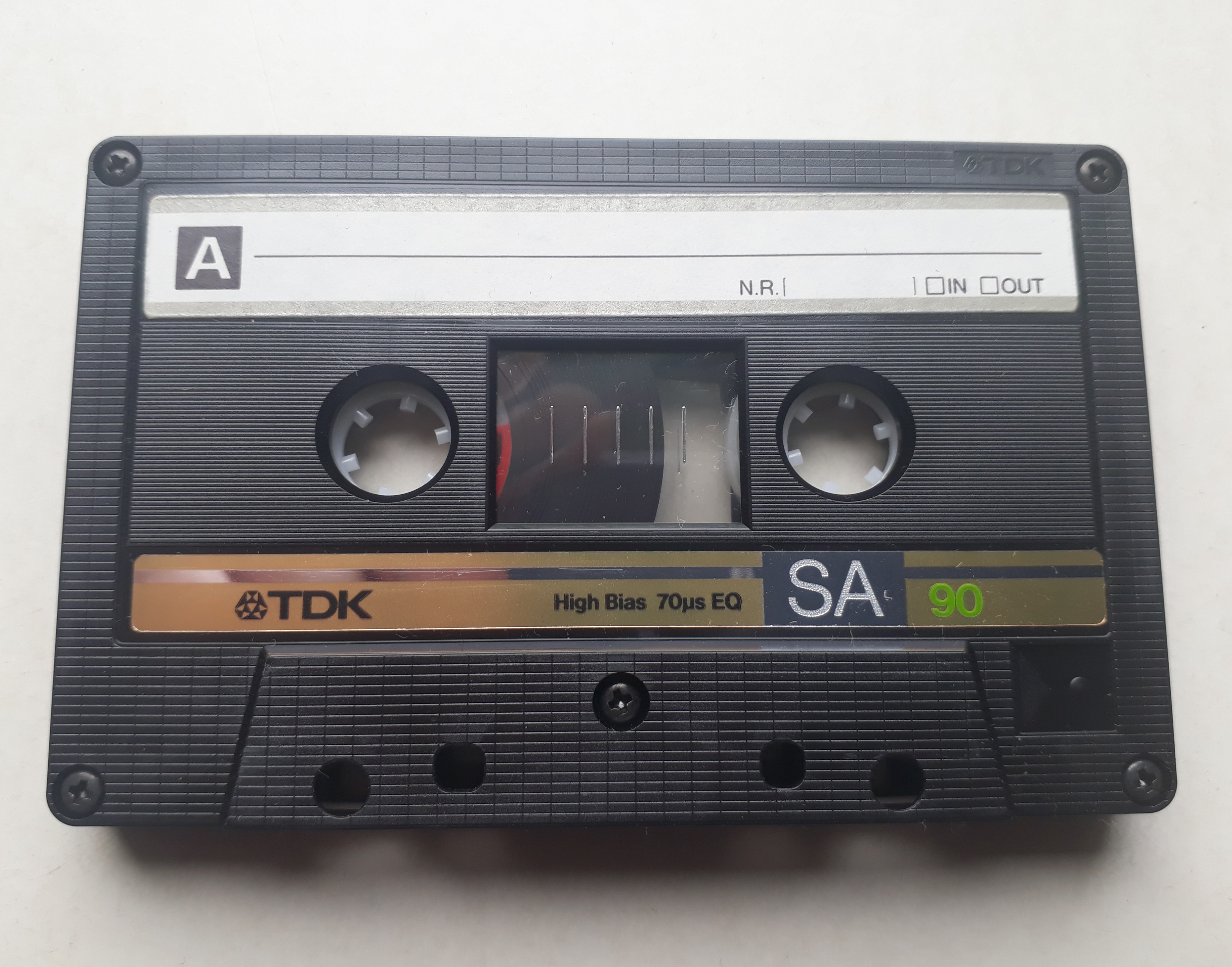
Here we have yet another compilation on Epitapes that was established by Mike Tetrault from Belchertown, Massachusetts.
Throughout the 80's dozens of these compilations were created. Each
compilation was based around a certain theme and assembled accordingly by Mike Tetrault. Some of the tracks were taken from existing releases while
others were sent specially for these tapes. You can read an interesting
interview about these cassette series with Mike Tetrault over here.
The title of this cassette "Warmth And Silence" already reveals the type of music that was selected for this compilation: subtle ambient experimental sounds for more than one hour and a half created by a large range of home-taping projects from around the globe. Present on here are quite a few more known cassette culture protagonists like Illusion Of Safety (Dan Burke, US), Hessel Veldman (Holland), DZ Lectric (France), Hands To (Jeph Jarman, US) and Los Paranos (Christophe Petchanatz, France).
A curiosity on this compilation is that Mike Tetrault also features a piece by himself in which delicate rhythms create a base for a whispered reading of André Breton's surrealist poem "Freedom Of Love".
Living It Out In The Dead Air-Space was the magnum opus cassette album release by the Ontario based composer, sound-artist and electronic music producer Darren Copeland. The music was realized over the course of half a year during 1987 and 1988 together with a larger group of Canadian experimental musicians: Ron McFarlan (also to be found on the blog under his project Dust That Collects), David Edwards, John Marriott, Michel Flock and Lhuke Shier.
The pieces create a conceptually hollistic space that consists of dark ambient electronic soundscapes, spoken word, field-recordings and ethno-tribal influences. It carries different properties that on the one hand seem to carefully invoke the void of space (a dead end space) with its dark and silent chaos of endless probabilities and on the other hand it displays human consciousness and rational forms of understanding that are defying the dead end space from an existential point of view. The sounds of the dark untamable and alienating universe have an eternal presence in the natural and urban environment on earth. Alienation and the presence of the unknown are of great influence on life existence.
Living It Out In The Dead Air-Space is another beautiful work of Canadian experimental music that is perfect for a deeper listening experience. Simultaneously it works well as an invocation for different existentialist questions on a scientific, natural or spiritual level.
Through the further development of technology in later decades sound explorations from scientific standpoints have obviously become endless and have elaborated into many realms. Yet on this recording we can experience the scientific exploration as a subject of the music rather than that scientific approaches are being used to create the music.
Considering the year of the release, ofcourse Mr. 'Star Wars-program' and buffoon-president Ronnie Raygun is depicted on the cassette cover, but I suppose we could all think of other people suitable for the cover in today's world.
Ras.Al.Ghul was an electronic music project from Lisbon created by Fernando Cerqueira and Paulo Rodrigues. The duo started out during the mid-80's as an electro-industrial group called Croniamantal. They released some tapes by themselves as well as on the Portuguese cassette label Ritual De Sombras and contributed to a number of Industrial compilations. After a short existence they decided to bury their industrial project to start the hypnotic electronic dance project Ras.Al.Ghul (perhaps named after a supervillain from the American DC Comics).
The Experimental Absorption Spectrum is a tape release that was apparently distributed through experimental cassette labels like Tonspur Tapes and Maljugin Musik in Germany. The album displays an electronic tribal sound that touches on different genres of electronic music of the 90's - from Drum 'n Bass to Downtempo - yet the music never really conforms to any of these genres. The sound is maybe closest to a 90's psychedelic trance atmosphere, but the lo-fi quality of the recording in combination with the electronic experimentation doesn't allow it to become generic.
It sonically connects the industrial culture's breeding ground of the 80's with the rave feel of the 90's through hypnotic beats and sub-aquatic ambient electronics fusing technology with the mind's eye: a Portuguese underground sound that balances on the sonic intersection between a neo tribal industrial music tradition à la late Muslimgauze and the sound of upcoming communal neo-psychedelic trance festivals.
Roy G. Biv (Red Orange Yellow Green Blue Indigo Violet) was the home-taping project and sound & color improvisation band of Dutch musician and visual artist Robin Deirkauf who sadly passed away last year. I think the first tapes were solo-projects and later the project was joined by Edward Vunderink (guitars, voice) and Frans Evers (keyboards). Yellow is one of the first three tapes by Roy G. Biv from 1980 and just like some of Conrad Schnitzler's work it was dedicated to a specific color. The band also did a red and a blue cassette (I have never seen or heard the blue one). Here's a brief and interesting biography I found on Deirkauf's personal website:
"In his early childhood Deirkauf grew up in the Caribbean, where his father was an antiques dealer, mainly specialized in African and Asiatic art. The exotic colorful underwater world at that time and the antiques has had a profound influence on his later drawings and paintings.
Sign, symbol and script are recurring elements in his sometimes eclectic work, it is characterized by ancient, primordial pictoral power, mixed with modern constructivist elements and bright colors. After this period he turned to a more formal and conceptual way of analizing the image, resulting in the development of a matrix used to create a pictographic alphabet consisting of primary colors and forms.
During the late 70's and early 80's Deirkauf founded the experimental sound and color improvisation group Roy G. Biv for the realization of the multimedia art project phase III with Edward Vunderink and Frans Evers, what resulted in 10 music albums."
Roy G. Biv's Yellow tape is a great improvised jam-session like endeavour of cosmic electronic soundscapes reminding me of Krautrock groups from the 70's like Agitation Free, Ash Ra Tempel and other Manuel Göttsching works. It's also highly influenced by minimal music and because of the color themes, the Conrad Schnitzler analogy remains a given ofcourse. Not too often do the early home-taping cassettes from The Netherlands lean more towards the psychedelic and cosmic electronic side of the musical spectrum instead of the more commonly found industrial or minimal synth tapes from those times.
It's nice to find out about the existence of different and more cosmic music from Amsterdam from a time when half of the city was filled with squats with punks and new wave had already arrived both in fashion and music. I suppose Roy G. Biv shows the musical transition from the 70's with its psychedelic sounds to the DIY sound approach of the 80's and carries both decades in its spirit. Maybe that approach is also interwoven into the story of the Dutch wave and ultra band Mekanik Kommando that later turned into the psychedelic group The Use of Ashes.
Most of the Roy G. Biv albums were uploaded on No Longer Forgotten Music some time ago. Wonderful stuff. And ofcourse rest in peace Robin Deirkauf. Maybe some reissues have to be done in his memory.
The red tape will also be uploaded to the blog one day.
Niala Effen is an anagram of Alain Neffe (to make it sound more Polish) who is the founder of legendary Belgian home-taping label Insane Music and the musical brain behind minimal synth acts like Bene Gesserit, Human Flesh, Pseudo Code, Cortex, Subject and many more projects. Those acts have probably also been Belgium's most widespread home-taping sounds, being featured on countless compilations of the DIY cassette culture across the globe.
Kolory Też Potrafią Śpiewać is the Polish translation of "Les Couleurs Aussi Peuvent Chanter" (The Colours Can Also Sing) which was the title of a drawing exhibition by artist Nadine Bal (Alain Neffe's wife and collaborative member of Bene Gesserit and Human Flesh a.o.) that took place in Brussels from 11.11-30.11.1989. Neffe created the background music that was to be heard during this exhibition. The material got released on the Polish underground label OBUH Records, which is one of the important labels that was dedicated to Polish underground music already since the socialist times. They published great Polish bands like Za Siódmą Górą.
The tracks on Kolory Też Potrafią Śpiewać are all titled by different girl names and are tainted by a mantric musical nature. The electronic music consists of swirling timbres and loops of repetition creating different sound-colours that I can imagine are perfectly fitting the drawings of Nadine Bal, probably just like the one on the cover of this cassette. Deep, colourful and hypnotizing.
This cassette is a solo effort by Hungarian musician and Industrial music protagonist Kósa Vince. Kósa played in the pioneering Hungarian industrial group Art Deco (posted a long time ago on the blog) as well as in the industrial group BP. Service. On this cassette he plays the music to the play A Görög (The Greek) written by English actor and playwright Steven Berkoff that was premiered in 1980 in London and performed in the Radnóti Theatre in Budapest in 1994. The Greek was a modern interpretation of the well-known ancient tragedy Oedipus Rex by Sophocles. The tragedy that also inspired Freud in his work to develop his concept of the Oedipus complex.
The music on the tape consists of two long pieces. The first side starts with rhythm based industrial in combination with collaged music taken from classical music. Later the music transitions into a subaquatic dark ambient soundscape. The B-side is a slightly more interesting affair, where Kósa fully embraces a synthetic tribal ambient sound even ending up in some 90's beats. Nevertheless it still holds on to darker atmospheres.
A Görög reminds me of the 1983 piece Neveleiland by Dutch home-tapers De Fabriek. Furthermore, the music is really in similar realms as the Hungarian avant-garde album Private Exits by composer Tibor Szemző or Hungarian composer László Hortobágyi and his electro-acoustic music built on Indian cosmologies.
A rare cassette, often mistaken for a screenplay or spoken word. Great music and soundscapes from the early nineties and another piece of the Hungarian experimental music puzzle. Lots of Hungarian cassettes still to come to the blog!
Next up is another album that connects to the previous post balancing on the thin line of alluring musical ambience and a generous pinch of cheesiness.
Italian Bass player Tiziano Barbieri and Guitarist Moris Fabbri made this quite obscure album of Mediterranean contemporary jazz and late 80's ambient sounds in 1988. Both musicians were not heavily involved in other projects but were definitely active musicians. Moris Fabbri still makes remarkable experimental music today which you can find on his own Youtube channel.
The music on this album is pretty much divided: the A-side has three tracks of composed atmospheres thriving on Italian Mediterranean guitar, eastern voices and guitar-synths-scapes. Actually no real synthesizer is used on the album and all electronic sounds are coming from the processed guitar. These first tracks are maybe too slick, although you also have the feeling that you're familiar with those melodies already for an eternity. The impressionistic style is similar to the Swedish Vinterhjärta tape I posted some time ago.
The music on the B-side should be more pleasing for the improvisation and experimental jazz fans. Those tracks are more abstract and free-form, showing the cinematic and adventurous side of the duo. It reminds me a bit of the Dutch contemporary Jazz soundtrack Golven by Louis Andriessen, but it mostly reminds me of the biblical Risonanze series of Italian library music that I posted ages ago on the blog.
Maybe something different, but it's definitely the soundtrack of the current Indian summer channeling the elements of Earth, Water, Air and Fire while you reminisce of a summer that gently flushes away...
Tecnologie Del Movimento was a cornerstone compilation of the late Italian Industrial scene that showcased some of the first sounds that were later to be established into the ritual and dark ambient techno styles of the nineties. The Hax label was run by Marco Milanesio who is also the mastermind behind the group DsorDNE from Turin, a group also featured on this compilation.
Another Italian Industrial act on TDM is Officine Schwartz that started out in 1983 in a classic industrial style using unconventional instruments as well as scrap metal and such. Then there is Gerstein, moniker of Maurizio Pustianaz, who published many experimental music and noise cassettes since 1984 and even had a release on the British Harsh Noise label Broken Flag in 1987. Furthermore there are a few unknown acts compiled: Alberi Per Debra, Unga and La Deviation.
The successor Tecnologie Del Movimento II was released on CD in 1992 and already moved into more dark ambient techno realms, also containing more outdated tracks. This first compilation however, really showcases a fine collection of industrial sounds with nice analog electronic sequence loops, ambient collages and musical theme's that even resemble those of Coil at times.
Merry Christmas and an Archaic New Year to all followers of the blog!
Blacklight Braille was an ever morphing band from Cincinatti, Ohio led by musicians Owen Smith and Doug Knight. The band claimed their own style called "Fringe Rock". Once they described it in a very good and thorough interview from 1993 as:
"Music created
by rock musicians, yet not quite meeting the classical definition of
rock' n' roll. It differs to the degree that it might be said to fall
within an entirely different location, fringe rock. When we started,
we were doing a music that was so far out on the fringe that the beauties
were cryptic or hidden. It
is highly improvisational music created with the available technology,
and it searches for new and different musical instruments and sounds, You can't dance to it, but it does have elements of rock music."
Blacklight Braille made numerous albums on their own Vetco Records and started out in the mid-seventies as a collective of street performance artists and musicians under the name Bitter Blood Street Theatre. They acclaimed some underground fame in Cincinatti for their weird shows. Eventually they created the project Blacklight Braille with their first totally demented and experimental collage album Electric Canticles Of The Blacklight Braille in 1981.
Later on Blacklight Braille was also picked up by the international deviant music scenes through the many albums that they distributed to radio stations worldwide. Besides their Fringe Rock music they also started to incorporate the somewhat occult fascination for British King Arthur and the Arthurian Legends. The musical influences became even more diverse and were now being accompanied by oral stories and poetry, regularly dealing with the Arthurian Legends.
The Carbonek Album, (Castle Carbonek is the place where supposedly the Holy Grail is kept) is a strange Arthurian concept album in which the world of Arthurian legends unfolds. About ten different people are part of the band for this occasion and the album goes into many directions, ranging from electronic ambient synth sounds to the new age sounds of fountains to dark experimentation with spoken tales. It has a humorous yet serious approach always keeping a pace with Arthurian atmospheres and concepts with tracks like The Fountain Falling From The Ace Of Cups, The Gift For Galahad and Guinhwyvare The Tall And Fair. It sort of reminds me of later work by Legendary Pink Dots, although more demented in approach. Also It makes me think of Big City Orchestra and their vast discography of albums.
Blacklight Braille is another one of those great US bands that is very much overlooked considering their unique music and the efforts they have put in their albums. Look out for the rest when you can!
Vinterhjärta, meaning Winter Heart, was an obscure impressionist prog outfit from Sweden that consisted of Peter Bryngelsson, Dan Jonsson and Lars Liljegren. Although summer is still here, maybe we can engage in these winter soundscapes in a less frustrated way than when winter is actually in full effect later on (at least here in Europe). I guess the Swedes aren't bad in translating these particular environmental circumstances into musical moods. I'm sure the outfit was actually inspired by the season of winter.
Vinterhjärta plays moodish pieces in which progressive rock elements, ambient sounds and gentle piano play is intertwined. The A-side is a 38 minute long track in which synthesizers and guitar create a dreamy world reminiscent of the more mellow releases of the French Pôle label in the seventies or of cosmic Heldon guitarist Alain Renaud. It is maybe improvised in a bit too conventional cheesy manner, but it still takes you into a certain world, because it doesn't change drastically or builds up towards more energetic heights or anything. It's an impressionist prog piece that's gets specially interesting when the synthesizers are more apparent.
The B-side has eight different shorter pieces, usually created with piano and synths shaping different moods and atmospheres. The pieces are gentle, spooky and dreamy at same time. It reminds me a bit the Dutch soundtrack made by Louis Andriessen named Golven (connected to the Dutch Noordzee) or Scandinavian ECM releases if they contained a bit more of the darkness from the eighties with electric guitar disturbance. All in all it's a beautiful and peaceful album from Sweden's eighties and fits in the current interest in more ambient musical works from the eighties.
The blog had a bit of a hiatus lately because I was out of town and I was pretty busy. Sometimes there will be periods in which it's harder to keep up the consistency. Nevertheless some of the best posts are still to come. I've got quite some insane material for the near future!