Showing posts with label Eastern Europe. Show all posts

Tuesday, 8 October 2019

Various Artists - Polish Road, Vol. 1 & 2 - Alternative Polish Scene -1989- (2x Tape, Organic), Poland/France


Here we have one of the pivotal compilations covering the Polish underground from behind the iron curtain during the 80's. It came out right before the change of the political system in Eastern Europe in 1989 on a French label. Obviously many of these bands only released their music marginally in their own circuits. They had to operate in the underground because of their subversive nature and artistic expression directly or indirectly opposing the socialist regime. Poland had a longer history of underground bands and artists fitting that realm already in the early 70's, with examples like the mythical psychedelic band 74 Grupa Biednych and improvisers like Grupa W Składzie. The Polish music underground has always been heavily inspired by Jazz and improvisation. Also more known bands from Poland that were accepted by the regime during the 70's like Niemen or SBB were quite experimental in their approach. Polish jazz played a hugely influential role behind the iron curtain during the 60's and 70's and became a trademark of adventurous quality jazz. 

During the 80's a broader underground had emerged in different Polish cities. The improvisational groups were now accompanied by new wave bands, punks, industrial noise makers and everything in-between. Quite a strong grey and bleak accent was being put in the music, reflecting the last bleak decade of communist totalitarian repression. More and more Polish music was slowly finding its way to the west by cassettes that were swapped as well through Polish dissidents that made their way to the west of Europe. One of the greatest post-punk bands that had a Polish singer (Andrej Dziubek Nebb) was Holy Toy from Norway. Their first album Warszawa (Warsaw) still stands as one of the strongest experimental new-wave albums from the 80's and incorporates a strong Polish component. 

Now that I think about it, even Joy Division was called Warsaw at first ofcourse. In the imagination of wave bands and punks from the west during the 80's Poland was definitely the epitome of bleakness and a symbol of the east-west schism that was casting its darkening shadow over Europe including the threat of nuclear warfare. This was pushing the no-future mentality even further in the heads of many youngsters. Subsequently theme's like the Warsaw-Pact were often used by western wave bands from the 80's. But let's get back to this release:

Polish Road was one of those important compilations for Polish bands to be heard in the west  spreading their underground sounds. It's a very nice, although heavily fragile, recording of different bands ranging from punk, wave, industrial and improvisation groups. It was released as a double cassette in a VHS case. The first volume consists of more experimental and punk groups, while the second volume has more improvised and electro-acoustic bands on it of which Reportaz might be the most known. The music was all recorded between 1985 and 1988, often containing live recordings. I won't go into every band separately because it's too much work, although from some bands I will upload more tapes in the future of the blog. 

Polish Road can be seen as a critical undermining of the socialist regime and a time document of what was going on at that time in the Polish underground, while Solidarność was already making big leaps and the change of political system was very near. Please note that I'm putting this music in a political narrative, but a lot of this music was just artistic expression and didn't have any political agenda in itself.

After the communist period a hopeful time arrived to Eastern Europe during the 90's (apart from Yugoslavia), but nowadays we know how much political difficulties we are facing yet again. It slowly fosters the realization that this music and its urgent character, pushing through all possible limits, whether having no audience, no listeners or the lack of technical production or musical skills, yet giving expression to the inner spirit and the need for change in society, could still be perfectly inspiring today.

Many more obscure Polish cassettes will be uploaded to the blog with time.

Get it HERE


Thursday, 18 April 2019

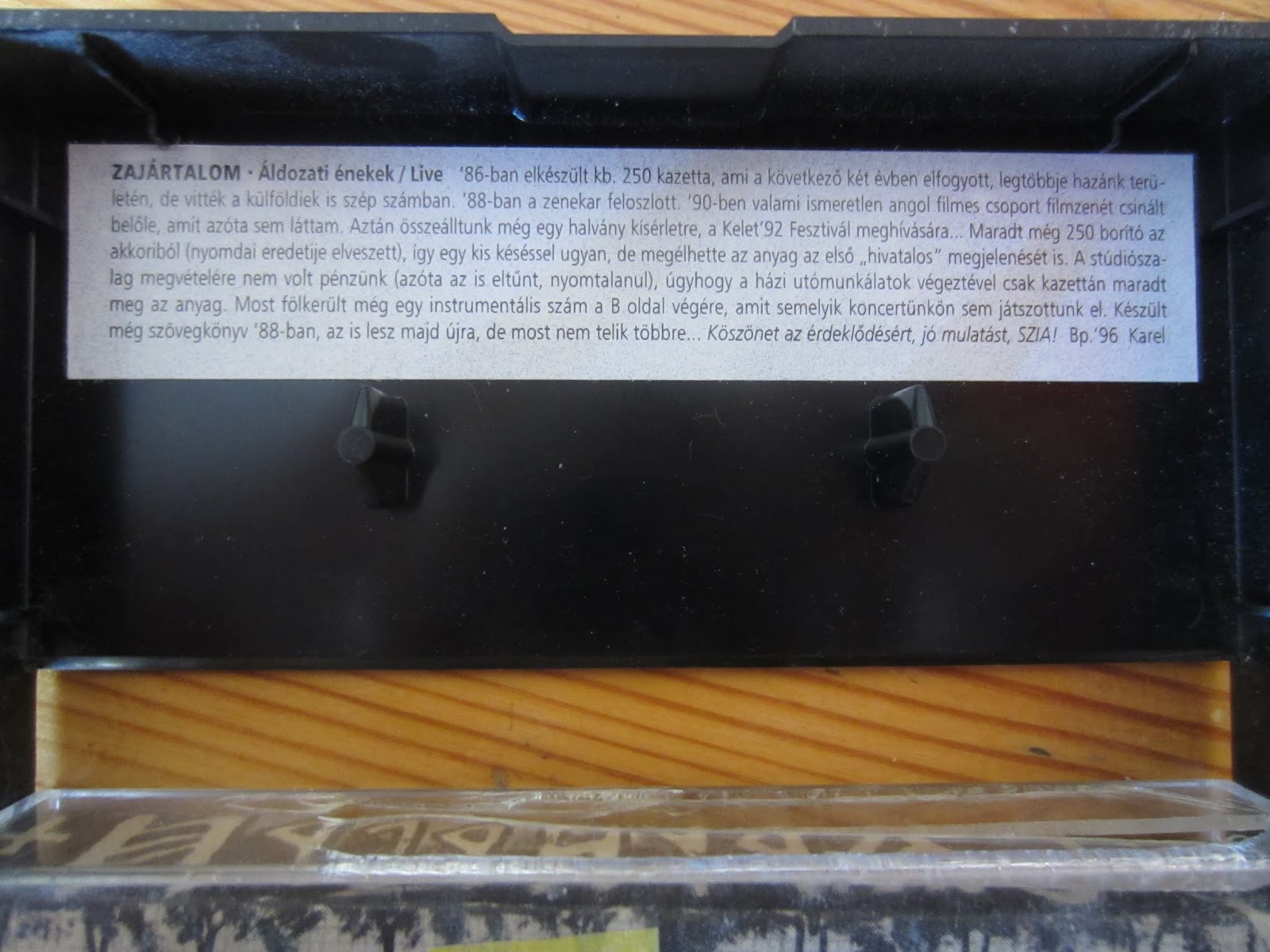
Zajártalom - Áldozati Énekek & Live -1987/1996- (Tape, Self-Released), Hungary


From the inner liner notes:

In 1986 about 250 cassettes were made that were distributed in the next two years. Most of them were shared in Hungary, but the foreigners also took the tapes with them in royal amounts. In 1988 the band disbanded. Somewhere in the 90's an unknown English film crew made film music out of the recording that I haven't seen or heard since. Then we reformed for a faint experiment being invited by the '92 East Festival... About 250 of the original cassette sleeves remained (the original print got lost), so with a little delay the first "official" publication survived and got published. We didn't have money to purchase the studio recording tape (it also vanished since then (without a trace), so after finishing this at home (as homework) the material only remained available on cassette. Now on the last bit of the B-Side an instrumental recording has surfaced that we didn't play at any of our concerts. A book with lyrics was made in '88, which will be republished, but as of now it doesn't go any further, thank you for the interest, jó mulatást, SZIA! (Have fun, BYE!), Budapest '96 Karel

Zajártalom means "Noise Pollution" in Hungarian and this little cassette here is an ultra rare music relic from the Budapest underground. And also of industrial music culture behind the communist iron curtain in general. I have uploaded some Hungarian industrial tapes before of bands like Art Deco, BP. Service or musician Kósa Vince. Zajártalom kind of fits a similar realm, mainly in its use of cut-up and collage, but they also move into greyer alternative noise-rock areas similar to the shamanic noise-rock punk of Vágtázo Hallotkémek or the obscure Hungarian industrial project Falatra(x).

The music is pure experimentalism with improvisation where noise and collage find each other with an added protagonistic role for dark existential poetry through lyrics. I wish I would be able to tell more about what the the lyrics say. Also the text that is recited at a certain point by a child is some of the darkest existential stuff I have heard. These are all musical examples of real subversive and deep artistic statements in need of freedom in a totalitarian country in which grey society bleakness and state censorship were shaping daily life. To get an idea of this feeling and to understand the Hungarian music underground within this bleak communist realm I recommend you to watch the 2012 documentary East Punk Memores which is uploaded online. It gives a nice view on the mentality and life back then.

This Zajártalom cassette is such a special document of that time and it's not often I stumble upon these things even when I know quite some of the underground figures of that time in Hungary. Ofcourse there was some Industrial music in the former socialist countries, but in extremely marginal forms. Czech Republic had a movement, Poland, Hungary etc. and ofcourse Yugoslavia that really birthed some iconic bands like Laibach or Borghesia. The political circumstances differed per country and in Yugoslavia there was less cultural censorship for example. Some punk and wave music from the west came out quite regularly on vinyl. Also their cinema was not overdubbed so people could much better understand and learn English and deal with all the marginal information. In Hungary it was much rather fragmented. A handful of people knew about industrial music somehow. Some tried to musically mimic that style, but some were just making noise or some detuned rock music and ended up doing industrial in hindsight.

A few examples of how Industrial music entered Hungary from what I know is the visit of some Hungarian punks to East-Berlin in the 80's. The East-Berlin punks knew about Einstürzende Neubauten, but also had more knowledge already about new wave bands like The Cure and such. Furthermore I know that Antwerp based industrial pioneers Club Moral visited the artist village Szentendre near Budapest at the beginning of the 80's where they also played live. This village birthed the legendary Hungarian art rock group A.E Bizottság for example, that was formed by a group of artists and painters.

Then later on in the first Budapest underground pubs like Fekete Lyuk (Black Hole) there were some alternative concerts. Once there was a concert of Belgian industrial band à;GRUMH, but this was already later than this release, maybe around 1989. The German Neue Deutsche Welle group Der Plan did a legendary compilation with different European bands called Fix Planet! in 1981. The album contained the first release of Esplendor Geometrico's cult song 'Moscu Está Helado' (Spain) for example, but also a track by Vágtázo Hallotkémek. Der Plan visited Budapest back then and met the band according to the sleeve notes. Anyway one never really knows how the information flow worked precisely, but these are just some examples of Industrial and underground music encounters in Hungary during the socialist times.

Check out the energy of this cassette, it's pretty interesting. It's all an answer to political repression as well as self-established anti-culture as an antidote to this repression. There is a so called 'album' entitled Áldozati Énekek (Songs of Sacrifice) on the A-Side that I couldn't dissect into different tracks and a Live recording on the B-Side that doesn't sound much more live than the A-Side. A rare relic of subversive experimental music from behind the iron curtain. Marginally released on cassette in 1987, officially marginally re-released in 1996.

Get it HERE

Friday, 25 January 2019

Carwashtagnacht - Distance -1996- (Cassette, Self-Released), Hungary


Carwashtagnacht was a Hungarian industrial metal band from the small city of Békéscaba in the south-east of Hungary formed by Kiss Balázs (guitar), Knyihár Pál (bass guitar) and Sörös Gergö (vocals and programming). They played a Godflesh inspired style in which long-lasting repetitive metal riffs were combined with drum machine patterns with in this case gloomy distorted vocals in Hungarian and English. A band like Godflesh has had a lot of influence in Eastern Europe after the change of the political system in the 90's. Because of the lack of musical extremes in dominant music culture in socialist countries like Hungary before the 90's, many people were inspired by metal and punk bands.

Those type of foreign alternative bands were also some of the first to tour the smaller cities in Eastern Europe. At first many of these unclassifiable alternative experimental metal bands came from Italy for example, but eventually even bands from Latin America came to play. Eastern Europe became a new fertile domain after it had previously been closed for tours of such bands. This development also had its influence on locals that in turn started bands with a similar sound. I think it's also a reason why metal and alternative rock styles are still big in Eastern Europe. But aside from that: the 90's was just an insane decade for the development of any genre really. More than end results and completion, potential ruled the musical output.

In the late 90's Carwashtagnacht published a CD on the legendary Trottel Records in Hungary that together with the label Bahia was responsible for the output of alternative and experimental bands in Hungary. The label revolved around the alter-rock band Trottel that started out in the early 80's as a punk band and later evolved into an ethno-experimental-space-band.

This particular cassette of Carwashtagnacht seems to be some sort of demo tape that was self-released a long time before their official album. The musical style is somewhat different to what usually finds itself to the blog, but it's important to keep extending genres and to shed light on the Hungarian underground of the 90's that is totally overlooked and that I happen to have an access to. The term rare doesn't even qualify anymore for a cassette like this. Specially since the band comes from the countryside and not from the capital Budapest.

More obscure Hungarian tapes will be gradually uploaded to the blog.

Get it HERE

Friday, 2 November 2018

Calliope Quartet - Incognita -1998- (Cassette, Crossroads Records), Hungary


Calliope Quartet was a short-lived Hungarian Jazz-Rock and experimental folk outfit that consisted of Molnár Tamás on bass, Pásztohy Bálint on drums, Hűvösvölgyi Péter on guitar and Bonyár Judit on cello and vocals. They released this one cassette only album on the Hungarian Crossroads Records. A label that tried to merge the genres of folk, jazz and world music with the contemporary sounds of the nineties.

Incognita that was recorded in 1997 is a stunning album balancing somewhere on the crossroads of rock in opposition, jazz-rock and even hinting towards Hungarian folk music at times. Within a Hungarian context they probably come closest to the RIO group Kampec Dolores, known for their combination of avant-rock, folk and improvisation. The tracks on Incognita are quite lengthy and leave lots of room for the listener to enter the musical world of the band. The tracks have nice abstract and sometimes humoristic titles like Aszimmetrikus Fémbuborék (Asymmetrical Metal Bubble) or Jelmezbál Jazzsznoboknak (Costume Ball For Jazz Snobs). The band plays great quality music, but doesn't lose its approach to have fun while playing. Also they don't portray themselves as academic jazz musicians. 

This is actually a great album from Hungary and already nearly impossible to find after just two decades that have passed. Clearly there is some Zappa influence going on, but it also reminds me of 70's French Zeuhl band ZAO or of Italian jazz-rock group Perigeo from the 70's or of the Ethno-Krautrock sound of Embryo or... should I keep it going?!

Excellent avant-jazz-rock from the East of Europe! 

Get it HERE

Thursday, 4 October 2018

Kósa Vince - Berkoff: A Görög -1994- (Tape, Razzia Distribution), Hungary


This cassette is a solo effort by Hungarian musician and Industrial music protagonist Kósa Vince. Kósa played in the pioneering Hungarian industrial group Art Deco (posted a long time ago on the blog) as well as in the industrial group BP. Service. On this cassette he plays the music to the play A Görög (The Greek) written by English actor and playwright Steven Berkoff that was premiered in 1980 in London and performed in the Radnóti Theatre in Budapest in 1994. The Greek was a modern interpretation of the well-known ancient tragedy Oedipus Rex by Sophocles. The tragedy that also inspired Freud in his work to develop his concept of the Oedipus complex.

The music on the tape consists of two long pieces. The first side starts with rhythm based industrial  in combination with collaged music taken from classical music. Later the music transitions into a subaquatic dark ambient soundscape. The B-side is a slightly more interesting affair, where Kósa fully embraces a synthetic tribal ambient sound even ending up in some 90's beats. Nevertheless it still holds on to darker atmospheres.

A Görög reminds me of the 1983 piece Neveleiland by Dutch home-tapers De Fabriek. Furthermore, the music is really in similar realms as the Hungarian avant-garde album Private Exits by composer Tibor Szemző or Hungarian composer László Hortobágyi and his electro-acoustic music built on Indian cosmologies.

A rare cassette, often mistaken for a screenplay or spoken word. Great music and soundscapes from the early nineties and another piece of the Hungarian experimental music puzzle. Lots of Hungarian cassettes still to come to the blog!

Recommended!

Get it HERE


PS: I have an extra copy of this tape. If you would like to trade it for another nice record or tape feel free to get in touch.

Monday, 24 September 2018

Various Artists - Druga Liga Prvo Kolo -1995- (CD, Helidon), Slovenia/Croatia


Druga Liga Prvo Kolo -Second League First Round - is an essential cornerstone compilation from post-Yugo 90's Slovenia. It compiles both Slovenian and Croatian bands that were active in the early and mid-90's in their respective underground scene. Eastern European underground bands from this time were very weird and unclassifiable, playing a combination of both unskilled punk and hyper-complex rock in opposition drenched in a healthy amount of absurdism while existing within a genuine alternative culture based on communal uplifting activisim and desperate local divertissement. Also don't forget that the decade of the 90's in former Yugoslavia and the Balkans was heavily loaded with political tensions and war sentiments that needed an explosive creative output in one way or the other.

Slovenian bands in general, also before the fall of the iron curtain and the disbanding of Yugoslavia, were always very intriguingly weird. With Laibach as main national music reference you know you're in for a blast when digging into the Slovenian musical underground. Other great alternative bands from Slovenia I can think of are Miladojka Youneed, Begnagrad, Lolita, Strelnikoff or the later Pinja Dzazna (who has those files for me!?)

The Slovenian bands on this compilation are experimental group Mamojebac (of which their whole and only existing tape from 1995 Tko Je Ovdje Kome Guzica? is present), strange punk band Absent Minded and the great avantgarde art-rock band Žoambo Žoet Workestrao

The Croatian groups present on Druga Liga are the demented HC-punk group Why Stakla (of which almost their whole cassette Daj, Dođi! from 1995 is compiled) and the free punk no jazz band from Rijeka Plod Mirže (I'm curious if more of their music exists). These bands also remind me of the Croatian band SexA.

Essential uneasy listening of post-Yugo punk-noise-insanity from the underground!

Get it HERE

Saturday, 4 November 2017

áPolóK - Szarvasgyár -1995- (Tape, Bahia), Hungary


I finally was able to track down the last of four cassettes by Hungarian band áPolóK (The Nurses) somewhere. The other three tapes I posted before on the blog. áPolóK is one of Hungary's finest groups to rule the Hungarian underground that manifested itself during the mid-eighties until the alternative boom of the nineties after the fall of the iron curtain.

Their absurdist music displays intricate musical structures, Hungarian folklore, zappa-esque manoeuvres and alternative rock. They are comparible to the Hungarian group Tudósok. Also later bands from Eastern Europe share some of this musical absurdity like the Slovenian band Pinja Dzazna (can anyone please find those albums for me? They seem to have disappeared.)

The title of this album is Szarvasgyár meaning Deer Factory as well as Shit Iron Factory. The title makes a lot of sense since the band came from the city of Miskolc which is Hungary's main city for heavy industry. This album is probably one of their craziest, but also the one that stands closest to Hungarian folk music.

áPolóK belong to Hungary's finest experimental underground music groups. Make sure to check out their crazy video's online to get an idea of who they were. Today they still exist through other obscure bands in Hungary.

Recommended!

Get it HERE


Saturday, 1 July 2017

Jana Koubková - Bosa -1985- (LP, Supraphon), Czech Republic


Somehow there always existed a relation with Brazilian Bossa Nova in Eastern Europe. Specially in times when coffee places behind the Iron Curtain flourished and nightly neon lights were flirting with western titles creating a concealed idea of a vibrant night life throughout all of the Eastern European capitals. Latin American tunes were played by jazz bands of the fifties and sixties and the particular feeling lived on all the way to the revival of the retro lounge movement around the change of the millenium, reminiscing the geometrical design imagery and nightly recreation created during the socialist times. It was a strange daily life counterpart to a political system that on the other hand ofcourse was looked upon as a system of repression and terror in many ways. Nevertheless exploring  the artists, designers and architects from the time one notices that this culture also contained something unique and refined. Besides that it coincidentally and not so coincidentally had a lot in common with modernism in Latin America.

Jana Koubková is a Czech Jazz singer that was active from the seventies in many Jazz groups like C&K Vokal and Jazz Fragment Prague. In 1985 she created her first solo album Bosa that can be viewed as a unique Czech deconstructed experimental avant-garde Bossa Nova album. Apart from the rhythms that are used, it's mainly a voice and scat album with weird overdubs, free jazz explosions and experimental repetitions. Actually it fits quite well next to the Brazilian contemporary music from the mid eighties that used traditional rhythm and melody with new experiments and unconventional instruments like Andréa Daltro or Cinema.

Bosa examplifies Jana Koubková's creativity and progressive spirit and totally exceeds a mere jazz album. This is true singing talent molded into avant-garde voice experiment art comparable to the amazing work of Russian singer Valentina Ponomareva (or for that matter).

Another one for this summer (letní)!

Get it HERE

Friday, 6 February 2015

Batu Kármen - Max Mara & Lili Luna -1994- (Tape, Bahia), Hungary


Batu Kármen is the moniker and band from the early nineties of Hungarian painter, writer, musician and director feLugossy László. He is a notable underground figure in Hungary and was the leadsinger of one of Hungary's best avant-garde groups called A.E. Bizottság (Albert Einstein Committee). They made two albums and toured Europe in the eighties. Make sure you find those recordings somewhere. Here you can see them in an old clip of the underground-movie Jégkrémbalett (Ice Cream Ballet) from 1984 in which they took part and did the soundtrack.

feLugossy is known for being part of a vibrant artist scene of Budapest and the nearby artist-town of Szentendre of the eighties. This recording of Batu Kármen is a nice insight into Hungary in the early nineties when many things became possible to do in the alternative scene due to the change of the political system. New bars and underground places were opened and festivals were being created which helped artists and musicians develop themselves in the new times.

The lyrics are quite absurd while keeping a very intelligent essence. The music is quite a bit Captain Beefheart-like in a post-punk context with maybe some strange eastern european "indie"-influences. Actually a great album. Some songs were uploaded to youtube before, but here's the whole thing.

Recommended!

Get it HERE

Sunday, 22 June 2014

Vágtázó Halottkémek (Galloping Coroners) - Live and Practice -1986- (Tape), Hungary


Vágtázó Halottkémek (VHK), in English Galloping Coroners, in German Rasende Leichenbeschauer is a Hungarian shamanistic noise-rock band. They are artistically rooted in Hungarian mythological stories, ancient Hungarian imagery and cosmic theories. They started out in the end of the seventies, but only released their first proper albums by the end of the eighties when those possibilities came to existence for these kind of bands from behind the iron curtain. During the early eighties they did manage to put a song on the legendary international sampler "Fix Planet" (1981) compiled by NDW legends Der Plan. They were featured alongside bands as Esplendor Geometrico from Spain and Fra Lippo Lippi from Norway. Der Plan describes the song on the back of Fix Planet as:

"The name of the band means "whizzing dead spys" and we don't dare telling who they are. Two of us met two of them once, we were all drunk and it was in Budapest, Hungary's strange capital."

As for the Music: It's the recording of two concerts in 1985 and 1986 in Budapest and two rehearsal songs. The songs are recognizable from their official albums which I suggest you should check out (not sure where) before you listen to these live versions drenched in white noise. I consider these albums to be at least among the top ten best albums from Eastern Europe from the eighties. The music can be defined as instinctive primeval music eliberating the elementary powers of nature creating ourselves and revolting to its high completion in a free spontaneity and overwhelming energy.

To me this is really one of Hungary's finest bands. I've seen them play live last summer in Budapest which was one of the best concerts I had seen in a while. They had reformed and had recorded their latest album called Veled Haraptat Csillagot! / Bite The Stars! It's still in print so get that while you can!

Get this historical tape HERE