Thursday, 18 April 2019

Zajártalom - Áldozati Énekek & Live -1987/1996- (Tape, Self-Released), Hungary


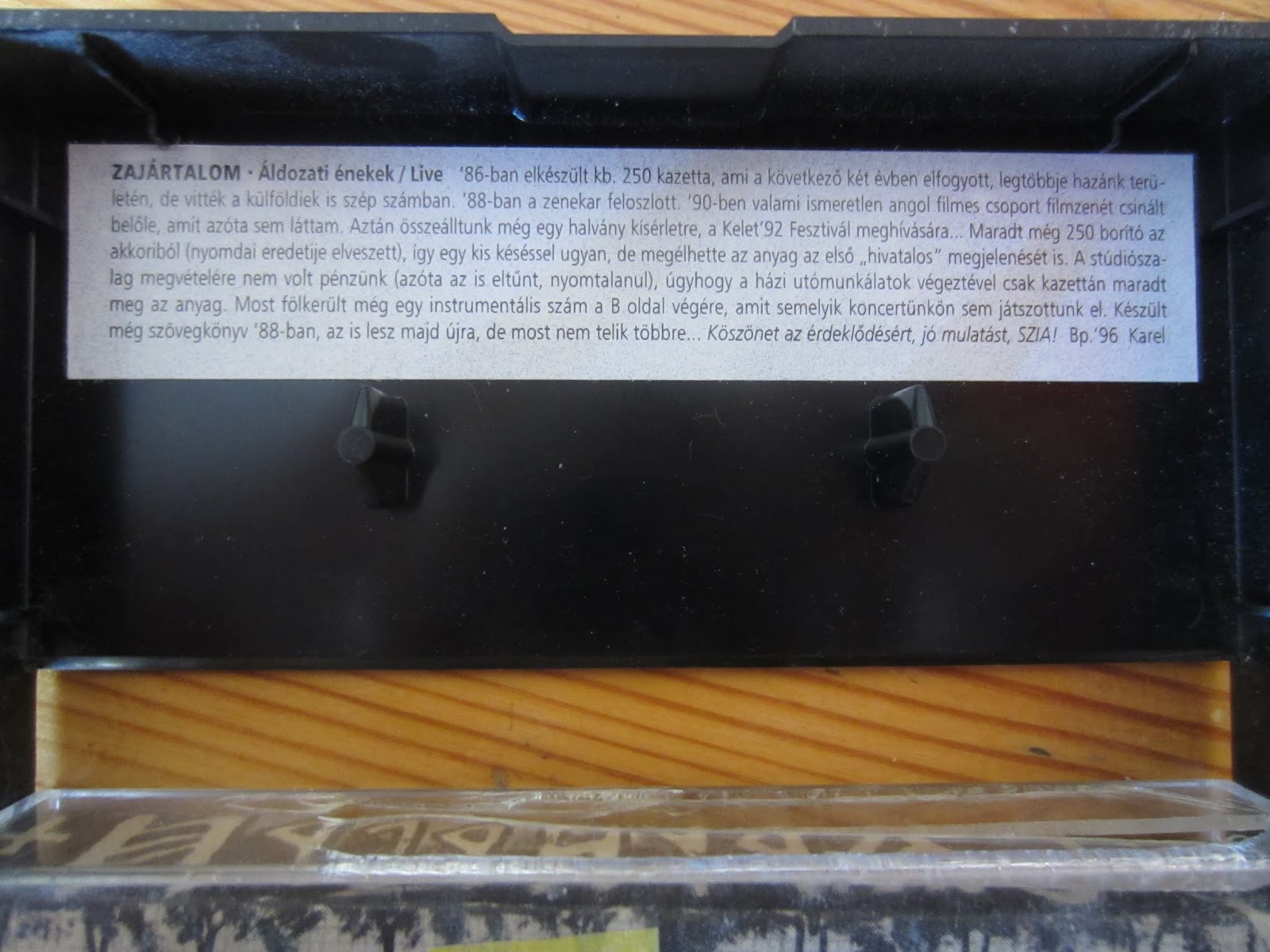
From the inner liner notes:

In 1986 about 250 cassettes were made that were distributed in the next two years. Most of them were shared in Hungary, but the foreigners also took the tapes with them in royal amounts. In 1988 the band disbanded. Somewhere in the 90's an unknown English film crew made film music out of the recording that I haven't seen or heard since. Then we reformed for a faint experiment being invited by the '92 East Festival... About 250 of the original cassette sleeves remained (the original print got lost), so with a little delay the first "official" publication survived and got published. We didn't have money to purchase the studio recording tape (it also vanished since then (without a trace), so after finishing this at home (as homework) the material only remained available on cassette. Now on the last bit of the B-Side an instrumental recording has surfaced that we didn't play at any of our concerts. A book with lyrics was made in '88, which will be republished, but as of now it doesn't go any further, thank you for the interest, jó mulatást, SZIA! (Have fun, BYE!), Budapest '96 Karel

Zajártalom means "Noise Pollution" in Hungarian and this little cassette here is an ultra rare music relic from the Budapest underground. And also of industrial music culture behind the communist iron curtain in general. I have uploaded some Hungarian industrial tapes before of bands like Art Deco, BP. Service or musician Kósa Vince. Zajártalom kind of fits a similar realm, mainly in its use of cut-up and collage, but they also move into greyer alternative noise-rock areas similar to the shamanic noise-rock punk of Vágtázo Hallotkémek or the obscure Hungarian industrial project Falatra(x).

The music is pure experimentalism with improvisation where noise and collage find each other with an added protagonistic role for dark existential poetry through lyrics. I wish I would be able to tell more about what the the lyrics say. Also the text that is recited at a certain point by a child is some of the darkest existential stuff I have heard. These are all musical examples of real subversive and deep artistic statements in need of freedom in a totalitarian country in which grey society bleakness and state censorship were shaping daily life. To get an idea of this feeling and to understand the Hungarian music underground within this bleak communist realm I recommend you to watch the 2012 documentary East Punk Memores which is uploaded online. It gives a nice view on the mentality and life back then.

This Zajártalom cassette is such a special document of that time and it's not often I stumble upon these things even when I know quite some of the underground figures of that time in Hungary. Ofcourse there was some Industrial music in the former socialist countries, but in extremely marginal forms. Czech Republic had a movement, Poland, Hungary etc. and ofcourse Yugoslavia that really birthed some iconic bands like Laibach or Borghesia. The political circumstances differed per country and in Yugoslavia there was less cultural censorship for example. Some punk and wave music from the west came out quite regularly on vinyl. Also their cinema was not overdubbed so people could much better understand and learn English and deal with all the marginal information. In Hungary it was much rather fragmented. A handful of people knew about industrial music somehow. Some tried to musically mimic that style, but some were just making noise or some detuned rock music and ended up doing industrial in hindsight.

A few examples of how Industrial music entered Hungary from what I know is the visit of some Hungarian punks to East-Berlin in the 80's. The East-Berlin punks knew about Einstürzende Neubauten, but also had more knowledge already about new wave bands like The Cure and such. Furthermore I know that Antwerp based industrial pioneers Club Moral visited the artist village Szentendre near Budapest at the beginning of the 80's where they also played live. This village birthed the legendary Hungarian art rock group A.E Bizottság for example, that was formed by a group of artists and painters.

Then later on in the first Budapest underground pubs like Fekete Lyuk (Black Hole) there were some alternative concerts. Once there was a concert of Belgian industrial band à;GRUMH, but this was already later than this release, maybe around 1989. The German Neue Deutsche Welle group Der Plan did a legendary compilation with different European bands called Fix Planet! in 1981. The album contained the first release of Esplendor Geometrico's cult song 'Moscu Está Helado' (Spain) for example, but also a track by Vágtázo Hallotkémek. Der Plan visited Budapest back then and met the band according to the sleeve notes. Anyway one never really knows how the information flow worked precisely, but these are just some examples of Industrial and underground music encounters in Hungary during the socialist times.

Check out the energy of this cassette, it's pretty interesting. It's all an answer to political repression as well as self-established anti-culture as an antidote to this repression. There is a so called 'album' entitled Áldozati Énekek (Songs of Sacrifice) on the A-Side that I couldn't dissect into different tracks and a Live recording on the B-Side that doesn't sound much more live than the A-Side. A rare relic of subversive experimental music from behind the iron curtain. Marginally released on cassette in 1987, officially marginally re-released in 1996.

Get it HERE

Thursday, 4 April 2019

Various Artists - Music From The White House Vol. 4: France -1984- (Tape, Exart 032), France/Netherlands


Music From The White House was a series of compilations on the cult home-taping label Exart from The Netherlands that was created by Hessel Veldman aka Y Create (also in Gorgonzola Legs) and his wife Nick Nicole. The compilations were made around different countries: Holland, England, France and the United States.

On Music From The White House Vol. 4: France only home-taping acts are compiled from the French 80's underground. Amongst others present is the experimental noise of Brume, the Artaud and De Sade inspired sounds of vulgarity by Suckdog affiliate Costes and the improvisation of Klimperei and La Sonorité Jaune. Furthermore there are some French lo-fi synth-punk tracks by the Dirty Husbands, Cripure S.A. and Hermaphrodisiak which all remind me of Kas Product. Lastly there is a minimal synth track by DZ Lectric and Anton Shield and some miscellaneous home-taping tracks throughout the whole compilation.

Another nice compilation from the 80's containing some better and some worse tracks that display the uncompromising home-taping spirit of the time in the context of transnational music exchange. The Exart label on which this was published functioned as one of the key cassette labels of The Netherlands in terms of home-taping distribution. Soon I will upload the Music From The White House: USA cassette as well.

This cassette was kindly donated to the blog by Hessel Veldman/Y Create.

Get it HERE


Message:
Crazy enough, I've got Archaic Inventions mapped out for at least a whole year: if not longer. The amount of never heard material and new content is vast, mind-blowing and extends into many different musical genres. Also I am working hard on establishing the upcoming record label simultaneously with various sound-art and podcast projects. Furthermore I'm developing a live-set of my own music that will see the light this summer.

The digitization process demands time and I have to balance all these different projects. I'll try to do the best I can to keep up the consistency of the blog, but there will be moments which will demand prioritizing my attention to one of these directions. Thanks to all supporting the blog (some of you since many years)! Lots of stuff still to come! - Bence AI

Tuesday, 12 March 2019

Mother Zosima - The Greatest Story Ever Sold -1990's- (Tape, Self-Released), US


Mother Zosima (the radical nun) was a feminist avant-folk project created by Kirsten Anderberg based on performances at Seattle (night-)clubs between 1983 and 2001. She took her name from the character Father Zosima who is one of the characters in The Brothers Karamazov (1879) of Russian author Fyodor Dostoevsky. In the story Father Zosima is some sort of guru as well as an ideal image of an orthodox Christian saint living in a monastry. He preaches for compassion and peace, basically as a reflection of Christ. During the course of the story Father Zosima dies and his holiness is called into question by the rest of the monastry because his body starts to decompose very rapidly leaving behind a terrible smell. This decomposing process is being looked upon as a sign of God prooving that Zosima was nothing but a mortal soul.

I suppose by inverting this character into Mother Zosima not only is Anderberg opposing Dostoevsky's approach of putting the man at a literary centerpoint - The "Brothers" Karamazov - as feminist critique, she is also shaping her own mirrored performative image as a radical nun that is preaching her own ideals. By choosing the title The Greatest Story Ever Sold she shows her cleverness of creating this image but also the self-irony she puts into her personification since Zosima is being looked upon as a mortal soul. And that's why this is some incredible music criticizing the American society. It is not at all stagnated into this contemporary gender and identity poltics debate we deal with nowadays, but it shows how cleverness, self-consciousness, lots of humor and appropriating commercial culture can actually serve the cause of the actual message.

The music by Mother Zosima is straight radical feminism, criticism of politics, criticism of commercial culture, criticism of weird American morals and Christianity etc. but it doesn't directly attack its enemy. It's an approach of empowering the woman, not obeying to conformism and preaches for self-empowerment while dissecting the different corrupted aspects of American society with humor and with a lot of skill. It reminds me of the feminist beat poets of the sixties like Diane Di Prima as well as some other female protest-song vocalists from the revolutionary hippie times in the States. It musically also comes close to Care of The Cow and their singer Christine Baczewska's solo work and even of certain songs by Annette Peacock. 

The songs by Mother Zosima are still so extremely relevant today. It's like nothing has ever changed. Specially when we look at this madness with Trump and the current state of the United States. To me it's really important to see how Mother Zosima's music is not some cult music stuff from the glory days of hippie hights, but music from a much later era carrying these important messages whilst not yet fallen victim to today's infinite cynical and polarised political views. We can learn from this creativity today and understand how political hyper-reality doesn't help us further by fighting it's xenophobic symptoms, but to put forward a message in a very clever package without being distracted nor doing concessions to constant exterior confirmation. This is what empowerment looks like. This is what is so deadly important about Feminism. I hope that Archaic Inventions can sometimes show the link from the past to today and provide possibilites and/or show the potentials of emancipatory power.

The Seattle scene of the 90's - aside from the birth of Grunge (an albino, a mosquito..) and stuff - was probably very very interesting and consisted of a creative diversity that was able to birth all of this legendary musical output. But yep, what a time we live in now! But we won't let our guard down. No worries. Enjoy Mother Zosima! (btw I wasn't too sure about the year of the release).

Get it HERE

Friday, 1 March 2019

Binder-Sanesi - Oriens & Occidens -1995- (BMM, CD), Hungary/Italy


Károly Binder is one of Hungary's most prominent jazz pianists. He is known for his rhythmic and unorthodox style of playing as well as for his experiments with the prepared piano. Binder takes the piano as a starting point but also uses many percussion instruments on the side. His first albums In Illo Tempore and Kontinentspiel that came out in the 80's in Hungary are great examples of Eastern European free jazz with lenghty pieces exploring rhythms while taking the listener into a world of its own. That is what usually matters: it's not just the plain exploration of sound. The sound is able to birth the existence of an own world. A bit comparable to the Pierre Courbois album I posted a long time ago.

Oriens & Occidens was recorded in the southern Hungarian cities of Baja and Szekszárd in 1995. On the album Binder works together with the Italian percussionist Federico Sanesi from Milan who was greatly inspired by oriental rhythms and percussion instruments like the Indian tabla and Javanese Gamelan. The result is an interesting musical meeting of cultures and free exploration of jazz, rhythm and non-western percussion instruments.

The music is played quite gently most of the time and tends to create an oriental background atmosphere that doesn't demand an overly focused attention from the listener. At times the music breaks loose from this atmosphere reminding me of certain moments of Embryo's Reise or of the British-Indian jazz album Cosmic Eye. Oriens & Occidens seems to fit this great European jazz tradition where Indian and oriental sounds are being combined with free jazz. Some examples of this tradition are the German project Jazz meets India, the British project Curried Jazz as well as the music of the Reform Art Unit from Austria.

In any case, this is a nice album of mid-90's Hungarian-Italian contemporary jazz meeting the orient.

Get it HERE

Thursday, 21 February 2019

Gefärhliche Klons - Reise Durch A Sunday Afternoon -1981- (Cassette, Pop-O-Records), Germany


*Archaic Inventions 6 Years Anniversary Post!*

Gefährliche Klons (Dangerous Clones) were a duo from Marburg, Hessen that consisted of Iggi Unpop (Exo Neutrino) and Uwe Linke. They started their musical project after a visit to legendary German Neue Deutsche Welle band Der Plan. Obviously they also took their name from the band's song Gefährliche Clowns (Dangerous Clowns).

Both members of Gefährliche Klons were very much inspired by The Residents, just like Der Plan was. Der Plan even named their first album after the The Residents concept Geri Reig. The principle that you can get best results with doing the least you can. Gefährliche Klons later also morphed into new incarnations like Little Clones, FunTastiKlons or Different Clones (VOD released some of their music as part of the German Punk Wave Box Set), but this cassette was their first output ever.

Reise Durch A Sunday Afternoon was self-released in an edition of 20 copies in 1981 and was recorded with the minimal tools of a tape-deck, toys, a mouth-harp, a xylophone, guitar and maybe some kitchenware during the course of a Sunday afternoon. It displays how the Gefährliche Klons were even more primitive than Der Plan, lacking even the implementation of synthesizers and other electronically generated sounds. It's a great example of the NDW scene of the early eighties that sometimes even used a non-music attitude in doing music anyway. More punk than punk, since you don't play punk! It reminds me of other German acts like Die Parkhaushänker or Der Ewige Musikant.

On the amazing Tape Attack blog I found a fanzine from 1981 called C.T.Z. Mainz and it includes a little review of Reise Durch A Sunday Afternoon. It's great how you can actually piece together all these different bits of obscure information. On the cover of the cassette you can clearly read that there are 24 different tracks and I started to dissect the tape into those different tracks until I found out it was impossible. So I left the tape unindexed in its two different sides (the dangerous clones got me...)

This is an amazing absurdistic Der Plan-related NDW relic from the early 80's DIY cassette culture. It contains nice primitive music, humor and maybe the best DIY cover of The House Of The Rising Sun ever. An edition of 20 hand-made copies! Don't ask me how I find this stuff, it probably finds me.

Get it HERE

Friday, 8 February 2019

Dojoji ‎- Meets The Fungle -1984- (Tape, D.J.J. 101), Netherlands


After accidentally providing something that was already available the last post I return to the essence of this blog: sharing something we have been waiting for to surface, not to be found before.

Dojoji were an excellent New Wave and Funk group from Rotterdam, The Netherlands that consisted of Pien Selleger and Ted Langenbach (Bass), Ron Louers (Bongos), Ferdinand Rolle (Drums), Leo Anemaet (Guitar), Trubus (Percussion), Hans Rath (Saxophone), Rudy Zinc (Synthesizer) and Fee Arnold (Vocals).

On this Cassette EP, Dojoji meets the funky jungle (Fungle) and plays lengthy pieces of energetic funk music with a new wave attitude. Dojoji released a very nice 12 Inch EP on Plexus records in 1984 and also a cassette with live recordings a year before that one. Both of their releases were uploaded a long time ago here and here. They remind me of other Dutch funk wave groups with electronic touches on the Fetisj tape label like Richenel or Necronomicon, but it even has hints of the band Sukursaal I posted not long ago.

Dojoji furthermore resembles some bands on the Cherry Red label like Rip, Rig and Panic or Medium Medium, but it's mainly fueled by the 80's New York styles in-between like James Chance's funky no-wave sounds and many of the boogie and 'break' records from old-school hip-hop. Actually Dojoji were quite unique in Holland and I like this cassette a lot due to the use of the synthesizer additions and the percussion elements. Nice stretched out tracks full of life one just has to dance to! It once again shows how Rotterdam was always the most New York oriented city of The Netherlands.

A good remedy for your winter depression!

Get it HERE

Monday, 4 February 2019

Various Artists - The Value Of Quality - A Concise History Of West-European Folk-Art -1982- (Tape, Aerosol P&P), Belgium


The Value Of Quality is a nice early 80's DIY compilation with mostly Belgian acts that was released on the Aerosol P&P label that was run by Guy de Bièvre who was also the person behind the home-taping act One Hundred Poems From The Japanese.

Like with most Belgian tape compilations this one too has many contributions by Insane Music For Insane People protagonist Alain Neffe. On the cassette we find different minimal synth tracks by his projects Bene Gesserit, Pseudo Code, Cortex and Human Flesh. His projects have seen many reissues on a variety of labels these last years. In the past his musical output on cassettes were probably Belgium's most wide-spread home-taping sounds. I am not sure whether the tracks on here also appeared on own releases, because there is simply too much material for me to verify.

Then present on this compilation is Flemish singer and artist Claude Perwez aka Kloot Per W. Also there is an industrial noise track contributed by Angst which was a project by Flemish writer, poet and musician Erik Vloeberghs. He also had projects such as The Firing-Squad, Kwajongens In Bloei and The Parts. He was closely related to the Antwerp based industrial and interdisciplinary art group Club Moral.

Furthermore present here are British home-taper Jack Marlow (possibly based in Germany back then) and the legendary French minimal-synth and artist collective La Fondation from Paris that consisted of many amazing music acts like Nini Raviolette, Hugo Weris and Lefdup & Lefdup.

Speaking about A Concise History Of West-European Folk-Art the only non-European contribution on here (I think) is the Canadian punk band Zyklon B, although it might be a Belgian punk band with the same name. The rest of the contributions are undoubtedly Belgian and unknown and perhaps own projects of Guy de Bièvre.

In any case this is another nicely varied cassette relic of the Belgian industrial, minimal synth and home-taping scene! The Value of Quality of the cassette recording is fluctuating from white noise backgrounds to cleaner production, but hey it's quality stuff in the end that has a value.

Get it HERE


Update: I see that this was uploaded a long time ago to the No Longer Forgotten Music Blog. Escaped my attention. Anyway worth it to give this some more attention and it was fun digitizing this. More stuff to come soon!