Showing posts with label Eastern European Underground. Show all posts

Thursday, 28 September 2023

M.A.B. - Words Never Told -1986- (Cassette, Anti-Musik Der Landsh, AML 5), Poland


Here's another relic from behind the iron curtain on the great Polish cassette label Anti-Musik Der Landsh that was founded by Mariusz Blachowicz in the small town of Łańcut. The label is another prime example of the hidden counter cultural expressions that were going on in the underground during the socialist times in Eastern Europe in the last century. In a nutshell, first there was state controlled cultural propaganda, then there were examples of youth culture expressions in music that were somehow allowed and then there were things like this, done by a handful of people somewhere deeply hidden in their small towns and basements with some recording equipment solely driven by their own need for expression and a need for artistic freedom. Usually also not really fond of the political circumstances, though never explicitly political. Just a feeling of being stuck, no where out and in need for something to do. Even if by the late 80's the situation had already somewhat softened, not being able to be properly classified by the authorities was potentially enough to somehow incriminate you.

Anti-Musik Der Landsh published a range of incredible Polish underground acts like R-27, Hiena, Reportaż, Rafael and KSU. Most of the music was free improvisation driven, a Polish signature that was also very apparent in the second half of the twentieth century in Polish jazz and contemporary composed music. But the other sonic side of the spectrum was already infused by punk and even more marginally so by industrial outings. Maybe some of those abstract sounds went along fine against the backdrop of some of the bleaker Polish urban landscapes.

M.A.B. was a project by Mariusz Blachowicz himself that was dedicated to his own experiments with tape loops, radio sounds, the manipulation of instruments and free improvisation. Three M.A.B. cassettes were released on AML and all three sound very different from each other. Words Never Told is a lo-fi primitive recording of cassette experimentation colliding with homemade anti-folk-rock; basically the sound of escapism and freedom against the weight of the last decade of a repressive political system that had Eastern Europe in its grip until the hopeful moment of the fall of the Berlin wall in 1989 and the gradual collapse of the Soviet Union. But unfortunately, whenever old problems dissolve, new problems rise. Or maybe the problems were never solved. Maybe it's time to grab that old tape recorder and that broken guitar again from the basement... Who knows. Te zabawki robią trochę hałasu i szkód. A ta była naprawdę prymitywna.

Get Words Never Told HERE

Thursday, 24 June 2021

R-27 - Activity 1987-1988 -1989- (Cassette, Anti-Musik Der Landsh), Poland


R-27 (initially Fragments of R-27) was an underground improvisational and experimental avant-garde music group from Kraków that was active during the second half of the 80's. They were comprised of Rafael Kozub (keyboards and percussion instruments, singing, compositions), Damian Kozub (drums, voice, piano, compositions), Rafał " Walek "Walczowski (bass), Piotr" Buzer "Łabuzek (trumpet, voice, synthesizer) and Pawel" Rudy "Ochel (guitar, voice). The band gave many concerts in their native Kraków (Klub Podwawelski, Nowohuckie Centrum Kultury, Klub Wola Zoo, Dworek Białoprądnicki etc..) as well as some concerts in other Polish cities.

The Polish underground from the 80's was generally influenced by two traditions. One side was the jazz tradition that was very developed in Poland after the Second World War during the communist period. There was a large output of Polish jazz and international jazz artists came to play many annual festivals. From there on jazz-rock and prog-rock cross-overs opened the doors for even more abstract and stranger forms of music that due to their nature were not banned and identified as clear political revolt. Towards the 80's the jazz and improvisation traditions kept evolving in the underground with bands like Reportaż, Kirkut Koncept or 13 -11

The other side of the spectrum consisted of new music influences that gradually had found their (secret) way into the Polish underground. The improvisational groups were now also accompanied by new wave bands, punks, industrial noise makers and everything in-between. Quite a strong grey and bleak accent was being put in the music, reflecting the last bleak decade of communist totalitarian repression. Obviously some small cracks in the totalitarian regime were already showing and there was a bit of a decrease of cultural repression to be felt, but nevertheless general society was still rough and gloomy during late 80's Poland. A series like Dekalog by director Krzysztof Kieślowski gives an interesting insight in the depressing existential crisis of Polish society at the time. A feeling that in a way was commonly felt in different countries behind the iron curtain. The musical underground can largely be regarded as non-existent compared to that dominant society, that's how marginal things were.

To return to R-27 we can hear some of this existential crisis in the music. The band was formed by amateur musicians that combined different elements of free-jazz, electronics and poetry based on their own subtleties, feelings and expressions. The mood, the state of mind and inspiration came from their own environment: the underground community of Kraków. R-27 released a couple of cassettes in very limited quantities. Most of the recordings are very primitive and lo-fi in quality reflecting their technical means at the time. 

Activity 1987-1988 was released on the legendary Polish underground cassette label Anti-Musik Der Landsh in the limited quantity of 30 copies and was dedicated to Charlie Mingus.

I'm living Still
At once time, I come
here, but I didn't know,
where I went
At once time I came
here, in order to take
a rest in the shadows
of the trees
And now we ask
What for I'm living
still
And that only I'm
living still,
although my soul
chose the shadow
And so, how can it be
so... - Buzer

Get it HERE

Monday, 14 September 2020

Flagrum - Occulitur Ante Verba -1996- (Cassette, Mastix Materiae), Hungary


Here we have another obscurity from the Hungarian underground of the 90's. Flagrum was an experimental minimalist metal band from Budapest that consisted of Tibor Gáll, János Gáll and  Levente Borsay. They started around 1992 and released their first album Per Ipsum in 1995 both domestically (cassette) and on the Czech Malarie label (vinyl). However, their second album Occulitur Ante Verba is probably their best work and even less known.

During the 90's there were obviously lots of different bands in Hungary. The metal, punk and hardcore genres were very much alive during that decade. That music was cultivated on aesthetics and ideologies that were not easy to put forward before the collapse of the totalitarian socialist regime. Surely these genres were already developing during communist times, but the full potential wasn't felt publicly yet because there was no infrastructure for their output. It was only from the 1990's on that alternative festivals were created and new communities of people started to carry alternative and independent culture through music and lifestyle.

Flagrum is one of those bands that operated deeply in the Hungarian underground of the 90's. Even in Hungary they are largely a mystery. During an era in which lots of new music from outside was rapidly entering the country a large proportion of bands was just imitating whatever they could hear. Flagrum on the other hand was more alone in its genre. They had a sort of doomish metal sound, but stripped it down to the bare minimum. Their music is fully instrumental, minimal and repetitive leaning towards an experimental No-Wave sound that is perhaps a bit reminiscent of Swans. There's a Godflesh inspiration too. I wrote about that some time ago regarding the Hungarian band Carwashtagnacht.

More unknown sounds from the Eastern European alternative music landscape of the 90's. (If you can, try to listen to this while having an Unicum!). Élvezd!

Get it HERE

Wednesday, 15 July 2020

Amalgam - 1978-1981 -1991- (Cassette, Black Point), Czech Republic


Amalgam 1978-1981 features the recordings of a series of concerts of this project led by the Czech drummer and percussionist Vlastimil Marek, along with a variety of guests that range from renowned Czech progressive rock musicians and ethnomusicologists active in the country’s underground scene to a rare participation at that time of an international guest like Mohan Lal.

The recording on the A-side of the tape stems from Amalgam’s participation at the Prague Jazz Days festival held at the Lucerna concert hall on the 19th may 1978. The occasion brought together Marek’s orientally inclined percussive music with the members of the progressive rock band Švehlík, which included Pavel Richter, Luboš Fidler and Alexandr Hajdovský along with the participation of the Indian tabla player Mohan Lal, one of the first foreign guests to play the festival. This first part depicts the inclination towards non-western musical traditions, in this case by Marek and its fusion with avant-garde rock bands like Švehlík, a style at that time already popularized in "the West" by musicians like John McLaughlin or bands like Tri Atma and Embryo for example. In a sense, such music is representative of a legacy of occidental musicians prone to experiment with oriental modes and percussion in order to escape from the constraining aspects of western music towards free and varied forms of music incorporating a clear tendency towards improvisation.

The first half of the B-side was recorded at the sports hall Na Folimance in Prague a year later featuring Czech music-ethnologist and multi-instrumentalist Jiří Mazánekon on acoustic guitar and voice, and Milan Valenta on the violin. The second half was recorded at Baráčnická Rychta also in Prague and the liner notes only name Vlastimil Marek’s use of tapes and percussion along the participation of a series of unknown guests.

While working on his solo percussion projects, Marek has also played with well known rock in opposition bands like MCH Band, Švehlík and Extempore, all of which have included Pavel Richter as a member. In this sense we may appreciate the diverse network of musicians of different genres which participated in the country’s underground scene, resulting in the creation of a fertile terrain for the development of non-conventional approaches towards a free music conception despite the ungoing political repression of the country at that time.

The first side of this tape was released as the second half of the CD Švehlík & Amalgam – Lucerna 19. Května 1978 in 2017 by Galén, a book publisher and record label from Prague.

 By Juan Vacas - RNR 

Get it HERE

Sunday, 7 June 2020

Persona Non Grata - Persona Non Grata (P.N.G.) -1994- (Cassette, Self-Released), Hungary


Here we have another obscure cassette from Hungary's underground belonging to the alternative 90's. I won't make it a habit to intertwine my personal history with the music I present on the blog, but in this particular case it's inevitable.

Persona Non Grata is a band from the small Southern Hungarian town of Szigetvár that in its longest consistent period consisted of Kaszper „René” Gyula (guitar and vocals), Bodor "Gizi" Ákos (bass guitar), Rosta „Kakas” Béla (Trumpet) and Balogh Tamás (drums). The band sometimes involved other musician friends and has been morphing into different line-ups until this day.

The band was formed in 1990 by a couple of friends living in the same building who were not specifically musically educated. They decided that a band had to be created and each person had to pick an instrument. No sooner said than done, Persona Non Grata came into existence and hours and hours of try-outs took place. In the beginning the band had an unorthodox punk sound of which the attitude was loosely reminiscent of the music approach of Dutch DIY punk band The Ex. Not long after that they started to grow into different directions and incorporated various music styles. The punk attitude became more of a point of departure than the main sound of the band.

Within the Hungarian music landscape of the 90's a protagonist band and label was Trottel (Stereodream Experience), another example of a band that started a decade earlier as a punk band within the context of totalitarian communist repression and developed a new more ethno-pychedelic sound later on. They created an important underground distro infrastructure and were a center point for contact information on different alternative bands in Hungary. PNG soon caught the attention of Trottel Records and some cassettes were released through their label and distributed across the Hungarian underground circuit.

PNG became a band I got close to during childhood in the 90's. My grandmother had moved to Szigetvár after the collapse of the communist system and my father was finally (communism collapsed) able to travel back to his native country after fleeing to Holland in 1980. Arriving to this unknown place it was almost miraculous that such a great band that had almost no other reference than itself had established itself in this small Hungarian town. My father became friends with these young musicians and an intensive creative music exchange took place. After some years past the guys of PNG had a rehearsal space in an old socialist shoe factory in town where a parallel universe existed to the regular quite poor and rough life of the Hungarian countryside. For me it was an introduction to a sort of communal setting where music and alternative leisure (people getting wasted) was the daily routine. As a child I was present at many of the rehearsals and concerts of the band. It was the first time being 5, 6 or 7 etc. years old playing drums or holding a bass guitar. I was fascinated with the whole scene and I knew they were my friends. It was life changing from the perspective of a child.

In Hungary, historically, most bands (attitude not sold separately unfortunately) come from the capital Budapest. There has always been a sort of weird bias against bands from the countryside. Nevertheless PNG did something incredible for their region and kept true to their city, identity, political stance and were not intimidated by public opinion nor popularized their sound. The music represented something of its own and proved to be of international quality (Kisvárosi Psycho). Gradually they started to play every year at the big Sziget Fesztivál in Budapest (that has an alternative origin, but corrupted into one of Europe's biggest commercial summer festivals) and they started touring abroad from Holland (a.o. OCCII Amsterdam) to Italy and from Croatia to Germany. They did so many gigs, organized many local festivals and did many other projects in their home-town Szigetvár and beyond. Eventually they developed a tight experimental nu-jazz and trip-hop infused art rock sound akin to 90's/early 00's bands like UK's Red Snapper or the underrated Polish band Robotobibok, yet maintaining an alternative edge.

I'm fortunate enough to have witnessed and grown up with this band during the entire 90's and beyond. This cassette is Persona Non Grata's first ever release from 1994. In April this year their drummer Balogh Tamás, one of Hungary's greatest drummers in general sadly passed away. I found out that the band had been looking for their first cassette in an attempt to gather their entire discography, but they couldn't find a copy anymore.

Here we are in this insane year of 2020 during their 30 Years Anniversary and I'm happy that I can recover that first cassette (my father's copy from an old dusty box here, maybe the only one that survived?). It brings back endless memories of Hungary in the 90's. Such good times. Probably those days are never coming back again but the legacy continues...

In loving memory of Balog Tamás and as tribute to Persona Non Grata (30 év!).

Get it HERE

Sunday, 29 March 2020

13 - 11 - Temporization -1988- (Cassette, TN/N 001), Poland


13 - 11 were a one-off improvisational outfit from Warsaw that consisted of Monika Szczecińska (Percussion), Bolek Błaszczyk (Cello and Keyboards), Michał Rollinger (Saxophone), Sernik (Tape, Guitar) and Jarek Siwiński (Keyboards). The group was named after the date on which they played this live-opus in Warsaw on the 11th of November 1988 at the Riviera-Remont Klub. Simultaneously, the 11th of November is the Polish National Independence Day on which Poland gained autonomy from the German, Austro-Hungarian and Russian empires in 1918. Whether that plays a role on this cassette is unclear.

When looking at the members of this group the name of Bolek Błaszczyk provides the most context for me. Błaszczyk is a cellist that played in several important Polish underground groups like Legendarne Ząbki. He also played together with the magical Rock In Opposition outfit Cukor, Bila Smert' (Цукор Бiла Смерть) from the Kiev underground scene (Ukraine). You can hear their collaboration on their beautiful album called Selo from 1993.

13 - 11 is a project that can be placed in the light of the Polish experimental underground of the 80's, the extensive Polish jazz and improvisation history and in the larger context of the Eastern European Rock In Opposition tradition. Even though the sound fidelity of this obscure tape is not very high the band displays a wonderful interplay of improvisational jazz, ambient electronics and cinematographic sound collage all subtly based on the city of Warsaw and the temporality of different places and their atmospheres. It's almost a soundtrack to a non-existing film at times. The music was recorded live as a continuous opus of which the compositions flow into each other. Because of that it was not easy to index this tape, so I left some tracks to transition into the following track. The music reminds me of their peer-band Kirkut-Koncept that also played in a similar style. Somehow the 90's project Kaddish by Towering Inferno also comes to mind, maybe because of its thematic approach.

A lo-fi sound quality cassette from behind the iron curtain again, but this truly is another masterpiece of the Polish underground of the 80's.

This tape was limited to 40 copies.

Highly recommended!

Kindly donated by the Y Create Archive

Get it HERE

Saturday, 7 March 2020

Korai Öröm - Live -199X- (Cassette, Self-Released), Hungary


Korai Öröm are a psychedelic and tribal band from Hungary that started out in the early 90's in the wake of the fall of the iron curtain and the end of the socialist system. At that time the gates of Eastern Europe were flooded with new sounds that came into the newly liberated countries and the neo-psychedelic 90's hit harder than anyone would have imagined. Tribal gatherings, free festivals and dance music styles changed the musical landscape and pirate radio stations (in the case of Hungary Tilos Radio meaning Forbidden Radio) started to transmit the music of the new underground and the neo-psychedelic revolution.

Korai Öröm was a band with many members that played free-flow jams that were a mix of psychedelic rock, tribal rhythms, electronics, downtempo and experimental sounds. The tradition of Hungarian jam music and the channeling of a free form stream of music can be traced back to the Shamanic rock group Vágtázó Halottkémek that can be seen as the originator of the genre within the Hungarian underground.

During the 90's Korai Öröm became increasingly more known playing many festivals as well as concerts outside of Hungary. They created some iconic albums during their first decade capturing the 90's underground mentality in a re-opened democratic Hungary that was searching to realize its new potential. It was the moment in which music was here. Music was now. Music was liberating. This rare tape is a collection of obscure unknown live recordings by the band from the mid 90's capturing the communal aspect of the Hungarian underground at the time through some lo-fi psychedelic jams. It reminds me somewhat of the Serbian psychedelic band Igra Staklenih Perli from Belgrade.

Get it HERE

Friday, 10 January 2020

Detachment / McMarian - Cienie (Shadows) -1988- (Tape, A.R.S.), US/Poland


Here's another obscurity from the Polish home-taping circuit from behind the Iron Curtain. This time it's a split-cassette between the American act Detachment created by Craig Coe from Dayton, Ohio recorded between '86 and '88 and McMarian one of Poland's great industrial home-taping acts created by Marcin Bednarski and Piotr Kalinowski from the city Kraków.

It's an interesting fact that this isn't just a Polish cassette and that the members of McMarian were somehow able to share and receive music material over the borders of the socialist state, even if the political system was in its very last stage before the collapse. The Polish home-taping scene had been created by necessity since these type of bands were unable to release their music officially, nevertheless one can see that they did have ties with the international cassette culture. Cienie, meaning shadows, is a vivid example of this mechanism, that through its "secret" distribution had much more meaning than just having a taste for particular music. It's part of an unclassifiable almost non-existing area where art opened up a place for individuals who could gain some autonomy through their marginalized practices to counter the political and cultural programming of the totalitarian regime.

I can't find much info on the Detachment project from the US, but it somehow reminds me of the minimal synth sounds of Patrick Gibson from Australia. A very nice combination of experimental sounds and rhythmic industrial minimal synth. The tracks by McMarian have an even stronger foundation in rhythmic industrial music creating loops of manipulated rhythms in combination with samples. Specially the last tracks on the tape remind me of the primitive era of Esplendor Geométrico from Spain or the early Australian industrial act Mesh.

Actually the music is quite nice, unfortunately it's buried under a thick layer of white noise. I tried to digitize this several times to get a better sound (dolby, no dolby, equalizing etc.), until I found out it will just turn out to be like this. With renaming files and cutting I've spent four hours on this tape. The opening track by Detachment also starts low in volume and then starts to peak later on. Anyway, that's one of the things with those obscure tapes from Eastern Europe from the 80's, the quality is not that high. But because of its background and totally different cultural and technical circumstances the music should be appreciated in its lo-fi nature as a testament of the underground. It actually sounds better directly from cassette, as if the music has become one with its medium.

This tape was limited to 50 copies.

Kindly donated by the Y Create archive

Get it HERE

Thursday, 18 April 2019

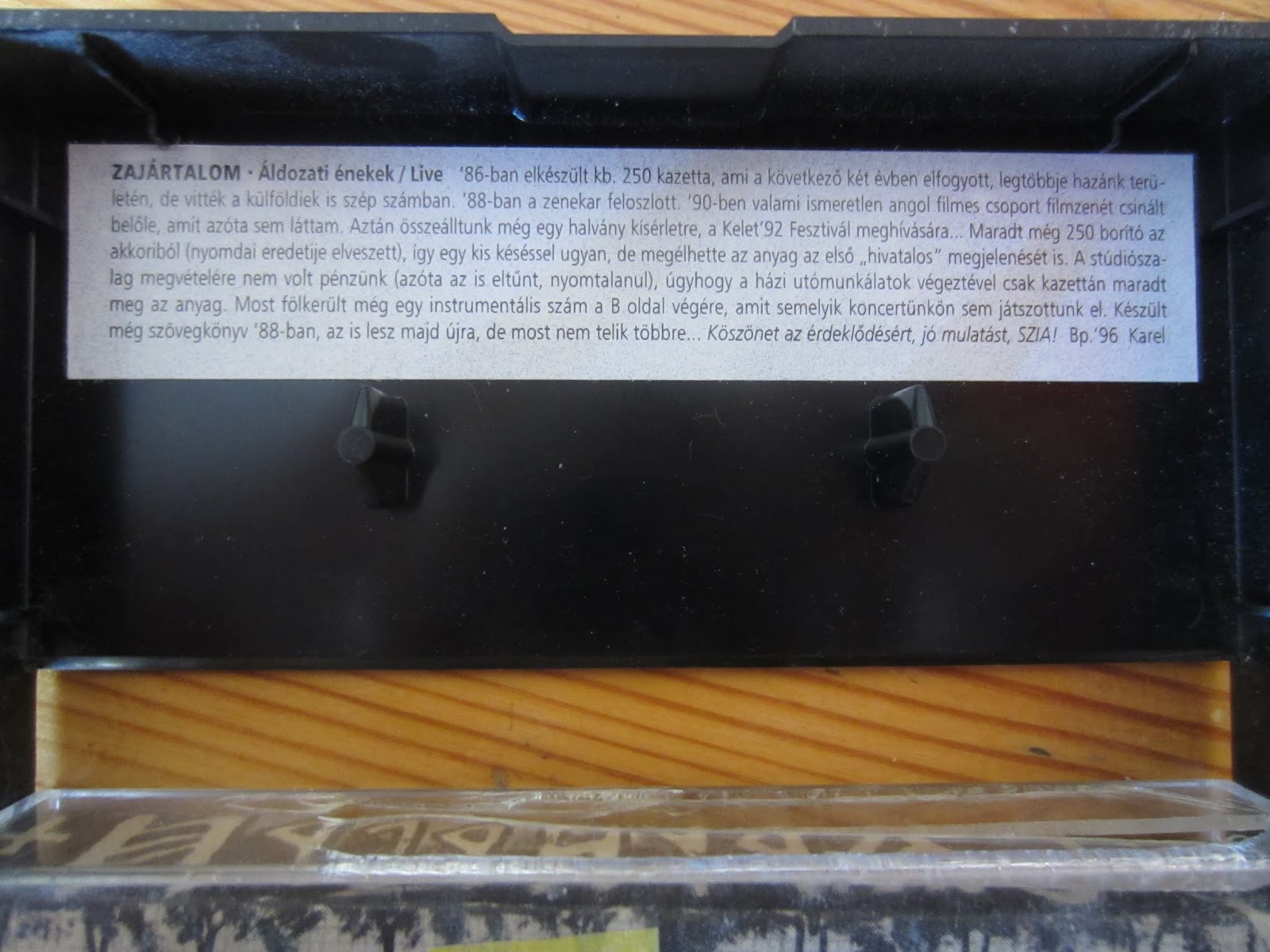
Zajártalom - Áldozati Énekek & Live -1987/1996- (Tape, Self-Released), Hungary


From the inner liner notes:

In 1986 about 250 cassettes were made that were distributed in the next two years. Most of them were shared in Hungary, but the foreigners also took the tapes with them in royal amounts. In 1988 the band disbanded. Somewhere in the 90's an unknown English film crew made film music out of the recording that I haven't seen or heard since. Then we reformed for a faint experiment being invited by the '92 East Festival... About 250 of the original cassette sleeves remained (the original print got lost), so with a little delay the first "official" publication survived and got published. We didn't have money to purchase the studio recording tape (it also vanished since then (without a trace), so after finishing this at home (as homework) the material only remained available on cassette. Now on the last bit of the B-Side an instrumental recording has surfaced that we didn't play at any of our concerts. A book with lyrics was made in '88, which will be republished, but as of now it doesn't go any further, thank you for the interest, jó mulatást, SZIA! (Have fun, BYE!), Budapest '96 Karel

Zajártalom means "Noise Pollution" in Hungarian and this little cassette here is an ultra rare music relic from the Budapest underground. And also of industrial music culture behind the communist iron curtain in general. I have uploaded some Hungarian industrial tapes before of bands like Art Deco, BP. Service or musician Kósa Vince. Zajártalom kind of fits a similar realm, mainly in its use of cut-up and collage, but they also move into greyer alternative noise-rock areas similar to the shamanic noise-rock punk of Vágtázo Hallotkémek or the obscure Hungarian industrial project Falatra(x).

The music is pure experimentalism with improvisation where noise and collage find each other with an added protagonistic role for dark existential poetry through lyrics. I wish I would be able to tell more about what the the lyrics say. Also the text that is recited at a certain point by a child is some of the darkest existential stuff I have heard. These are all musical examples of real subversive and deep artistic statements in need of freedom in a totalitarian country in which grey society bleakness and state censorship were shaping daily life. To get an idea of this feeling and to understand the Hungarian music underground within this bleak communist realm I recommend you to watch the 2012 documentary East Punk Memores which is uploaded online. It gives a nice view on the mentality and life back then.

This Zajártalom cassette is such a special document of that time and it's not often I stumble upon these things even when I know quite some of the underground figures of that time in Hungary. Ofcourse there was some Industrial music in the former socialist countries, but in extremely marginal forms. Czech Republic had a movement, Poland, Hungary etc. and ofcourse Yugoslavia that really birthed some iconic bands like Laibach or Borghesia. The political circumstances differed per country and in Yugoslavia there was less cultural censorship for example. Some punk and wave music from the west came out quite regularly on vinyl. Also their cinema was not overdubbed so people could much better understand and learn English and deal with all the marginal information. In Hungary it was much rather fragmented. A handful of people knew about industrial music somehow. Some tried to musically mimic that style, but some were just making noise or some detuned rock music and ended up doing industrial in hindsight.

A few examples of how Industrial music entered Hungary from what I know is the visit of some Hungarian punks to East-Berlin in the 80's. The East-Berlin punks knew about Einstürzende Neubauten, but also had more knowledge already about new wave bands like The Cure and such. Furthermore I know that Antwerp based industrial pioneers Club Moral visited the artist village Szentendre near Budapest at the beginning of the 80's where they also played live. This village birthed the legendary Hungarian art rock group A.E Bizottság for example, that was formed by a group of artists and painters.

Then later on in the first Budapest underground pubs like Fekete Lyuk (Black Hole) there were some alternative concerts. Once there was a concert of Belgian industrial band à;GRUMH, but this was already later than this release, maybe around 1989. The German Neue Deutsche Welle group Der Plan did a legendary compilation with different European bands called Fix Planet! in 1981. The album contained the first release of Esplendor Geometrico's cult song 'Moscu Está Helado' (Spain) for example, but also a track by Vágtázo Hallotkémek. Der Plan visited Budapest back then and met the band according to the sleeve notes. Anyway one never really knows how the information flow worked precisely, but these are just some examples of Industrial and underground music encounters in Hungary during the socialist times.

Check out the energy of this cassette, it's pretty interesting. It's all an answer to political repression as well as self-established anti-culture as an antidote to this repression. There is a so called 'album' entitled Áldozati Énekek (Songs of Sacrifice) on the A-Side that I couldn't dissect into different tracks and a Live recording on the B-Side that doesn't sound much more live than the A-Side. A rare relic of subversive experimental music from behind the iron curtain. Marginally released on cassette in 1987, officially marginally re-released in 1996.

Get it HERE

Monday, 24 September 2018

Various Artists - Druga Liga Prvo Kolo -1995- (CD, Helidon), Slovenia/Croatia


Druga Liga Prvo Kolo -Second League First Round - is an essential cornerstone compilation from post-Yugo 90's Slovenia. It compiles both Slovenian and Croatian bands that were active in the early and mid-90's in their respective underground scene. Eastern European underground bands from this time were very weird and unclassifiable, playing a combination of both unskilled punk and hyper-complex rock in opposition drenched in a healthy amount of absurdism while existing within a genuine alternative culture based on communal uplifting activisim and desperate local divertissement. Also don't forget that the decade of the 90's in former Yugoslavia and the Balkans was heavily loaded with political tensions and war sentiments that needed an explosive creative output in one way or the other.

Slovenian bands in general, also before the fall of the iron curtain and the disbanding of Yugoslavia, were always very intriguingly weird. With Laibach as main national music reference you know you're in for a blast when digging into the Slovenian musical underground. Other great alternative bands from Slovenia I can think of are Miladojka Youneed, Begnagrad, Lolita, Strelnikoff or the later Pinja Dzazna (who has those files for me!?)

The Slovenian bands on this compilation are experimental group Mamojebac (of which their whole and only existing tape from 1995 Tko Je Ovdje Kome Guzica? is present), strange punk band Absent Minded and the great avantgarde art-rock band Žoambo Žoet Workestrao

The Croatian groups present on Druga Liga are the demented HC-punk group Why Stakla (of which almost their whole cassette Daj, Dođi! from 1995 is compiled) and the free punk no jazz band from Rijeka Plod Mirže (I'm curious if more of their music exists). These bands also remind me of the Croatian band SexA.

Essential uneasy listening of post-Yugo punk-noise-insanity from the underground!

Get it HERE

Sunday, 26 August 2018

BP. Service - Same -1990- (Tape, Weast CMC Agency), Hungary


This is the first in a series of Hungarian cassettes that I will slowly upload to the blog:

BP. Service was one of Hungary's important industrial music groups. Industrial music in Hungary did exist behind the iron curtain in the 80's but in very marginal forms. Some of the bands I can come up with are Art Deco (posted ages ago on the blog), CMC and Falatra(x). Basically it was not until the early nineties that industrial groups could publish their music regularly in Hungary and that also more groups started to exist.

BP. Service consisted of Szabó György, Kósa Vince and Orbán Balázs. Szabo György is subsequently known for his graphic design and creating many of the posters for underground concerts in Budapest before the fall of the iron curtain. Lately those posters have received renewed attention and have been compiled in a book. Kósa Vince was also the founder of the group Art Deco and can be considered as one of the pioneers of Industrial music in Hungary.

This cassette that came out in 1990 contains two lengthy tracks of classic industrial sounds. It conceptually takes on the big city or metropole (in this case Budapest) as a place of noise where traffic, construction, dirt, automation and industry are part of the daily urban environment. A concept that can be seen often in this particular vein of industrial music, tracing back most notably to Berlin's finest Einstürzende Neubauten, but ofcourse there are numerous examples. The music contains bleak Hungarian lyrics, sound-manipulations and the use of metal and other physical materials that are being used rhythmically.

Get it HERE

Tuesday, 7 August 2018

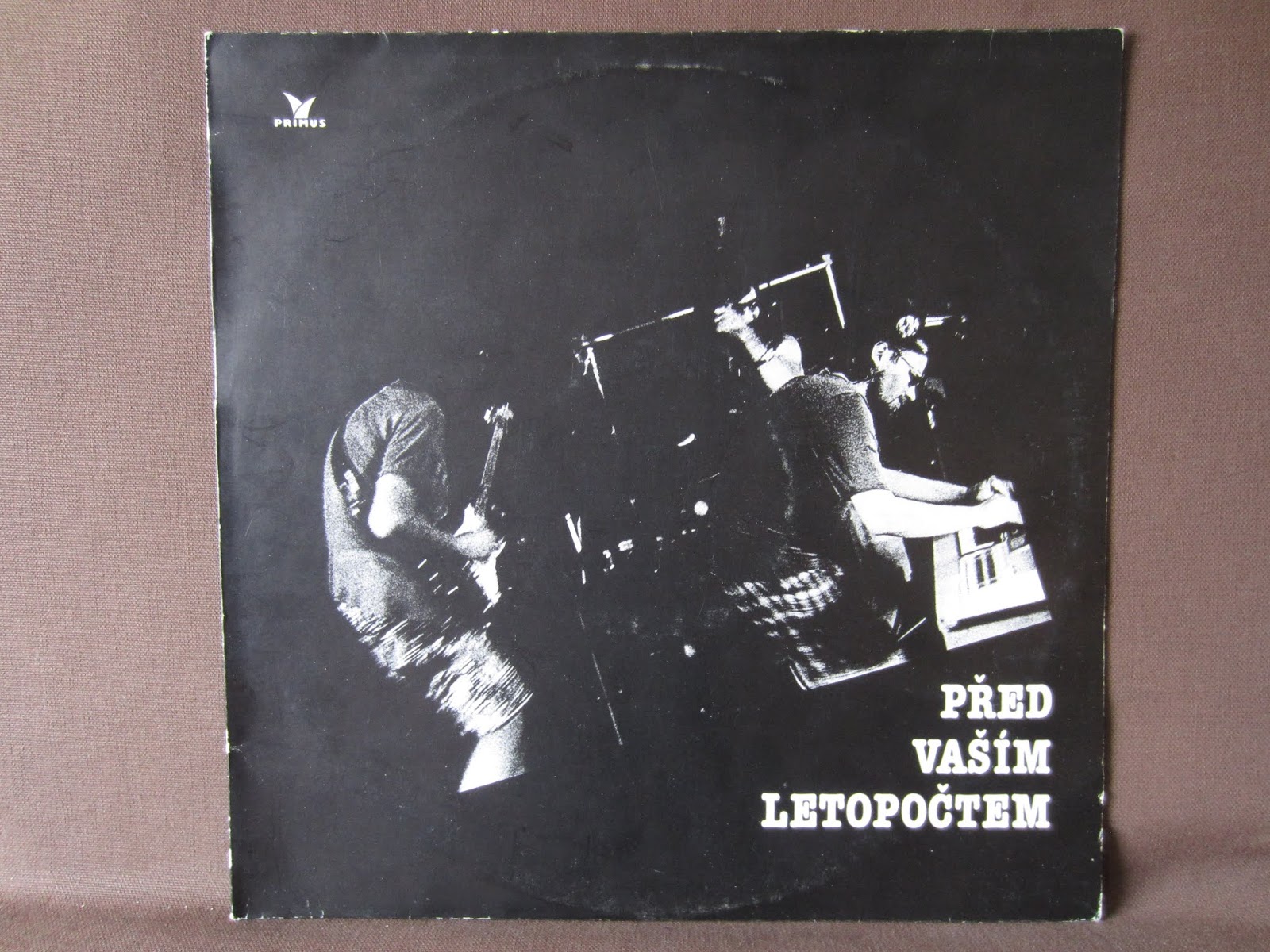
Před Vaším Letopočtem - Same -1991- (LP, Primus), Czech Republic


Although obviously there are many exceptions, the musical decade of the nineties in Eastern Europe (or the former socialist countries in Europe, as you wish) is largely the equivalent of underground music in the seventies and eighties in the west. Not only was it after the fall of the iron curtain that previously unknown and "illegal" bands were able to finally publish their music, also their influence trickled down into fresh bands of the beginning and mid-nineties. Because of a certain creativity that was mediated by or against political inlfuences as well as certain underground music traditions from before the communist system collapsed, the music was not always based on trying to be western or something hype. People understood how they related to their own national underground. Due to a slight delay in getting familiar with new genres and contemporary music finding its way randomly to Eastern Europe in the early nineties (and also before) the music there developed fragmented. Nevertheless, in result it was often taken a lot less shallow by the people than in western countries where there was a constant musical (production) overload combined with a constant competitiveness of setting the new tone. The nineties in Eastern Europe were musically an open field field of creativity, an explosion of freedom. It was a moment of hope, change and seizing the moment to harvest full creative potential.

Před Vaším Letopočtem was a Czech trio from Prague that consisted of Vlastislav Matoušek on bass and vocals, František Janče on guitar and vocals and Jan Jeřábek on keyboards and vocals. Musically they play a quite simplistic and repetitive rock music that thrives on wave-y patterns and occasional experiments encompanied by lyrics in Czech. Obviously they stand on that verge of the change of pollitical systems sharing some of their sounds with peer-bands like Půlnoc, Máma Bubo or Onkel Zbynda’s Winterrock (O.Z.W.). It also hints a bit to Czech synth band Betula Pendula (that made an album not really worth to listen to) and even to the Greek group Chapter 24.

It's not as groundbreaking as some of the stuff I am about to post from Eastern Europe the coming year on the blog, but it's definitely nice unclassifiable underground stuff that carries a free spirit and shows the Czech Underground in full effect. Před Vaším Letopočtem also released another cassette in the same period. If anyone could share that one I'd be very grateful!

Get it HERE

Thursday, 4 May 2017

áPolóK - Egyedül A Világon -1993- (Tape, Artalom), Hungary


Time for another cassette by Hungarian cultband áPolóK (trans. The Nurses) after two of their other releases I posted on the blog before. áPolóK comes from the Hungarian city of Miskolc and started out in 1982. They are ranked among Hungary's finest weirdo avant-garde groups. They can be placed among other Hungarian underground bands from the eighties and nineties like A.E. Bizottság (Albert Einstein Committee), Kampec Dolores, Tudósok, Vágtázo Hallottkémek and many others.

Their humoristic hyper-intelligent lyrics combine the insanity of the Hungarian culture with great poetic depth and absurdity. áPolóK is a quite unique band in Hungary mashing up a Rock In Opposition sound that contains unorthodox transitions in zappaesque ways with a great punk attitude and alternative rock manoeuvres. It's a band that is very underrated and deserves a lot more attention.

Egyedül A Világon (alone in the world) was áPolóK's first album that was also published abroad as a CD in England which was translated to The One And Only In The World (get that one here!). The cassette was self-released on their own Artalom label (it's a word merging the words Art and Content with each other.) I think this album is one of the stronger releases and shows a more developed sound of the band. The musical quality is keeping the right pace with the showcased absurdity. Some of the members of áPolóK are still playing in bands in Hungary like the absurd punk group Büdösök. Again check out their other releases in the archive of this blog.

Highly Recommended!

Get it - in all its original cassette glory - HERE